Fujikura shares plunge 17% on disappointing AI demand outlook
Fujikura, an optical fiber manufacturer, saw its share price plunge 17%. The company published a three-year forecast that disappointed investors, who had been expecting a demand boom for network infrastructure from AI data centers. Reality turned out to be more modest. The forecast was not negative: Fujikura still expects growth. But the pace and volumes fell short of what the market had priced in.
AI-processed from Bloomberg Tech; edited by Hamidun News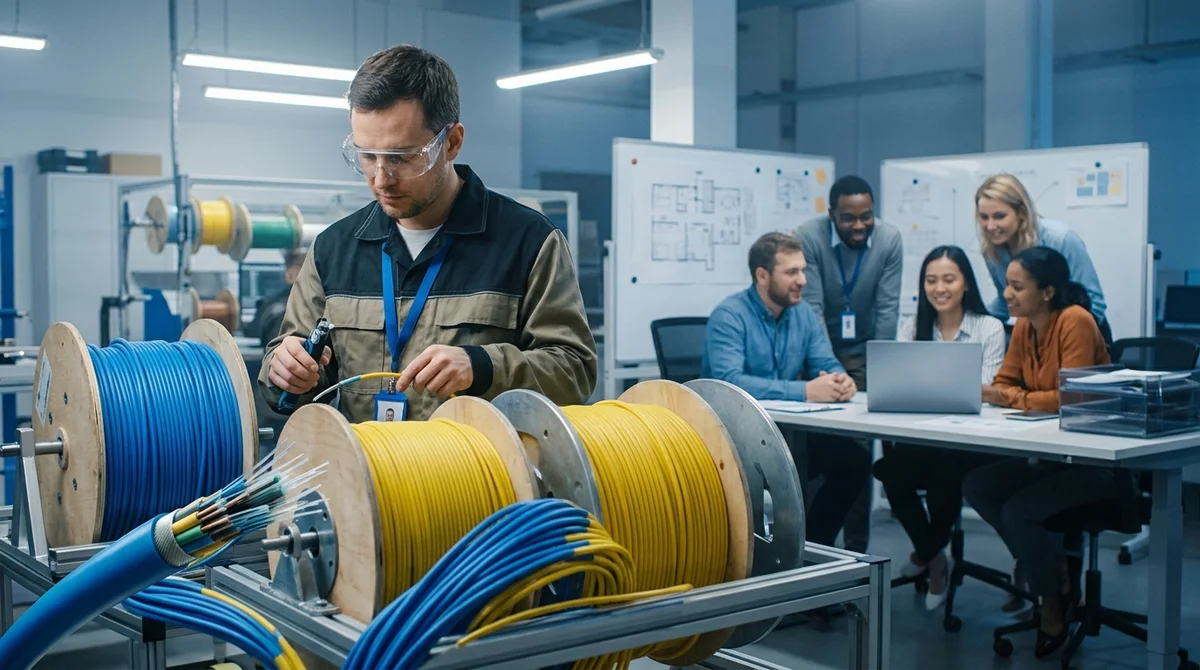
Shares of Japan's Fujikura Ltd. lost 17% of their value after the company published a three-year forecast that came in below market expectations for AI-driven demand for high-density optical fiber used in global communication networks.
What happened
Fujikura, one of the world's leading makers of optical fibers and cables, published its three-year outlook. Investors had expected an optimistic statement about growth in demand tied to AI data centers. Instead, the company gave figures that sounded more modest.
This was not a negative forecast: Fujikura still expects growth. But the pace and volumes were lower than what the market had priced into the shares. Investors promptly repriced the stock downward. During the session, the shares fell by more than 17%.
Why investors believed in AI demand
The logic seemed clear and unassailable: AI chips require huge data centers. Data centers have to be connected to each other and to customers through a global network. That requires optical fibers, the cables that carry signals at the speed of light. Fujikura is one of the largest suppliers of these cables. So when AI takes off, its revenue takes off too.
That rule worked for chips (Nvidia, TSMC) and, in part, for cooling. Investors decided to apply it to network infrastructure as well, and Fujikura's shares rose on the wave of AI hype.
But the optical fiber market works differently. It is not microelectronics, where one player dominates. It is a fairly competitive segment with several large manufacturers. Demand is growing, but more steadily. It cannot be tripled in a year just because a new hype cycle has appeared.
Why demand disappointed
Several factors left real demand below expectations:
- The pace of cloud data center expansion has slowed, as providers have become more cautious
- The volume of new optical fiber orders for 2024-2026 turned out smaller than forecast
- Competition keeps prices under pressure and squeezes manufacturers' margins
- Existing network capacity has not yet been fully exhausted
What this means
The Fujikura story shows something important: AI hype overvalues not only the chips themselves but the entire infrastructure chain. Investors are betting that the world will rebuild itself around AI within a year, but reality is slower. Every component, from silicon to cables, needs a sober assessment.
Fujikura is falling not because it forgot how to make fiber, but because its income will grow more slowly than enthusiastic investors priced in.
- Nov 1, 2026Local models lose to Opus and Codex: 0.21 on a MacBook versus 1.00 for Codex
- Nov 1, 2026Habr author fine-tunes YOLOv8l on dental X-rays and pushes mAP50 to 0.642
- Nov 1, 2026Voice bots built on LLMs turn to Jev, a fast classifier, for decisions in 200–500 ms
- Nov 1, 2026MoneyGate safety layer blocked all 42 fraudulent requests to local AI models
Key Questions Answered
What happened?
Fujikura, one of the world's leading makers of optical fibers and cables, published its three-year outlook. Investors had expected an optimistic statement about growth in demand tied to AI data centers. Instead, the company gave figures that sounded more modest. This was not a negative forecast: Fujikura still expects growth. But the pace and volumes were lower than what the market had priced into the shares. Investors promptly repriced the stock downward. During the session, the shares fell by more than 17%.
Why investors believed in AI demand?
The logic seemed clear and unassailable: AI chips require huge data centers. Data centers have to be connected to each other and to customers through a global network. That requires optical fibers, the cables that carry signals at the speed of light. Fujikura is one of the largest suppliers of these cables. So when AI takes off, its revenue takes off too. That rule worked for chips (Nvidia, TSMC) and, in part, for cooling. Investors decided to apply it to network infrastructure as well, and Fujikura's shares rose on the wave of AI hype. But the optical fiber market works di
Why demand disappointed?
Several factors left real demand below expectations: The pace of cloud data center expansion has slowed, as providers have become more cautious The volume of new optical fiber orders for 2024-2026 turned out smaller than forecast Competition keeps prices under pressure and squeezes manufacturers' margins Existing network capacity has not yet been fully exhausted
Ship AI Faster with Founders, Engineers & Weekly Architecture Reviews
Inside Vibe Club (hamidun.com/club) — weekly live masterminds with Zhemal Khamidun, Tech Radar, full LMS access, and 370+ production Claude Code skills.
The AI world, distilled — once a week
Seven stories that actually mattered, hand-picked. No noise, no reposts, no press releases.
Done! Check your inbox for a confirmation.