Google Is Third in the AI Model Race: Its I/O 2026 Strategy
At I/O 2026, Google is no longer the leader but the third player in the AI model race. OpenAI and Anthropic have overtaken it with GPT-4o and Claude 3.5. A year ago, Google was seen as the undisputed favorite. At the conference, the company is expected to reveal a real strategy for regaining the lead and to lean on its advantage in distribution.
AI-processed from MIT Technology Review; edited by Hamidun News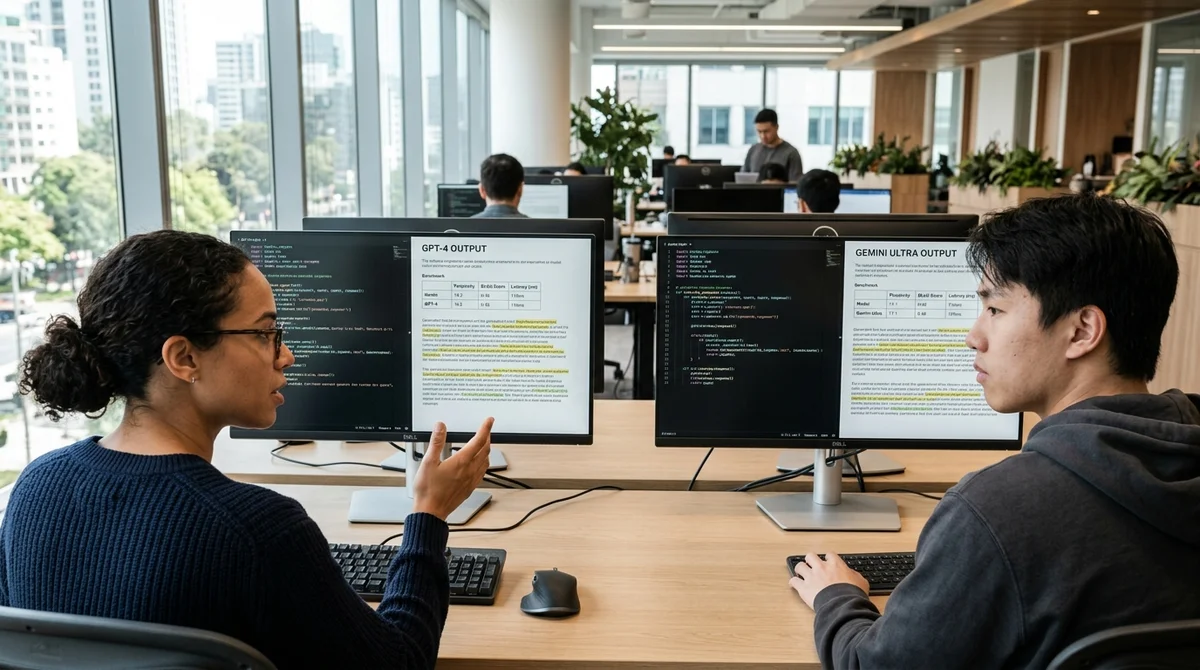
At Google I/O 2026, which starts this week, the company will take the stage in an unusual position for it: not as the leader, but as the third player in the foundation model race. OpenAI and Anthropic have pulled ahead in building frontier language models. A year ago such an outcome seemed entirely impossible, but Google lost the initiative at a critical moment.
How Google Lost Its Lead in Models
When Google introduced Gemini in late 2023, it looked as though the company was ready for another decade of dominance. Gemini Ultra was positioned as a direct competitor to OpenAI's GPT-4. On paper, the benchmark numbers looked convincing, sometimes even surpassing OpenAI. In practice, though, everything rolled out more slowly than promised. Deadlines slipped one after another.
Meanwhile, more powerful models kept appearing on the market. OpenAI's GPT-4o showed that closing the gap was entirely possible, and Anthropic's Claude 3.5 Sonnet showed that a model could match and surpass competitors in developer reviews.
Google also suffered deep organizational problems. Leadership changes in its AI divisions, reshuffling between departments and uncertainty about its development strategy all diverted resources and slowed development. Meanwhile, its rivals moved with a clear goal. Anthropic raised substantial investment and worked with a compact team focused on a single mission.
Google's main mistake: it failed to turn its enormous research advantage into a frontier model. OpenAI and Anthropic managed to build small but effective teams fully focused on one goal: making the best model. Google, by contrast, remained scattered across many competing projects and initiatives.
What Google Could Show at I/O
The conference is expected to bring announcements of significant improvements to the Gemini family: better image and video processing, a longer context window, deep integration with Android and Chrome, and broader API access for developers. All of this matters for the ecosystem and may attract enterprise customers.
Announcements of new specialized models for specific industries are also expected, for example for financial analysis, medical diagnostics or logistics. It is a classic strategic move: instead of trying to win the war over general quality against OpenAI and Anthropic, win in a niche where narrow specialization gives an edge.
- Better coding in Gemini
- Models integrated directly into Android and Chrome
- New tools and APIs for developers
- Specialized models for industries
Why Distribution Cannot Make Up for the Gap
Google's main remaining asset is its ecosystem and its distribution. Billions of people use Android, Chrome, Search and Gmail every day. Google can build its models into its products faster and more deeply than any competitor.
But even such powerful distribution cannot compensate for a noticeable lag in model quality. If Gemini is perceptibly worse than GPT-4o or Claude 3.5, experienced users will notice very quickly. Google now needs a real strategy: either catch up quickly on quality, or bet on specialized solutions that require depth in a specific field.
"Third place in the model race does not mean third place in the AI application race" is the message
Google may try to deliver at I/O.
What This Means for the Market
The AI model race has reached an age where even a dominant monopolist can lose the lead. A three-player dynamic (OpenAI, Anthropic, Google) is objectively better for innovation than a monopoly. Google is not dropping out of the game entirely, but losing the lead means a serious loss of momentum and psychological advantage.
The company must urgently show a convincing path back to the top or refocus on specialization. Otherwise it risks sliding to fourth place, where its ecosystem advantages would matter less.
- Nov 2, 2026Karpathy builds a YouTube clone with 6454 videos from Hacker News recommendations in two hours
- Nov 2, 2026Karpathy used Claude to build HackerTube from 6,454 videos recommended on Hacker News
- Nov 2, 2026Anthropic needs to grow revenue 32% a year to cover $850 billion in contracts
- Nov 2, 2026Bun creator uses Claude Code to port 750K lines from Zig to Rust in 11 days
Key Questions Answered
How Google Lost Its Lead in Models?
When Google introduced Gemini in late 2023, it looked as though the company was ready for another decade of dominance. Gemini Ultra was positioned as a direct competitor to OpenAI's GPT-4. On paper, the benchmark numbers looked convincing, sometimes even surpassing OpenAI. In practice, though, everything rolled out more slowly than promised. Deadlines slipped one after another. Meanwhile, more powerful models kept appearing on the market. OpenAI's GPT-4o showed that closing the gap was entirely possible, and Anthropic's Claude 3.5 Sonnet showed that a model could match and
What Google Could Show at I/O?
The conference is expected to bring announcements of significant improvements to the Gemini family: better image and video processing, a longer context window, deep integration with Android and Chrome, and broader API access for developers. All of this matters for the ecosystem and may attract enterprise customers. Announcements of new specialized models for specific industries are also expected, for example for financial analysis, medical diagnostics or logistics. It is a classic strategic move: instead of trying to win the war over general quality against OpenAI and Anthr
Why Distribution Cannot Make Up for the Gap?
Google's main remaining asset is its ecosystem and its distribution. Billions of people use Android, Chrome, Search and Gmail every day. Google can build its models into its products faster and more deeply than any competitor. But even such powerful distribution cannot compensate for a noticeable lag in model quality. If Gemini is perceptibly worse than GPT-4o or Claude 3.5, experienced users will notice very quickly. Google now needs a real strategy: either catch up quickly on quality, or bet on specialized solutions that require depth in a specific field. "Third place in
Test Frontier LLMs & Autonomous Agents in One Workspace
Run Claude Opus 5.5, GPT-6, Gemini 3.1, and DeepSeek side-by-side in Nomad AI (nomadnet.ai) — unified model routing, deep research, and multimodal workflows under one subscription.
The AI world, distilled — once a week
Seven stories that actually mattered, hand-picked. No noise, no reposts, no press releases.
Done! Check your inbox for a confirmation.