LEGO Education drops its own platform, adds AI and NFC cards
In 2026, LEGO Education is making a 180-degree turn: it is moving to open platforms, reducing the role of coding, adding AI assistants and replacing electronic hubs with NFC cards. This is not just a hardware upgrade but a rethink of the entire model of STEM education.
AI-processed from Habr AI; edited by Hamidun News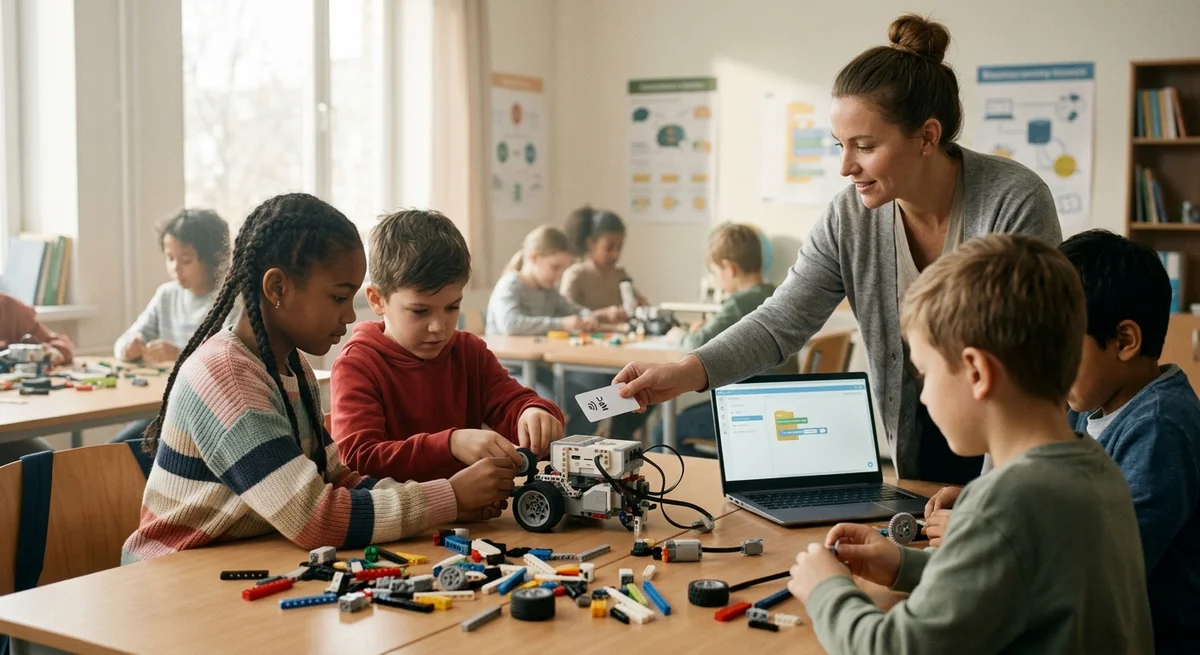
LEGO Education is making a move that seemed unthinkable a couple of years ago: it is abandoning its own robotics platform, reconsidering the central role of programming in its courses and introducing elements of artificial intelligence. At the same time, the company is changing how its sets are controlled, replacing traditional electronic hubs with simple NFC cards. This is not just a generational hardware upgrade. It is a rethink of the very approach to STEM education.
The end of the proprietary-platform era
LEGO Education's history with robots began in the late 1990s, when Mindstorms revolutionized educational sets. For a quarter of a century, the company developed, improved and defended its platforms, building an ecosystem in which children learned to program on LEGO "hardware". Teachers, schools and even entire countries chose LEGO precisely because it was a closed, stable, understandable system.
In 2026, this strategy turns 180 degrees. LEGO Education is moving to open, universal control systems. That means the same construction sets will be able to work with different platforms and controllers, whether the popular Arduino, Raspberry Pi or the company's own future developments. Market logic dictates the move: closed ecosystems lose to open ones.
For education, this transition matters a great deal. Children will no longer be tied to a single platform. They will be able to apply their skills in a wider context, carry knowledge between different systems and avoid being trapped in legacy technology.
From coding to systems thinking
The second fundamental shift is a reduced role for programming as the central pillar of STEM learning. LEGO Education candidly admits that not every child needs code, and that focusing only on syntax and programming narrows education instead of widening it.
Instead of teaching children to write programs for a robot, the company is building AI elements directly into its courses. AI assistants help students understand a problem, suggest possible solutions and think through consequences, but they do not solve the task for them. This shifts the focus from syntax to logic and creativity.
What exactly is changing in the curriculum:
- Less time on syntax and debugging code, more time on defining tasks and analyzing problems
- AI assistants as prompters and learning partners, not as a replacement for the teacher
- Interdisciplinary approach: the robot becomes a tool for physics, math and logistics, not a goal in itself
- Emphasis on meta-skills: critical thinking, collaboration, adaptability
This shift reflects a global move in education from hard skills (code, syntax) to meta-skills (how to think, how to learn, how to work in a team).
NFC cards instead of electronics
The third change sounds paradoxical: replacing programmable electronic hubs with simple NFC cards. At first glance, it looks like a simplification, even a step backward. In fact, it is a radical rethink of the learning architecture.
Instead of the set containing a programmable controller (a hub), control will be built around cards that carry instructions. A child places a card on a reader, and the robot receives a set of actions. That may sound primitive, but it has huge practical advantages: sets become cheaper and easier to use, need no batteries in hubs and, above all, are more affordable for schools with limited budgets.
As one of the developers puts it: "We moved from complexity for the
sake of complexity to simplicity that actually works."
What this means
In 2026, LEGO Education is not just refreshing its product line. It is rebuilding the fundamental model of STEM education as the company understood it for decades: from closed platforms to open systems, from programming as the center to systems thinking, from electronics to intelligent solutions.
This could either produce a new generation of creative problem solvers who are not afraid to experiment, or create a transitional period of confusion for schools that spent years adapting to the old approach.
- Nov 1, 2026Local models lose to Opus and Codex: 0.21 on a MacBook versus 1.00 for Codex
- Nov 1, 2026Kimi scores 96.2% on a 1C database analytics test and emerges as a fallback if Claude access is blocked
- Nov 1, 2026OpenAI Rewrites GPT Behavior Rules: Five Values and a Chain of Command
- Oct 31, 2026Author puts his script before an AI jury: the verdict cost 850 thousand tokens
Key Questions Answered
What are the key details on The end of the proprietary-platform era?
LEGO Education's history with robots began in the late 1990s, when Mindstorms revolutionized educational sets. For a quarter of a century, the company developed, improved and defended its platforms, building an ecosystem in which children learned to program on LEGO "hardware". Teachers, schools and even entire countries chose LEGO precisely because it was a closed, stable, understandable system. In 2026, this strategy turns 180 degrees. LEGO Education is moving to open, universal control systems. That means the same construction sets will be able to work with different plat
What are the key details on From coding to systems thinking?
The second fundamental shift is a reduced role for programming as the central pillar of STEM learning. LEGO Education candidly admits that not every child needs code, and that focusing only on syntax and programming narrows education instead of widening it. Instead of teaching children to write programs for a robot, the company is building AI elements directly into its courses. AI assistants help students understand a problem, suggest possible solutions and think through consequences, but they do not solve the task for them. This shifts the focus from syntax to logic and cr
What are the key details on NFC cards instead of electronics?
The third change sounds paradoxical: replacing programmable electronic hubs with simple NFC cards. At first glance, it looks like a simplification, even a step backward. In fact, it is a radical rethink of the learning architecture. Instead of the set containing a programmable controller (a hub), control will be built around cards that carry instructions. A child places a card on a reader, and the robot receives a set of actions. That may sound primitive, but it has huge practical advantages: sets become cheaper and easier to use, need no batteries in hubs and, above all, a
Test Frontier LLMs & Autonomous Agents in One Workspace
Run Claude Opus 5.5, GPT-6, Gemini 3.1, and DeepSeek side-by-side in Nomad AI (nomadnet.ai) — unified model routing, deep research, and multimodal workflows under one subscription.
The AI world, distilled — once a week
Seven stories that actually mattered, hand-picked. No noise, no reposts, no press releases.
Done! Check your inbox for a confirmation.