Anthropic is building AI agents for traders, but they're not ready to replace them
Anthropic has built AI agents for Wall Street, but experiments show that language models aren't ready to operate on their own in real-world trading. They are slower than the market demands, can get numbers wrong, and miss contextual nuance. Traders won't be replaced anytime soon.
AI-processed from Bloomberg Tech; edited by Hamidun News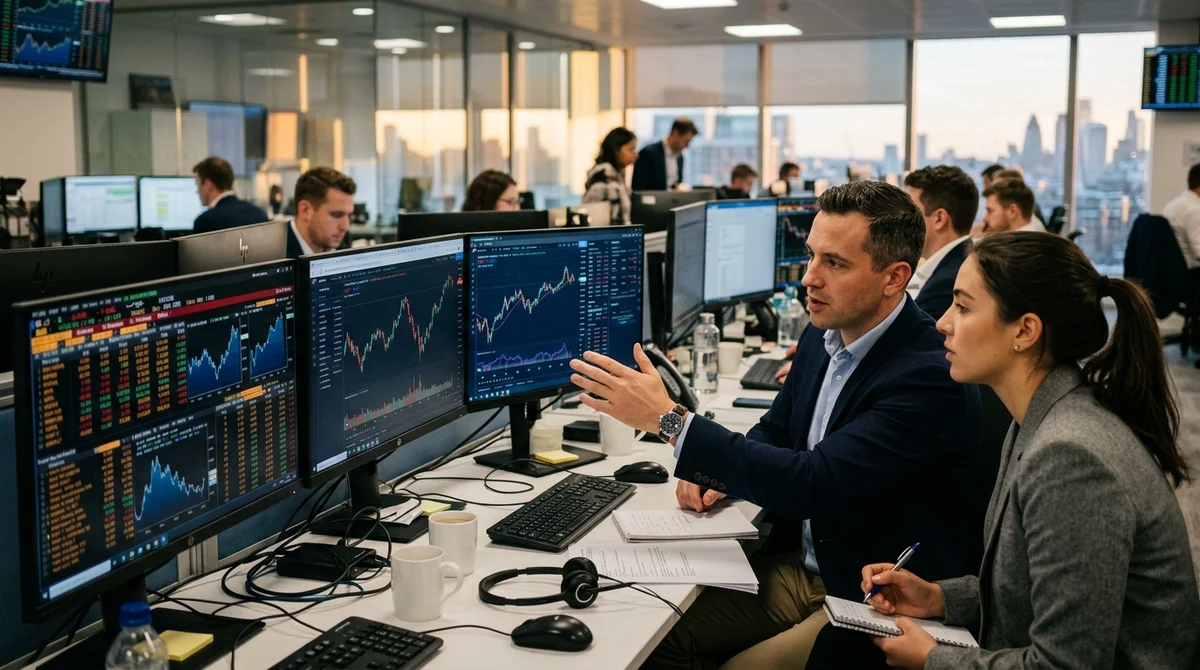
Anthropic has developed a new series of AI agents built specifically for financial markets. The company wants to win over traders and investment funds on Wall Street, but recent experiments show that today's language models aren't yet ready to operate fully independently in real-world trading.
Ambitions in the financial market
The financial sector is one of the most attractive markets for B2B AI. Every day, traders handle complex tasks involving huge volumes of data, with billions of dollars at stake. If AI can reliably help with market analysis, spotting opportunities, and decision-making, it could give any fund a massive competitive edge.
Anthropic's agents are trained to work with real-time financial data, analyze corporate news, identify trading patterns, and predict price movements. In theory, they should help traders make decisions faster and reduce the risk of costly human errors.
Where the experiments fell short
But testing exposed serious problems. It turns out that LLMs, for all their strength on text tasks, are fundamentally ill-suited to the demands of financial trading:
- Execution speed — in trading, microseconds are everything. LLMs operate with latencies the market won't tolerate.
- Hallucinated numbers — models can misread quotes or "make up" figures, and in finance that means losses.
- Shallow grasp of context — LLMs miss political signals and macroeconomic news that move markets by billions.
- No accountability — huge sums require guarantees and a clear chain of decisions, which AI cannot provide.
Experienced traders aren't just people doing routine work. They are professionals who combine intuition, decades of experience, instant reactions to market moves, and skillful risk management. Replacing all of that with a single model proved far harder than expected.
The path to hybrid systems
The setback in Anthropic's experiments isn't a failure of AI but an entirely expected stage of development. The company has gathered valuable data, learned exactly where its models fall behind, and can work on improvements.
The realistic path forward appears to be hybrid systems rather than full automation. AI handles the analysis: it works through hundreds of reports, picks out anomalies, monitors markets in real time, and issues recommendations. The trader reviews the analysis, adds context, and executes the decision. Human judgment stays at the final stage, where the stakes are high.
What this means
Traders can breathe easier — AI won't take their jobs tomorrow. Robots won't take over Wall Street. Instead, we'll see gradual, practical automation: report analysis, anomaly detection, position monitoring. Complex strategic decisions that demand experience and accountability will remain in human hands for a long time to come.
- Nov 1, 2026Local models lose to Opus and Codex: 0.21 on a MacBook versus 1.00 for Codex
- Nov 1, 2026Kimi scores 96.2% on a 1C database analytics test and emerges as a fallback if Claude access is blocked
- Nov 1, 2026OpenAI Rewrites GPT Behavior Rules: Five Values and a Chain of Command
- Nov 1, 2026Google admits AI Mode cuts search revenue, shares fall 15%
Key Questions Answered
What are the key details on Ambitions in the financial market?
The financial sector is one of the most attractive markets for B2B AI. Every day, traders handle complex tasks involving huge volumes of data, with billions of dollars at stake. If AI can reliably help with market analysis, spotting opportunities, and decision-making, it could give any fund a massive competitive edge. Anthropic's agents are trained to work with real-time financial data, analyze corporate news, identify trading patterns, and predict price movements. In theory, they should help traders make decisions faster and reduce the risk of costly human errors.
Where the experiments fell short?
But testing exposed serious problems. It turns out that LLMs, for all their strength on text tasks, are fundamentally ill-suited to the demands of financial trading: Execution speed — in trading, microseconds are everything. LLMs operate with latencies the market won't tolerate. Hallucinated numbers — models can misread quotes or "make up" figures, and in finance that means losses. Shallow grasp of context — LLMs miss political signals and macroeconomic news that move markets by billions. No accountability — huge sums require guarantees and a clear chain of decisions, which
What are the key details on The path to hybrid systems?
The setback in Anthropic's experiments isn't a failure of AI but an entirely expected stage of development. The company has gathered valuable data, learned exactly where its models fall behind, and can work on improvements. The realistic path forward appears to be hybrid systems rather than full automation. AI handles the analysis: it works through hundreds of reports, picks out anomalies, monitors markets in real time, and issues recommendations. The trader reviews the analysis, adds context, and executes the decision. Human judgment stays at the final stage, where the sta
Test Frontier LLMs & Autonomous Agents in One Workspace
Run Claude Opus 5.5, GPT-6, Gemini 3.1, and DeepSeek side-by-side in Nomad AI (nomadnet.ai) — unified model routing, deep research, and multimodal workflows under one subscription.
The AI world, distilled — once a week
Seven stories that actually mattered, hand-picked. No noise, no reposts, no press releases.
Done! Check your inbox for a confirmation.