SoftBank to open battery production for AI data centers at Sharp plant
SoftBank is launching battery production for energy-intensive AI data centers at a former Sharp plant in Osaka. The target is 1 gigawatt-hour of batteries annually. Korean companies Cosmos Lab and DeltaX are involved in the project. The first batteries will begin production in April 2025, with zinc-halogen technology due in 2027.
AI-processed from TNW; edited by Hamidun News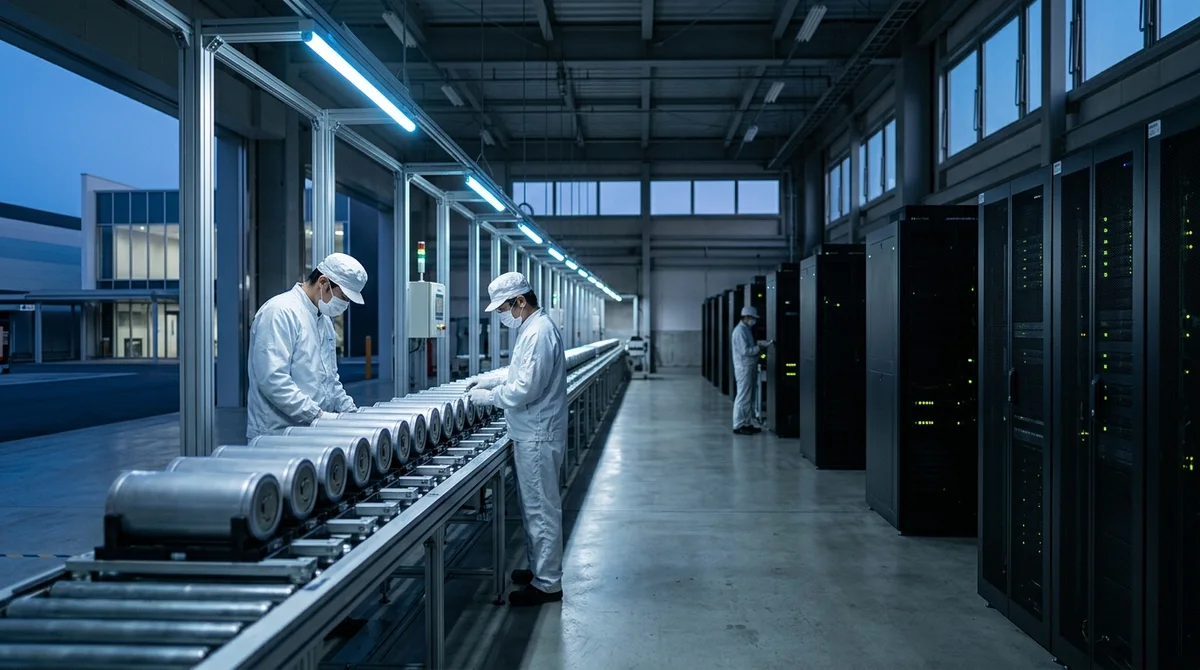
SoftBank has announced the launch of its own battery production for AI data centers at the former Sharp site in Osaka. The Japanese company views batteries as a strategic asset in the era of energy-intensive artificial intelligence.
New Life for Sharp's Factory
The factory in Sakai, Osaka, once produced electronic components for Sharp. Now it is being retooled for battery manufacturing. SoftBank has set an ambitious production target: 1 gigawatt-hour of batteries per year. This means the factory could power a small data center for a full day of operation. The production line is scheduled to launch in April 2025. The company has already planned for expansion: in 2027, battery production based on zinc-halogen chemistry will be added, which promises better characteristics in terms of energy density and cost.
International Partnership
SoftBank did not pursue this alone. The project has brought in two companies with deep expertise:
- Cosmos Lab from South Korea — battery system development
- DeltaX — battery integration into complex networks
- SoftBank — manufacturing base and financing
This partnership allows each party to focus on their core competence and accelerate the time-to-market for a competitive product.
Energy for AI Becomes Critical
Data centers training large language models consume megawatts of electricity. A single training run of a GPT-scale model can consume as much electricity as a city does in a month. Batteries are needed for several purposes:
- Peak load smoothing — during peaks, batteries are used instead of requesting power from the grid
- Backup power — in case of failure of the primary power source
- Reducing electricity bills — batteries reduce peak demand
SoftBank, as a cloud services owner and investor in AI companies, understands this need from the inside. Owning its own battery production will give it a competitive advantage and a new revenue stream.
What This Means
Batteries for data centers are transitioning from niche equipment to strategic infrastructure. SoftBank's investment signals that this is a market with potential in the tens of billions of dollars. Expect other major cloud providers to begin investing in their own battery production.
Need AI working inside your business — not just in your newsfeed?
I build production AI for companies — custom CRM, internal tools, autonomous agents, workflow automation. Owned by you, shaped to your process, no per-seat tax. Built by Zhemal Khamidun, CPO of AlpinaGPT (AI platform, 6,000+ users).
The AI world, distilled — once a week
Seven stories that actually mattered, hand-picked. No noise, no reposts, no press releases.
Done! Check your inbox for a confirmation.