How to Automate Engineering Drawing Reading: 6 YOLO Models Instead of Manual Work
A system built on 6 YOLO models and a custom OCR automatically pulls every cost-relevant parameter from engineering drawings: dimensions, threads, material, and tolerance grades. The pipeline converts a PDF into structured JSON for a manufacturing cost calculator. The whole process runs without manual data entry.
AI-processed from Habr AI; edited by Hamidun News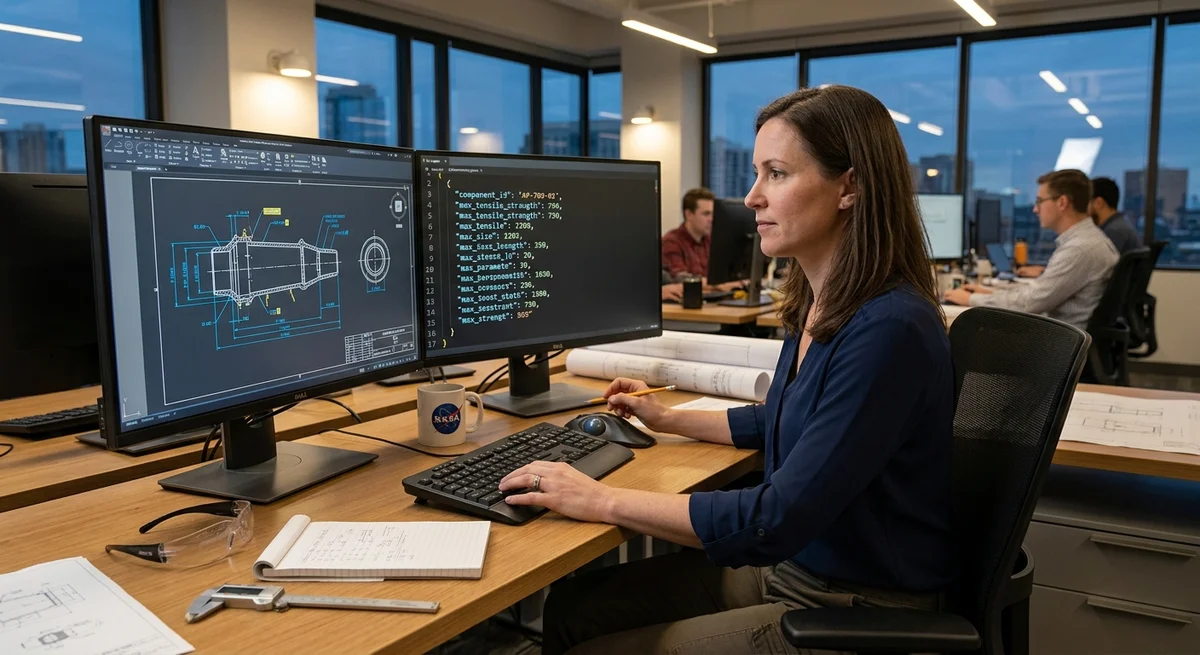
Extracting data from engineering drawings by hand is tedious and error-prone. To order a custom part, someone has to type roughly 20 parameters from the drawing into a calculator: dimensions, threads, tolerance grades, surface roughness, tolerances, material, and mass. One engineering team built an automated pipeline that takes a PDF drawing, reads it the way a human would, and extracts everything it needs in structured form. The output is JSON for the calculator.
Solution architecture
The system works in three steps: data localization, text recognition, and result synthesis. A PDF drawing goes in, and JSON with the parameters comes out. The intermediate stages are:
- Normalizing resolution and contrast
- Identifying projections (front, side, and top views)
- Separating the part outline from auxiliary lines
- Locating text fields and dimension arrows
- Recognizing symbols (thread, tolerance grade, roughness)
- Linking arrows to their values through a connectivity graph
Pipeline components
The computer vision side relies on six specialized YOLO models. Each one is trained on a subset of 500+ real production drawings:
1. Projection detection — finds the front, side, and top views on the drawing. 2. Dimension localization — picks out all dimension arrows and text fields. 3. Special symbol recognition — reads thread (M10), tolerance grade (IT6), and roughness (Ra 3.2) callouts. 4. Part outline — separates the visible outline from auxiliary lines. 5. Auxiliary lines — finds centerlines and construction geometry. 6. Arrows and leaders — locates every type of arrow and the text values attached to them.
The YOLO models feed into a custom OCR. Off-the-shelf solutions handle handwritten notes and special symbols such as ∅ (diameter) and thread designations poorly. The team trained the neural network on a dataset annotated by specialists.
The arrow logic is a weighted graph: if an arrow starts at point A, passes through geometric object B, and ends near text C, then value C belongs to object A. In practice it gets messier: arrows can be dashed or S-shaped, several arrows may point to the same spot, and ambiguity creeps in.
Reality gets in the way
Testing on real production drawings exposed problems that clean datasets don't have:
- Dirty scans — 20-year-old drawings, photocopier scans, water stains, stray pencil marks.
- Typographic liberties — a thread may be written as «Ø10×1.5», «M10», or even drawn as a little spring.
- Colored annotations — someone highlights a dimension in red pen, but OCR often filters out red lines as noise.
- Crowded sheets — a single drawing carries 30+ dimensions, arrows cross each other, and things get confused.
Data augmentation solved the problem: the team generated synthetic drawings with added noise, clutter, contrast changes, and simulated old scans. After training on the expanded dataset, accuracy on dirty drawings rose from 68% to 92%.
What it means
Automated drawing reading shows how human labor gets replaced by a combo of publicly available tools (YOLO), engineering logic (the arrow graph), and specialized tuning. For manufacturing, that means a 15x speedup: 2 minutes on autopilot instead of 30 minutes of manual entry. For the business, it means sending out quotes faster without manual data entry.
Key Questions Answered
What are the key details on Solution architecture?
The system works in three steps: data localization, text recognition, and result synthesis. A PDF drawing goes in, and JSON with the parameters comes out. The intermediate stages are: Normalizing resolution and contrast Identifying projections (front, side, and top views) Separating the part outline from auxiliary lines Locating text fields and dimension arrows Recognizing symbols (thread, tolerance grade, roughness) Linking arrows to their values through a connectivity graph
What are the key details on Pipeline components?
The computer vision side relies on six specialized YOLO models. Each one is trained on a subset of 500+ real production drawings: 1. Projection detection — finds the front, side, and top views on the drawing. 2. Dimension localization — picks out all dimension arrows and text fields. 3. Special symbol recognition — reads thread (M10), tolerance grade (IT6), and roughness (Ra 3.2) callouts. 4. Part outline — separates the visible outline from auxiliary lines. 5. Auxiliary lines — finds centerlines and construction geometry. 6. Arrows and leaders — locates every type of arrow
What are the key details on Reality gets in the way?
Testing on real production drawings exposed problems that clean datasets don't have: Dirty scans — 20-year-old drawings, photocopier scans, water stains, stray pencil marks. Typographic liberties — a thread may be written as «Ø10×1.5», «M10», or even drawn as a little spring. Colored annotations — someone highlights a dimension in red pen, but OCR often filters out red lines as noise. Crowded sheets — a single drawing carries 30+ dimensions, arrows cross each other, and things get confused. Data augmentation solved the problem: the team generated synthetic drawings with add
Ship AI Faster with Founders, Engineers & Weekly Architecture Reviews
Inside Vibe Club (hamidun.com/club) — weekly live masterminds with Zhemal Khamidun, Tech Radar, full LMS access, and 370+ production Claude Code skills.
The AI world, distilled — once a week
Seven stories that actually mattered, hand-picked. No noise, no reposts, no press releases.
Done! Check your inbox for a confirmation.