Alibaba, Baidu and Huawei Are Moving Away From Nvidia Toward Their Own AI Accelerators
Alibaba, Baidu and other Chinese giants are ramping up production of their own AI accelerators. The move is strategic: it is meant to guarantee independence from US sanctions. Despite rumors that Nvidia could return to the Chinese market, local companies are pushing further toward full technological autonomy.
AI-processed from 3DNews AI; edited by Hamidun News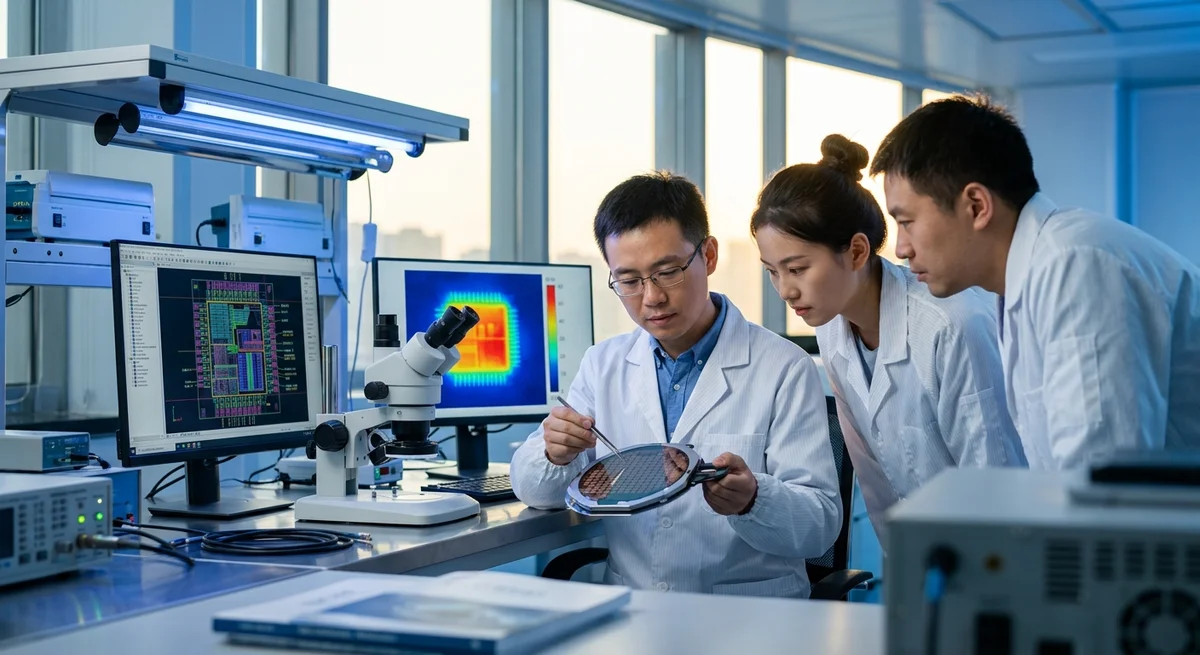
Chinese IT giants Alibaba, Baidu and Huawei are aggressively ramping up in-house production of AI accelerators. They are doing so despite rumors that Nvidia may return to the Chinese market, and the effort is part of a broader strategy of technological independence.
Why the shift accelerated
Western sanctions on exports of advanced microchips forced China to invest in its own solutions. Nvidia, the main supplier of GPUs for AI, is practically unavailable in the region because of US restrictions.
Building machine learning systems without relying on American technology is now more than an economic question: it is a question of technological sovereignty. Even if the US lets Nvidia back into the market, companies understand that relying on foreign hardware is risky.
Who is building capacity
China's largest companies have invested tens of billions of yuan in developing their own AI accelerators:
- Alibaba — the Dharma and Yitian lines, already built into Aliyun cloud services
- Baidu — the fourth-generation Kunlun series, running in its own data centers
- Huawei — Ascend, used in the cloud and in Kirin mobile processors
- Tencent — chips developed for recommendation systems and NLP tasks
- ByteDance — investments in specialized startups and its own chips
Each company optimizes for its own workloads: Alibaba for e-commerce and cloud, Baidu for search and LLMs, Huawei for mobile.
Local technology is becoming competitive
Chinese accelerators have already reached a 5-nanometer process and are approaching the performance of Nvidia's A100. The architecture has stabilized, engineering teams have gained experience, and development costs are falling along the learning curve. These are no longer crude copies; they are genuinely competitive products, optimized for local stacks and requirements.
The ecosystem is growing in parallel: frameworks (MindSpore, PaddlePaddle), optimization tools, drivers. A year ago, developers had to guess how their code would run on a Chinese chip. Now there are ready-made solutions.
"We are not just copying Nvidia.
We are building a system tailored to Chinese requirements and scale," is how local analysts describe the position.
What this means
The global AI hardware market is fragmenting. Nvidia is losing its monopoly in the largest Asian market, but this is not its collapse. It is the norm for any technology: sooner or later, local players close a critical gap in the supply chain.
For Western companies, this means strategic control over hardware no longer guarantees dominance. For researchers, it means AI models will now be trained on different architectures, which may lead to new optimizations and trade-offs.
The process will be long, not a matter of one or two years, but it is irreversible.
- Nov 1, 2026Voice bots built on LLMs turn to Jev, a fast classifier, for decisions in 200–500 ms
- Nov 1, 2026Local AI models agreed to pay scammers, while simple rules blocked all 42 schemes
- Oct 31, 2026A 22B-Parameter Video Model Runs on an RTX 3080 with 10 GB of VRAM
- Oct 30, 2026Mistral opens Large 4 weights: strong at code, but Chinese models score 32 to its 26
Key Questions Answered
Why the shift accelerated?
Western sanctions on exports of advanced microchips forced China to invest in its own solutions. Nvidia, the main supplier of GPUs for AI, is practically unavailable in the region because of US restrictions. Building machine learning systems without relying on American technology is now more than an economic question: it is a question of technological sovereignty. Even if the US lets Nvidia back into the market, companies understand that relying on foreign hardware is risky.
Who is building capacity?
China's largest companies have invested tens of billions of yuan in developing their own AI accelerators: Alibaba — the Dharma and Yitian lines, already built into Aliyun cloud services Baidu — the fourth-generation Kunlun series, running in its own data centers Huawei — Ascend, used in the cloud and in Kirin mobile processors Tencent — chips developed for recommendation systems and NLP tasks ByteDance — investments in specialized startups and its own chips Each company optimizes for its own workloads: Alibaba for e-commerce and cloud, Baidu for search and LLMs, Huawei for
What are the key details on Local technology is becoming competitive?
Chinese accelerators have already reached a 5-nanometer process and are approaching the performance of Nvidia's A100. The architecture has stabilized, engineering teams have gained experience, and development costs are falling along the learning curve. These are no longer crude copies; they are genuinely competitive products, optimized for local stacks and requirements. The ecosystem is growing in parallel: frameworks (MindSpore, PaddlePaddle), optimization tools, drivers. A year ago, developers had to guess how their code would run on a Chinese chip. Now there are ready-ma
Delegate Deep Research, Coding & Multi-Step Workflows to Nomad Agent
Deploy autonomous task execution with Nomad Agent (agent.nomadnet.ai) — automated web research, data synthesis, code generation, and MCP tool orchestration.
The AI world, distilled — once a week
Seven stories that actually mattered, hand-picked. No noise, no reposts, no press releases.
Done! Check your inbox for a confirmation.