Creator of the K.C. Green meme accuses Artisan of stealing his art for ads
K.C. Green, creator of the iconic internet meme "This Is Fine," has accused AI startup Artisan of using his illustration without authorization. The company is running his art in a controversial billboard campaign urging businesses to stop hiring people in favor of artificial intelligence. Green says nobody asked for his permission.
AI-processed from TechCrunch; edited by Hamidun News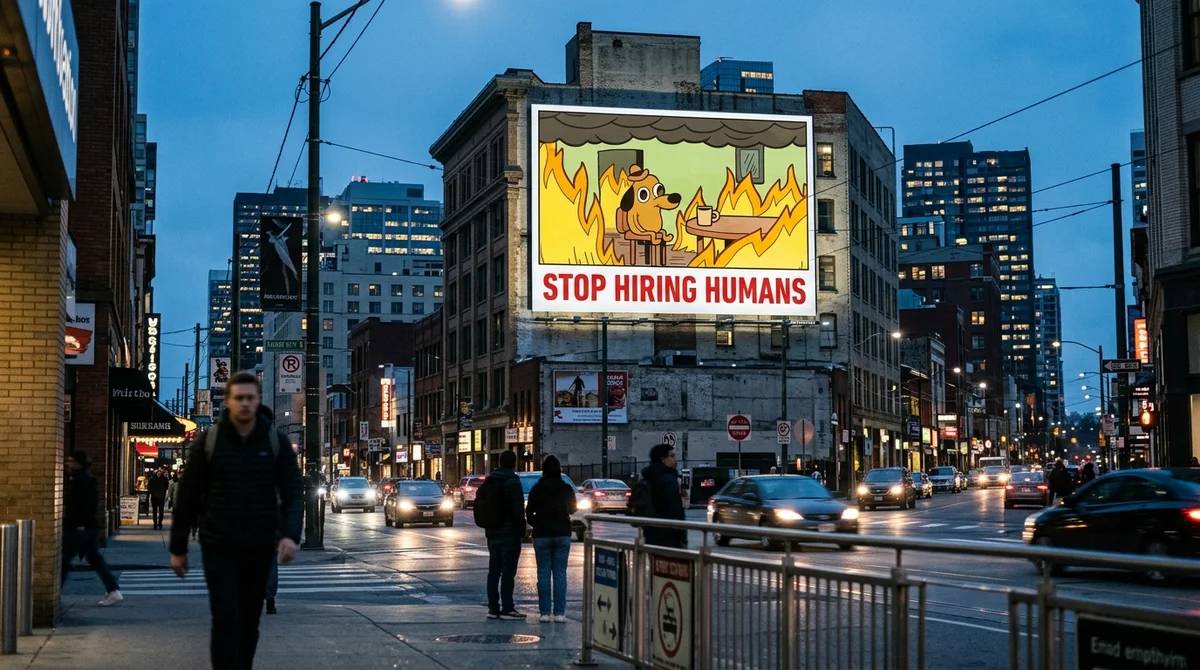
K.C. Green, creator of the iconic internet meme "This Is Fine," discovered that AI startup Artisan used his illustration in an advertising campaign without asking permission.
Billboards pushing the replacement of humans
Artisan, a startup that develops AI tools for automating corporate processes, launched a controversial series of billboards with the provocative slogan "Stop Hiring Humans." The large-format posters use K.C. Green's illustration: a dog sitting calmly in the middle of a burning room.
The irony is hard to miss. One of the world's most recognizable illustrations of human denial of reality has become a symbol of the new AI revolution, one that literally urges companies to get rid of their employees in favor of automation. All of this happened without a single word of thanks to the author and without any compensation.
How the meme conquered the internet
The meme began in 2013, when K.C. Green published a Gunshow comic featuring a dog in a burning room. Over more than ten years, it became one of the most quoted and recognizable images on the internet. People use it in contexts ranging from serious financial crises and political upheavals to openly funny situations.
The meme became a universal way to express cognitive dissonance: the state in which a person faces an unpleasant reality but keeps smiling and saying everything is fine. That psychological depth made the meme powerful and enduring. It reflects a deeply human survival mechanism: denial.
But the illustration remains K.C. Green's intellectual property. Using it for commercial purposes has always required permission and usually involved royalties.
- Created in 2013 in the web comic Gunshow
- Became one of the most recognizable memes in 13 years
- Used in politics, corporate culture and everyday life
- Copyright remains with K.C. Green
A growing wave of authorship conflicts
The Artisan case is only the tip of the iceberg of a larger problem. In recent years, major AI companies have repeatedly used other people's creative work without permission, from mass training of models on data collected without the authors' consent to the literal use of others' illustrations in marketing. Artists, writers and designers around the world have voiced discontent that their work feeds systems that then compete with them in the market.
K.C. Green has joined a growing chorus of critics outraged by how the tech industry treats creators' rights. The question is getting sharper: who pays for AI progress, and will the work of the millions of creators whose data feeds these systems ever be compensated?
What this means
The Artisan case exposes a fundamental conflict: how should creative work be valued when it can be easily copied and reused without consequences? If corporations appropriate other people's content, creators lose not only income but also control over their legacy. This matters for internet culture, where work is often made out of enthusiasm but has real market value.
Key Questions Answered
What are the key details on Billboards pushing the replacement of humans?
Artisan, a startup that develops AI tools for automating corporate processes, launched a controversial series of billboards with the provocative slogan "Stop Hiring Humans." The large-format posters use K.C. Green's illustration: a dog sitting calmly in the middle of a burning room. The irony is hard to miss.
How the meme conquered the internet?
The meme began in 2013, when K.C. Green published a Gunshow comic featuring a dog in a burning room. Over more than ten years, it became one of the most quoted and recognizable images on the internet. People use it in contexts ranging from serious financial crises and political upheavals to openly funny situations. The meme became a universal way to express cognitive dissonance: the state in which a person faces an unpleasant reality but keeps smiling and saying everything is fine.
What are the key details on A growing wave of authorship conflicts?
The Artisan case is only the tip of the iceberg of a larger problem. In recent years, major AI companies have repeatedly used other people's creative work without permission, from mass training of models on data collected without the authors' consent to the literal use of others' illustrations in marketing. Artists, writers and designers around the world have voiced discontent that their work feeds systems that then compete with them in the market. K.C.
Test Frontier LLMs & Autonomous Agents in One Workspace
Run Claude Opus 5.5, GPT-6, Gemini 3.1, and DeepSeek side-by-side in Nomad AI (nomadnet.ai) — unified model routing, deep research, and multimodal workflows under one subscription.
The AI world, distilled — once a week
Seven stories that actually mattered, hand-picked. No noise, no reposts, no press releases.
Done! Check your inbox for a confirmation.