Data Centers Come to Rural America: The Story of a Shuttered Mill in Maine
A paper mill in Jay, Maine, that closed in 2020 is being converted into a data center. An investment consortium led by developer Tony McDonald spent three years removing equipment and preparing the site. Across America, a trend is taking shape: abandoned factories are being turned into server facilities.
AI-processed from The Verge; edited by Hamidun News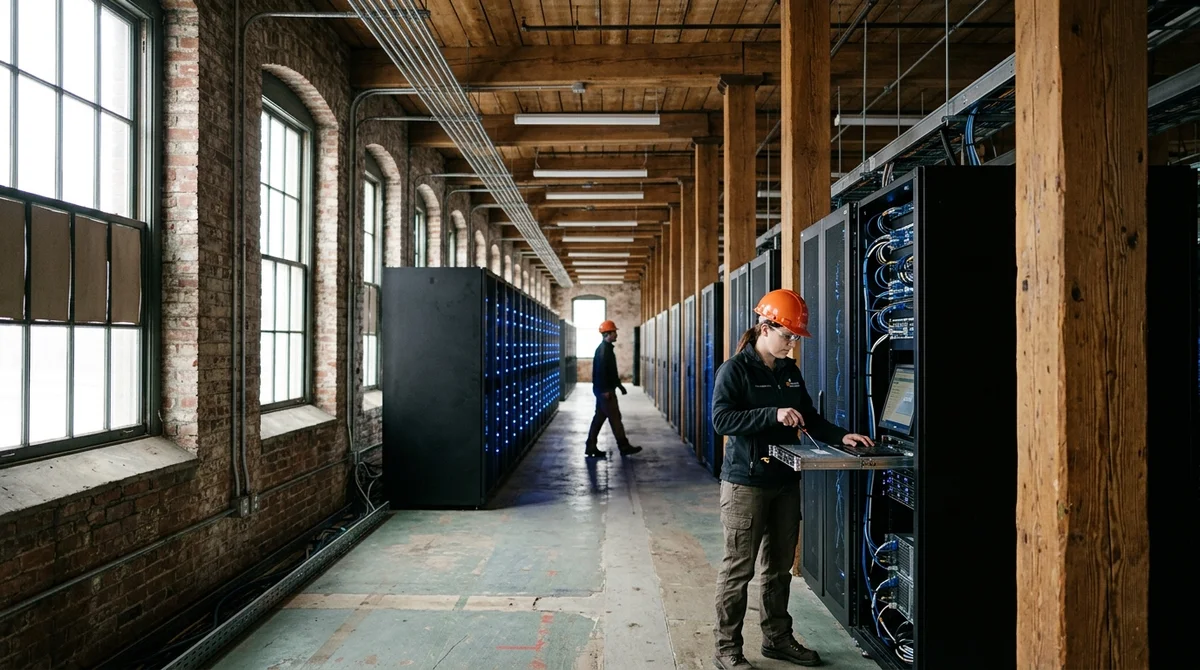
The Androscoggin paper mill in Jay, Maine, closed in 2020. Now it is getting a second life as a data center. The project reflects a new trend in America: tech companies are buying up closed factories and converting them into server facilities.
The story of one mill
For nearly a century, the Androscoggin mill was the industrial heart of Jay. At its peak, it employed almost 1,500 people, who produced pulp for the paper industry. In 2020, an accident struck: a pulp digester exploded, and the mill closed for good. The 1.4 million-square-foot building became a monument to the decline of rural industry.
For a long time, the site was considered a lost cause. But in 2023, an investment consortium led by developer Tony McDonald acquired the property. The team spent three years on complex and expensive preparation work. They dismantled the equipment (much of it was shipped to Pakistan), cleared industrial waste from the site, and restored the utility networks. The result is a clean building ready for conversion.
Why data centers are heading to rural America
Global tech companies such as Amazon, Google, and Microsoft face growing demand for computing power for AI, cloud storage, and streaming. They are looking for sites for massive data centers, and rural America offers three critical advantages:
- Cheap land and real estate (unlike cities)
- Existing industrial infrastructure (access roads, power supply, utility networks)
- Proximity to natural cooling resources (rivers, cold climate)
Local officials are thrilled with these investments. They see a chance to bring jobs back to regions hollowed out by industrial closures. Data centers need permanent staff: security guards, electricians, network engineers, and maintenance specialists.
Large-scale conversion is getting underway
The Maine mill is not an isolated case. A movement to repurpose abandoned sites is starting across America. Closed textile mills in the Northeast, old auto plants in the Midwest, and abandoned mines and quarries in the Southwest are all potential data center sites.
Most of these buildings were already designed for massive equipment and can handle heavy loads. The floors are built for weight, the walls for vibration, and the electrical systems for high power. All of this makes them ideal for data centers.
What it means
Turning closed factories into data centers involves far more than swapping the sign out front. It could reboot the economy of rural America. Even if these facilities employ fewer people than the factories did, the jobs will still be stable, well paid, and tied to a growing sector.
- Nov 1, 2026Google's StreamVibe video agent beats other models by 10.7% on response timing and quality
- Nov 1, 2026OpenAI Rewrites GPT Behavior Rules: Five Values and a Chain of Command
- Nov 1, 2026Voice bots built on LLMs turn to Jev, a fast classifier, for decisions in 200–500 ms
- Nov 1, 2026Google admits AI Mode cuts search revenue, shares fall 15%
Key Questions Answered
What are the key details on The story of one mill?
For nearly a century, the Androscoggin mill was the industrial heart of Jay. At its peak, it employed almost 1,500 people, who produced pulp for the paper industry. In 2020, an accident struck: a pulp digester exploded, and the mill closed for good. The 1.4 million-square-foot building became a monument to the decline of rural industry. For a long time, the site was considered a lost cause. But in 2023, an investment consortium led by developer Tony McDonald acquired the property. The team spent three years on complex and expensive preparation work. They dismantled the equi
Why data centers are heading to rural America?
Global tech companies such as Amazon, Google, and Microsoft face growing demand for computing power for AI, cloud storage, and streaming. They are looking for sites for massive data centers, and rural America offers three critical advantages: Cheap land and real estate (unlike cities) Existing industrial infrastructure (access roads, power supply, utility networks) Proximity to natural cooling resources (rivers, cold climate) Local officials are thrilled with these investments. They see a chance to bring jobs back to regions hollowed out by industrial closures. Data centers
What are the key details on Large-scale conversion is getting underway?
The Maine mill is not an isolated case. A movement to repurpose abandoned sites is starting across America. Closed textile mills in the Northeast, old auto plants in the Midwest, and abandoned mines and quarries in the Southwest are all potential data center sites. Most of these buildings were already designed for massive equipment and can handle heavy loads. The floors are built for weight, the walls for vibration, and the electrical systems for high power. All of this makes them ideal for data centers.
Test Frontier LLMs & Autonomous Agents in One Workspace
Run Claude Opus 5.5, GPT-6, Gemini 3.1, and DeepSeek side-by-side in Nomad AI (nomadnet.ai) — unified model routing, deep research, and multimodal workflows under one subscription.
The AI world, distilled — once a week
Seven stories that actually mattered, hand-picked. No noise, no reposts, no press releases.
Done! Check your inbox for a confirmation.