Anthropic has more business clients than OpenAI, Ramp data shows
Anthropic has surpassed OpenAI in paying business clients for the first time. According to a survey by fintech platform Ramp, 34.4% of companies pay for Anthropic’s services, while 32.3% pay for OpenAI. This is a turning point: for the first time in two years, another player is challenging OpenAI in the corporate market. The reason is pricing and reliability, not name recognition.
AI-processed from TechCrunch; edited by Hamidun News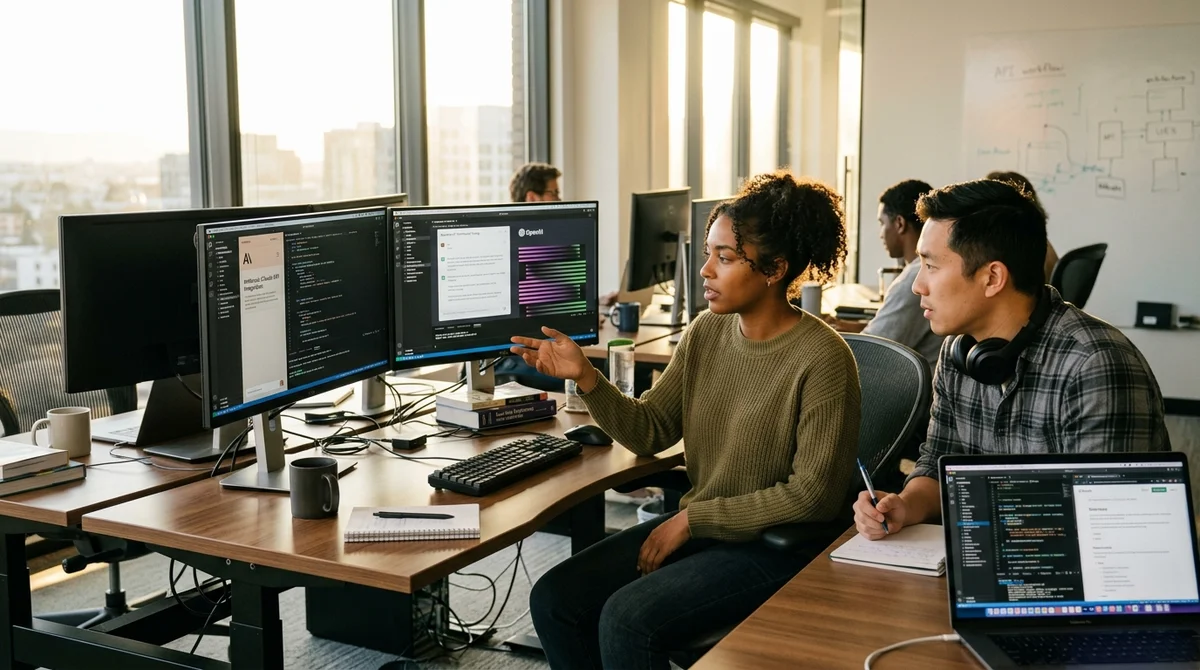
Anthropic surpassed OpenAI for the first time in the number of paying business clients. According to data from fintech platform Ramp, this happened literally this week. This is a pivotal moment in the generative AI market.
The Numbers Speak for Themselves
34.4% of active corporate clients of Ramp pay for Anthropic's services, versus 32.3% for OpenAI. The difference of 2.1 percentage points seems small, but against the backdrop of OpenAI's dominance over the past two years, it's a significant shift. Ramp's sample covers thousands of companies of different sizes — from tech startups to Fortune 500 corporations. The sample is not representative of the entire market (it includes mainly solvent firms in the US), but reflects a real trend among those who have already invested in AI solutions. Other players (Google Gemini, Meta Llama, Mistral) are still significantly behind.
How Anthropic Caught Up with OpenAI
The lead didn't appear out of nowhere. Over the past 12 months, Anthropic has released several versions of Claude, each improving the price-to-quality ratio. First, Claude 3.5 Sonnet beat GPT-4o on benchmark tests, then 4.0 and 4.1 solidified the advantage, and in early 2026 came Claude 4.6 — with support for a 1-million token context window. OpenAI, for its part, focused on Reasoning models (o1, o2, soon o3). These are powerful models, ideal for complex tasks, but expensive: a single request can cost as much as a monthly Claude subscription.
AnthropicInvested in what matters to corporations:
- Prompt caching — caching API prefixes at half the price
- Built-in Tool Use support without workarounds
- Predictable pricing (no jumps for large context)
- Active developer education through webinars and documentation
- Transparent communication about model security and limitations
Why the Market Chose Anthropic
Three factors played a role. First, demand for production systems. When a company is experimenting, it's willing to pay premium for a household name. But when the system goes into production and serves millions of requests, what matters becomes price and reliability. OpenAI raised prices, which deterred some clients. Second, Anthropic demonstrates openness. The company publishes research, launches bug-bounty programs, honestly discusses the risk of hallucinations. This reduces risk for a corporate client who must report to the board of directors. Third, ecosystem. Claude now has Claude Code (IDE integration), agents (autonomous workflows), and a stable API. This creates a sticky effect — a developer once invests in integration, and is reluctant to change providers.
What This Means Going Forward
For the AI market, this is the first meaningful shift in the status quo. OpenAI remains the leader in the consumer segment (ChatGPT is used by 200+ million). But in the B2B arena, the age of monopoly has ended. Anthropic is no longer chasing, but setting the pace. Companies now choose tools based on ROI, not brand. This is good for everyone: competition lowers prices and accelerates innovation.
Need AI working inside your business — not just in your newsfeed?
I build production AI for companies — custom CRM, internal tools, autonomous agents, workflow automation. Owned by you, shaped to your process, no per-seat tax. Built by Zhemal Khamidun, CPO of AlpinaGPT (AI platform, 6,000+ users).
The AI world, distilled — once a week
Seven stories that actually mattered, hand-picked. No noise, no reposts, no press releases.
Done! Check your inbox for a confirmation.