arXiv to ban authors for a year over 'AI slop' papers and fabricated references
arXiv is introducing harsh sanctions against researchers who upload papers with obvious traces of unchecked LLM generation. If the platform spots hallucinated references, the model's own meta-comments or other signs of raw AI text, the author may be banned for a year. After such a violation, according to representatives of the platform, future submissions may have to be accepted at a peer-reviewed journal or conference first.
AI-processed from The Verge; edited by Hamidun News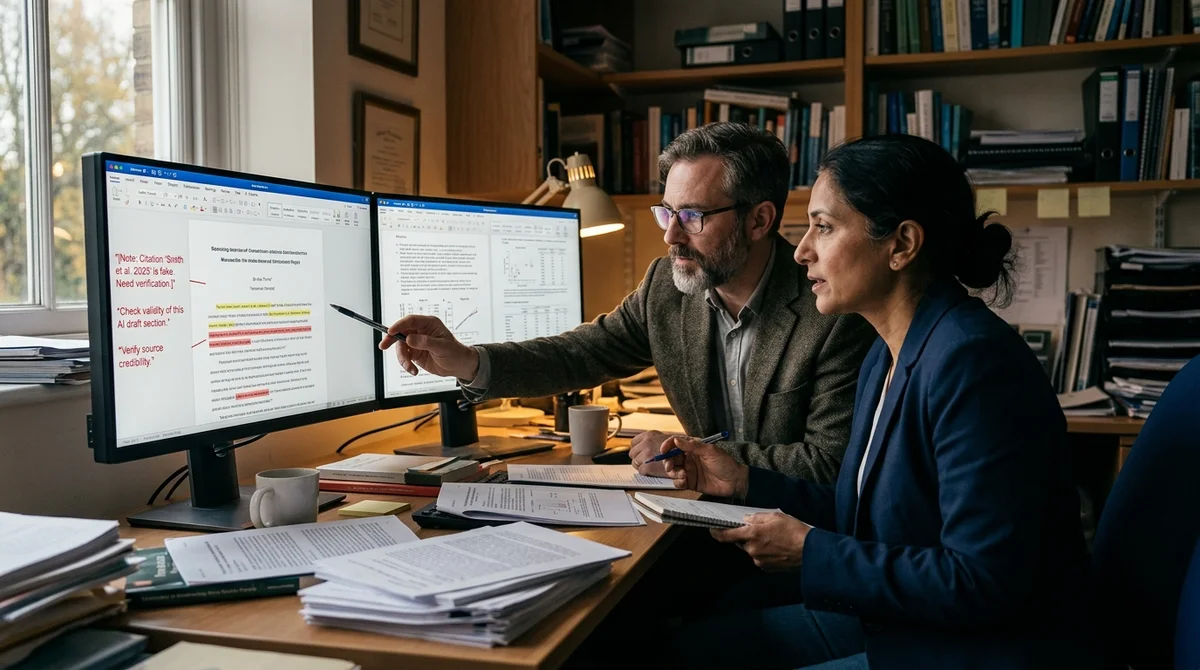
arXiv is tightening its rules against so-called AI slop: scientific manuscripts in which authors paste model-generated text without checking it. If the platform sees clear signs of such a submission, the penalty will be significant, ranging from a one-year ban to additional restrictions on future uploads.
A new barrier for preprints
For arXiv, this is not a cosmetic rule update but an attempt to protect the reputation of one of the main preprint archives. The platform has long been the place where researchers quickly publish fresh results ahead of a formal journal or conference. But as LLMs have become more accessible, manuscripts assembled with almost no editing have started to enter the stream: confident in tone, but with erroneous facts, absurd phrasing and references to nonexistent works. For a scientific platform, this is no longer a question of style but of trust.
Thomas Dietterich, chair of arXiv's computer science section, described the new approach. According to him, sanctions will apply not for the mere fact of using a model, but for the absence of human review of its output. In other words, the problem is not that authors use LLMs as a tool, but that some upload nearly raw model output under their own name. For arXiv this violates a basic principle: if you put your name on a work, you answer for every reference, formula and conclusion.
What will get authors banned
The key wording is "irrefutable evidence that the authors did not check the result of LLM generation." This refers to markers that are hard to explain by ordinary carelessness. It is not a dispute over writing quality and not a nitpick about style. If a manuscript retains traces of a machine-generated draft showing that the text was not even read before submission, arXiv will treat that as sufficient grounds for sanctions. arXiv regards exactly such traces as the clearest signal of bad-faith submission.
- fabricated or nonexistent bibliographic references
- meta-comments from the model, accidentally left in the text
- claims that contradict the sources and were not checked by the author
- traces of automatic pasting showing the absence of a final proofread
"If there is irrefutable evidence that the authors did not check the
result of LLM generation, a one-year ban will follow."
This is an important nuance for academia. arXiv is not declaring war on generative tools as such: a researcher may use an LLM for a draft, translation or editing. The red line lies where the author stops being an author and becomes a copy-paste operator. The archive is trying to set a simple rule: automation is acceptable, but responsibility for content cannot be delegated to a model, especially when it comes to citations and verifiable facts.
What awaits authors
The penalty for such submissions will be harsh: a one-year ban on uploading new work to arXiv. In addition, according to Dietterich's statement, subsequent submissions after such a violation may require extra confirmation of quality, for example acceptance of the paper at a reputable peer-reviewed conference or in a journal.
This is painful for a researcher. arXiv is often used to show results quickly to colleagues, establish priority for an idea and get early feedback. Losing that channel for a year is a serious blow to a work's visibility.
The signal is aimed not only at offending authors but at the whole academic-writing market. Over the past year, a layer of services has grown around research that promise to "speed up publication" by generating text, abstracts and literature reviews. The new measure shows that scientific platforms are starting to separate productive use of AI from careless mass-production of manuscripts. The more popular LLMs become, the higher the chance that similar filters will appear at journals, conferences and data repositories.
What this means
For researchers, it is a reminder of basic discipline: a model can help assemble a draft, but it cannot sign a paper in place of a human. For the AI industry, it is another sign that the market is moving from enthusiasm for "fast generation" toward demands for verification, editorial accountability and verifiable quality.
Key Questions Answered
What are the key details on A new barrier for preprints?
For arXiv, this is not a cosmetic rule update but an attempt to protect the reputation of one of the main preprint archives. The platform has long been the place where researchers quickly publish fresh results ahead of a formal journal or conference. But as LLMs have become more accessible, manuscripts assembled with almost no editing have started to enter the stream: confident in tone, but with erroneous facts, absurd phrasing and references to nonexistent works. For a scientific platform, this is no longer a question of style but of trust. Thomas Dietterich, chair of arXi
What will get authors banned?
The key wording is "irrefutable evidence that the authors did not check the result of LLM generation." This refers to markers that are hard to explain by ordinary carelessness. It is not a dispute over writing quality and not a nitpick about style. If a manuscript retains traces of a machine-generated draft showing that the text was not even read before submission, arXiv will treat that as sufficient grounds for sanctions. arXiv regards exactly such traces as the clearest signal of bad-faith submission. fabricated or nonexistent bibliographic references meta-comments from t
What awaits authors?
The penalty for such submissions will be harsh: a one-year ban on uploading new work to arXiv. In addition, according to Dietterich's statement, subsequent submissions after such a violation may require extra confirmation of quality, for example acceptance of the paper at a reputable peer-reviewed conference or in a journal. This is painful for a researcher. arXiv is often used to show results quickly to colleagues, establish priority for an idea and get early feedback. Losing that channel for a year is a serious blow to a work's visibility. The signal is aimed not only at
Test Frontier LLMs & Autonomous Agents in One Workspace
Run Claude Opus 5.5, GPT-6, Gemini 3.1, and DeepSeek side-by-side in Nomad AI (nomadnet.ai) — unified model routing, deep research, and multimodal workflows under one subscription.
The AI world, distilled — once a week
Seven stories that actually mattered, hand-picked. No noise, no reposts, no press releases.
Done! Check your inbox for a confirmation.