Sunday hits $1.15 billion valuation after $165 million round for Memo home robot
Sunday is the newest unicorn in home robotics: the startup raised $165 million at a $1.15 billion valuation. The company builds Memo, a robot for household tasks such as clearing the table, handling laundry and loading the dishwasher. The focus is now shifting from demonstrations to real deployments. A beta program is due to start as early as 2026, and investors see data from real homes as Sunday's main asset.
AI-processed from Bloomberg Tech; edited by Hamidun News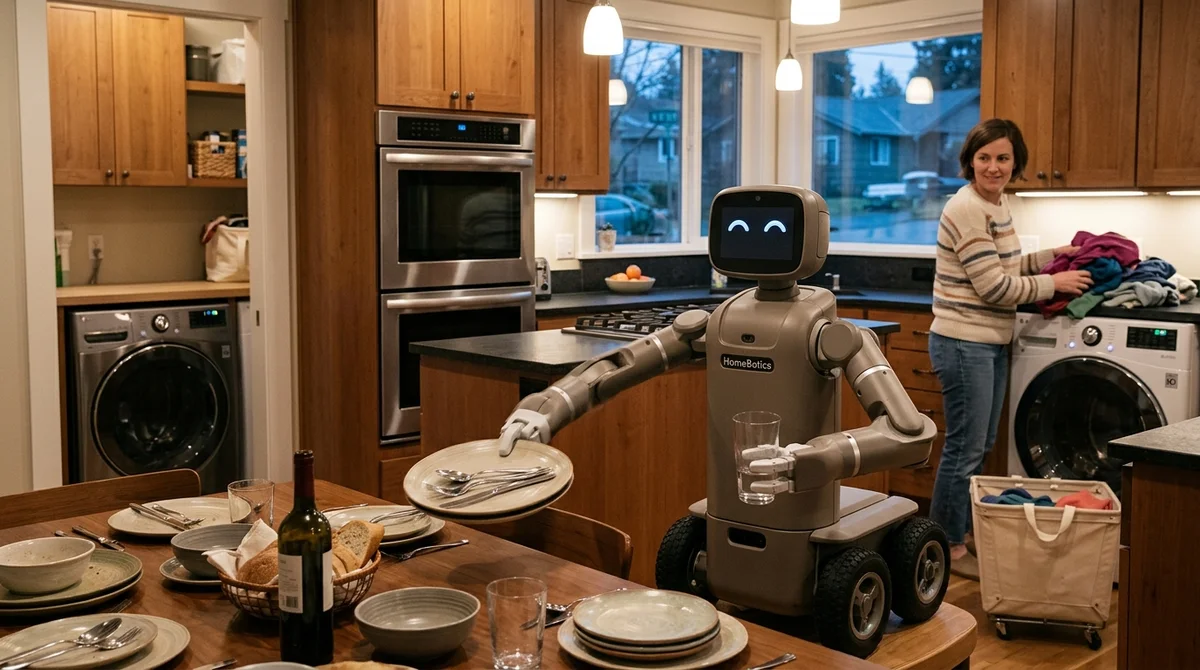
Sunday raised $165 million in a Series B round at a valuation of $1.15 billion. The company is building Memo, a home robot meant to take over household routine, from clearing the table to loading the dishwasher and handling laundry.
The round and the plans
The round was led by Coatue Management. Bain Capital Ventures, Fidelity, Tiger Global, Benchmark, Conviction and Xtal Ventures also took part. For the market, it is one more signal that investors are willing to bet not only on industrial robots for warehouses and factories, but also on a riskier segment: home helpers, where promises are plentiful and working products are still almost nonexistent.
Sunday plans to put the new money into scaling its research and launching the first Memo deployments in real homes. The company is effectively moving the project from polished videos and controlled demos to field testing: by its plan, beta shipments start as early as 2026.
"We raised our
Series B to stop making demos and focus fully on deployment," said Sunday CEO Tony Zhao.
What Memo can do
Memo is designed for long chains of household work, not a single party trick. It has to do more than pick up an object: it must understand the context of a room, grip items of different shapes and fragility, carry them and finish the whole sequence of actions without constant human help.
According to Sunday, the robot targets the most annoying and repetitive chores:
- clearing plates, glasses and cutlery after dinner
- loading the dishwasher and putting items back in their places
- carrying and sorting laundry
- tidying the kitchen, living room and storage area
Unlike bipedal concepts, Memo is designed specifically for an apartment, with an emphasis on stability, safe movement between furniture and a friendlier look that does not resemble an industrial machine that wandered into a home by accident. The emphasis matters: the company is not selling a "robot in general" but a concrete saving of time on chores. That approach is closer to how the mass market adopts new devices: not for the technological wow factor, but for clear benefit in everyday scenarios.
A bet on data
The main problem in home robotics is not the mechanics but the data. Everything in a home is too unpredictable: plates differ in size, towels crumple, glasses are fragile, and objects are not where they were yesterday. That is why many impressive robot demos fare poorly when they meet a real kitchen or laundry room.
Sunday is betting on its own training pipeline. According to the company, Memo learns from household routines collected in more than 500 real homes, and the key tool is the Skill Capture Glove, a glove that records a person's movements during ordinary chores. These recordings become datasets for the models that handle object grasping, scene recognition and action sequencing.
This approach became the main argument for investors. Sunday promises that the robot will learn not in a sterile lab but amid real household mess. If the company does bring Memo to stable operation in apartments, it will be one of the first serious cases of embodied AI moving from prototypes to a consumer product.
What it means
The $1.15 billion valuation shows the market is willing to believe in home robots again, but the bet is now placed not on flashy motion but on data, reliability and usefulness around the house. For the whole industry it is a test: can an AI robot finally become ordinary household equipment rather than another viral demo?
Key Questions Answered
What are the key details on The round and the plans?
The round was led by Coatue Management. Bain Capital Ventures, Fidelity, Tiger Global, Benchmark, Conviction and Xtal Ventures also took part. For the market, it is one more signal that investors are willing to bet not only on industrial robots for warehouses and factories, but also on a riskier segment: home helpers, where promises are plentiful and working products are still almost nonexistent. Sunday plans to put the new money into scaling its research and launching the first Memo deployments in real homes. The company is effectively moving the project from polished vide
What Memo can do?
Memo is designed for long chains of household work, not a single party trick. It has to do more than pick up an object: it must understand the context of a room, grip items of different shapes and fragility, carry them and finish the whole sequence of actions without constant human help. According to Sunday, the robot targets the most annoying and repetitive chores: clearing plates, glasses and cutlery after dinner loading the dishwasher and putting items back in their places carrying and sorting laundry tidying the kitchen, living room and storage area Unlike bipedal conce
What are the key details on A bet on data?
The main problem in home robotics is not the mechanics but the data. Everything in a home is too unpredictable: plates differ in size, towels crumple, glasses are fragile, and objects are not where they were yesterday. That is why many impressive robot demos fare poorly when they meet a real kitchen or laundry room. Sunday is betting on its own training pipeline. According to the company, Memo learns from household routines collected in more than 500 real homes, and the key tool is the Skill Capture Glove, a glove that records a person's movements during ordinary chores. Th
Test Frontier LLMs & Autonomous Agents in One Workspace
Run Claude Opus 5.5, GPT-6, Gemini 3.1, and DeepSeek side-by-side in Nomad AI (nomadnet.ai) — unified model routing, deep research, and multimodal workflows under one subscription.
The AI world, distilled — once a week
Seven stories that actually mattered, hand-picked. No noise, no reposts, no press releases.
Done! Check your inbox for a confirmation.