AAF Framework Lays Out Architecture for an Autonomous AI Agent with GraphRAG and a Docker Sandbox
AAF is an open-source framework for an autonomous AI agent. It runs as a long-lived async process, uses GraphRAG for memory, relies on an EventBus to react to events, and launches subagents in a Docker sandbox. The author is trying to close three weak spots of agent systems: loss of context, endless ReAct loops and unsafe code execution on the host. The project is already being discussed as one of the most stable options for an agent running on a personal Telegram account.
AI-processed from Habr AI; edited by Hamidun News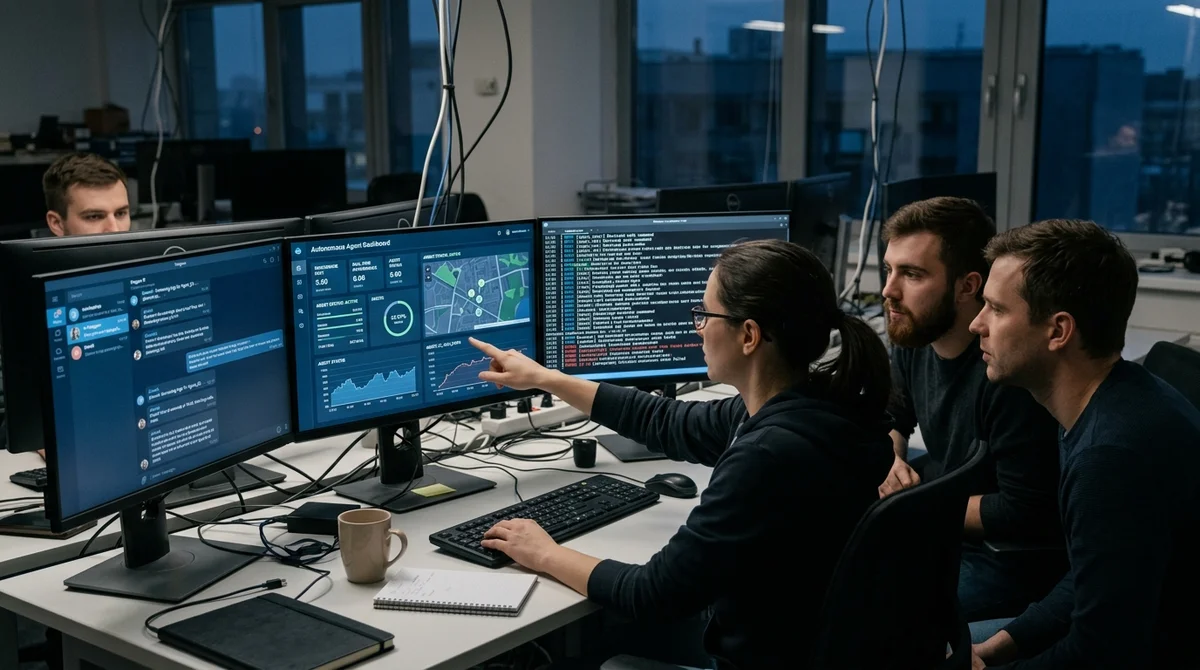
The Habr AI community has taken a close look at the Autonomous Agent Framework (AAF), an open-source architecture for an autonomous AI agent that lives as a long-running process, operates through a personal Telegram account and launches subagents in an isolated Docker environment. The project is published on GitHub and is presented as an attempt to solve three long-standing problems of agent frameworks: memory loss, looping and unsafe code execution.
Why ordinary agents break
The author of AAF starts from a simple complaint about most open-source solutions: they look good in demos but fall apart quickly in real autonomous operation. After a few steps the agent loses coherence, because memory turns into a pile of similar vectors with no cause-and-effect links. Then comes the opposite extreme: the model falls into an endless loop of reasoning and acting, repeating nearly identical steps instead of moving toward the goal. In autonomous mode this is not a cosmetic flaw but an outright failure of the whole system.
Security is an equally painful topic. In many agent projects, generated code is still executed almost directly on the host machine. That is too risky for a process that runs permanently and has access to files, accounts and external services. Against this background, AAF proposes to see the agent not as an on-demand script but as a durable system entity with its own lifecycle, state and a tightly controlled execution environment.
How AAF is built
The key idea of AAF is that an autonomous agent should live continuously, react to events and build memory in several layers, not only through classic vector search. Instead of a one-off pipeline, the author proposes an asynchronous Python process that receives signals from different sources, distributes tasks among components and can spin up subagents for specific actions. In spirit, this is no longer a prompt wrapper around an LLM but a service architecture designed for long operation without constant manual restarts.
An agent should not be just a script waiting for a prompt.
The published architecture description highlights several core elements that together give the model a working environment rather than just a set of tools:
- GraphRAG memory — to store not only similar text fragments but also the links between facts, tasks, actions and results.
- EventBus — so the agent reacts to incoming events and switches between processes instead of living in a single linear scenario.
- Docker sandbox — to run code and subagents in an isolated environment instead of directly on the host system.
- Long-lived async process — so state is not reset after each model call and tasks can continue between sessions.
- Personal Telegram account — as an interface for the agent's real presence in a community, not only in a test chat or an API console.
In essence, AAF builds an operational shell around the LLM: memory, events, isolation, delegation and state management. This matters because the infrastructure layer is what most often breaks elegant agent concepts when they are left to run unattended for more than a couple of hours. If this foundation is done right, autonomy has a chance to become a repeatable engineering practice rather than a series of lucky runs on a local machine.
Which questions remain open
The publication matters not only for the code itself but also because the author brings architectural problems to the community for discussion. The project is already described as one of the most stable options for an autonomous agent with a personal Telegram account, but that does not mean the key questions are settled. On the contrary, they involve fundamental trade-offs: how deep memory should be, how to limit subagents' independence, how to measure task progress, and where the line lies between useful autonomy and uncontrolled behavior.
There is also a practical layer without which any architectural idea remains a nice diagram. Even with GraphRAG, an event bus and container isolation, autonomous agents remain expensive to maintain: they need observability, resource limits, access-rights control and emergency-stop mechanisms. If AAF can show that all of this fits into a reproducible open-source stack without constant manual intervention, it will become a reference point not only for hobby projects but also for applied enterprise assistants.
What this means
AAF shows that the market for agent systems is gradually moving from toy demos to full engineering: memory as a graph, event-driven architecture, execution isolation and long-lived processes. If this approach takes hold, autonomous AI agents will be seen not as flashy conversationalists but as manageable digital workers for long tasks, where context, resilience and safety matter at every step.
For the open-source scene it is also a signal: the next stage of competition will be decided not only by model quality but by the quality of the environment the agent lives in.
- Nov 1, 2026Local models lose to Opus and Codex: 0.21 on a MacBook versus 1.00 for Codex
- Nov 1, 2026Adobe's EditAgent judge picks a usable edit 81.3% of the time, versus 74.8% for EditScore
- Nov 1, 202616 models tested on 7 search tools: Exa averaged 10.5 out of 14, SearXNG about 3
- Nov 1, 2026Google's StreamVibe video agent beats other models by 10.7% on response timing and quality
Key Questions Answered
Why ordinary agents break?
The author of AAF starts from a simple complaint about most open-source solutions: they look good in demos but fall apart quickly in real autonomous operation. After a few steps the agent loses coherence, because memory turns into a pile of similar vectors with no cause-and-effect links. Then comes the opposite extreme: the model falls into an endless loop of reasoning and acting, repeating nearly identical steps instead of moving toward the goal. In autonomous mode this is not a cosmetic flaw but an outright failure of the whole system. Security is an equally painful topic
How AAF is built?
The key idea of AAF is that an autonomous agent should live continuously, react to events and build memory in several layers, not only through classic vector search. Instead of a one-off pipeline, the author proposes an asynchronous Python process that receives signals from different sources, distributes tasks among components and can spin up subagents for specific actions. In spirit, this is no longer a prompt wrapper around an LLM but a service architecture designed for long operation without constant manual restarts. An agent should not be just a script waiting for a pro
Which questions remain open?
The publication matters not only for the code itself but also because the author brings architectural problems to the community for discussion. The project is already described as one of the most stable options for an autonomous agent with a personal Telegram account, but that does not mean the key questions are settled. On the contrary, they involve fundamental trade-offs: how deep memory should be, how to limit subagents' independence, how to measure task progress, and where the line lies between useful autonomy and uncontrolled behavior. There is also a practical layer w
Test Frontier LLMs & Autonomous Agents in One Workspace
Run Claude Opus 5.5, GPT-6, Gemini 3.1, and DeepSeek side-by-side in Nomad AI (nomadnet.ai) — unified model routing, deep research, and multimodal workflows under one subscription.
The AI world, distilled — once a week
Seven stories that actually mattered, hand-picked. No noise, no reposts, no press releases.
Done! Check your inbox for a confirmation.