AI data centers prepare to switch to direct current instead of the usual alternating current
Growing AI workloads are forcing data centers to rethink their power architecture. Instead of the usual alternating current, the industry is increasingly looking at direct current: it reduces conversion losses, makes it easier to power GPU racks, and helps keep heat under control. The idea may look like a step backward in the history of power systems, but for modern data centers it is more an attempt to remove unnecessary stages between the grid and the chips.
AI-processed from CNews AI; edited by Hamidun News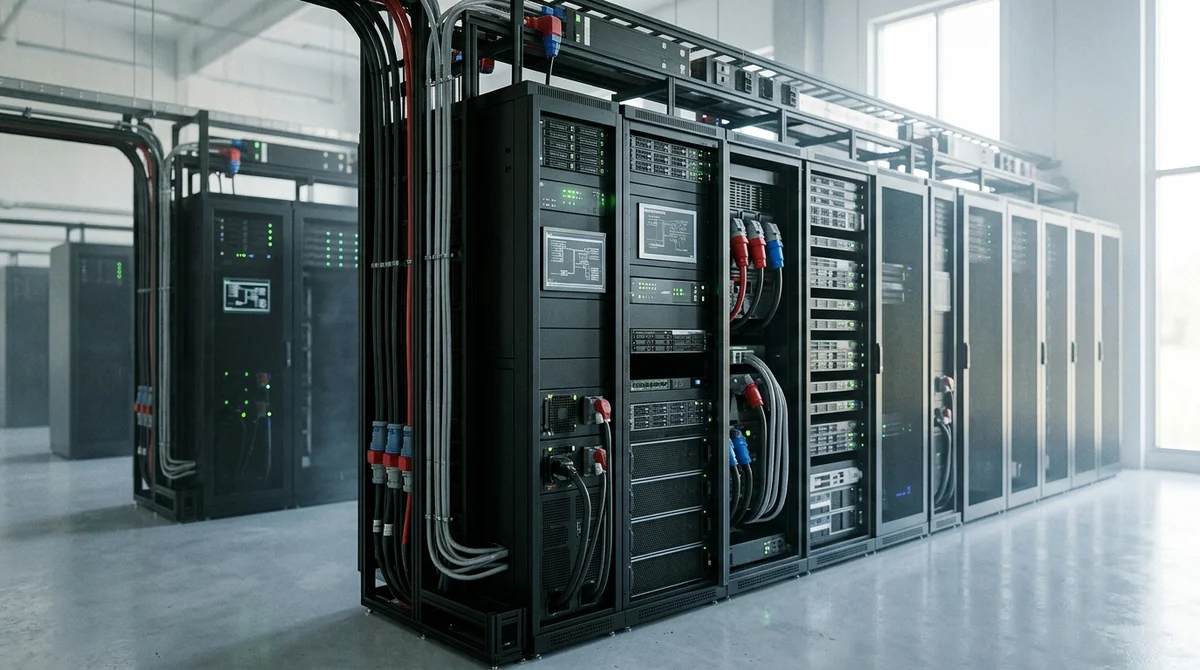
AI-load is changing not just servers, but the entire power infrastructure of data centers. Operators of facilities and equipment suppliers are seriously discussing a return to direct current, because when powering accelerators, every extra transformation stage means losses, heat, and increased costs.
Why the scheme is changing
Today, electricity in most data centers goes through a long chain of transformations. The grid supplies alternating current, which is then converted to direct current multiple times for batteries, uninterruptible power supplies, server power supplies, and already within the circuit boards themselves. For classical servers, this was tolerable, but the AI era sharply increased power density in a rack.
When a cabinet with GPUs consumes tens, and soon hundreds of kilowatts, even a small percentage of losses becomes significant money and additional cooling requirements. Historically, alternating current won not because it was ideal everywhere, but because it was simpler and cheaper to transmit over long distances. For city grids, this remains true today.
But inside a modern data center, the conditions are different: distances are short, loads are predictable, and almost all computing equipment ultimately works on direct current anyway. So the industry asks a pragmatic question: if the end consumer is electronics, why maintain so many intermediate stages between the power inlet and the chips?
What's changing in data centers
Interest in direct current is linked not to fashion, but to economics. Operators are trying to squeeze more computing power out of the same megawatts without building endless new power nodes. If some transformations are removed, the power system can become more efficient, which means the same facility can serve more AI accelerators without immediate expansion of external infrastructure. For hyperscalers and large colocation facilities, this is especially important: power, not racks or servers, is increasingly becoming the main constraint on growth. The potential benefits of such a transition look like this:
- less energy loss at each transformation stage
- lower heat generation in power circuits and reduced cooling load
- simpler rack design for powerful GPU and AI systems
- better chance of fitting within existing power limits without expensive facility restructuring
But such a transition won't be quick. It requires changing the power distribution architecture, agreeing on standards, and checking compatibility with existing UPS, batteries, and server platforms. Besides, data centers aren't built for one or two years: many facilities have invested huge sums in current AC schemes and won't throw them away just for a nice idea. So in practice, the market will likely go through hybrid models, pilot zones, and new AI clusters that are designed for DC from the start.
Why this isn't the past
At first glance, the news sounds like a power rollback a hundred years, but the comparison is deceptive. We're not talking about cities again starting to transmit electricity as direct current to homes and offices. We're discussing local architecture within data centers, where conditions differ greatly from the city-wide grid.
In such systems, direct current has a different profile of advantages: it works on a short span, near the load, and in an environment where every percent of efficiency matters. In a way, the industry isn't returning to the past, but removing the legacy of an era when server capacity was much more modest. Batteries already store energy as direct current, solar panels and some power electronics are also closer to DC logic, and modern AI racks require increasingly direct and dense power delivery.
So the transition looks not like nostalgia for Edison, but engineering optimization for the new reality: accelerators are getting more expensive, capacity is insufficient, and any extra conversion becomes too costly.
What this means
If the trend takes hold, competition in AI infrastructure will shift from chips alone to power engineering. Those operators and vendors who can quickly restructure data center power circuits for dense computing and reduce the cost per megawatt for AI workloads will win.
Want to stop reading about AI and start using it?
AI News is a curated feed of AI/tech news. Hamidun Academy teaches you to use AI systematically in your work.
The AI world, distilled — once a week
Seven stories that actually mattered, hand-picked. No noise, no reposts, no press releases.
Done! Check your inbox for a confirmation.