How a Habr author swapped prompts for reference images in ChatGPT and created a series of AI prints
Habr outlined a practical image-generation technique: instead of long descriptions, the author started uploading three reference images to the model — the subject, the clothing, and the scene. This approach gave more control over the pose, uniform details, and frame composition. The result was THE HOCKEY GODS SERIES, featuring mythologized depictions of Ovechkin, Malkin, Panarin, and other notable hockey players.
AI-processed from Habr AI; edited by Hamidun News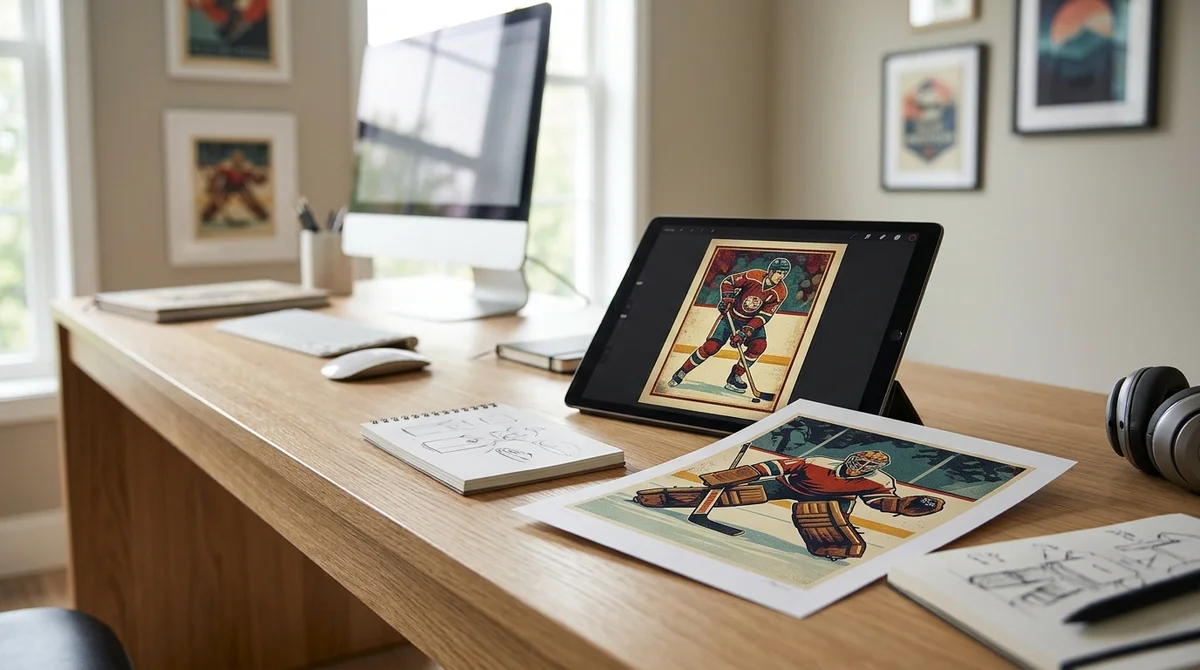
On Habr, a detailed case study was published about how a designer's experiment with hockey prints turned into a working scheme for AI image generation. The main idea is simple: instead of endlessly refining a text prompt, the author started showing the model exactly what needed to be drawn.
How the process changed
Initially, the project was conceived as a series of T-shirts with epic images of famous hockey players. It was based on archetypes like "Alexander Ovechkin — The Archangel" and "Evgeny Malkin — The Storm Master," and the final set included six players: Ovechkin, Panarin, Bobrovsky, Datsyuk, Sergachyov, and Malkin. During the work, the author abandoned some foreign athletes: on one hand, they wanted to make the collection more understandable for a Russian audience, on the other hand, not all characters were equally well suited to generation in the required style.
Before this, the workflow looked familiar to anyone working with generative graphics: first, a detailed explanation of the task to ChatGPT, then writing a prompt for a specific model, then generation, upscaling, color correction, and manual cleanup in Photoshop. To increase resolution, the author first used AI Photo & Art Enhancer, then switched to Topaz; for styling — Luminar AI. But the approach with purely text control had a ceiling: even a very detailed prompt did not guarantee the exact pose of the character, specific elements of the uniform, numbers, insignia, and other details critical for merchandise.
Why references worked
The turning point was the transition to multimodal prompting. Instead of one text instruction, the author began assembling a request from three types of input data: images of the hero himself, photographs of clothing or equipment, and a separate reference for the environment and mood of the scene. In other words, the model received not only a description of the plot, but also visual constraints that previously had to be tried to "write out in words." This sharply reduced the number of random deviations in pose, shape, symbolism, and composition.
- Photo of the central character
- Reference of uniform, clothing, or equipment
- A separate image with the needed scene and atmosphere
- A text brief with the archetype, action, and composition details
For tests, the author switched to arena.ai, where you can run several strong image models for free and compare results in Side by Side mode. The case separately mentions gemini-3-pro-image-preview-2k, also called nano-banana-pro, and gpt-image-1.5-high-fidelity. According to the author, these provided the most convincing results with minimal post-processing. An additional plus was relatively short pauses after reaching free limits — about 30-40 minutes, which for iterative work is noticeably more convenient than many alternatives.
Using the example of an image of Evgeni Malkin — The Stormbringer, the author showed how the new approach works in practice. In the prompt, the model was asked to combine three uploaded references and turn Malkin into a mythological master of an icy storm: with stormy sky over the arena, cracks in the ice, a stick as a lightning conductor, and a puck resembling ball lightning. Such a request no longer tries to describe everything from scratch — it sets a framework and allows the model to more accurately assemble the needed image from pre-shown visual examples.
What the project became
As a result, the experiment evolved into a full collection THE HOCKEY GODS SERIES. For each player, the author came up with a separate image: Pavel Datsyuk became The Hockey Magician, Sergei Bobrovsky — The Man-Fortress, Alexander Ovechkin — The Archangel, Mikhail Sergachyov — The Ice Warden, Artemiy Panarin — The Trickster, and Evgeny Malkin — The Stormbringer. The series logo was created with ChatGPT's help, then converted from raster to vector through Adobe Illustrator so it could be scaled without quality loss.
Initially, the project was considered commercial: the author thought about selling the collection through merchandise printing platforms. But the calculation turned out to be not very inspiring — low margins, bureaucracy with registration, and manual design moderation made the venture operationally heavy. At some point, the project changed its goal: instead of trying to monetize, the author decided to release the materials into the public domain, including original layout files in Adobe InDesign, large JPEG versions, and a logo in several formats.
"Sometimes it's much more interesting not to sell an idea, but to let
it drift freely."
What this means
The case well demonstrates where practical work with AI graphics is shifting in 2026. The winners are not the longest prompts, but a combination of text, references, and quick comparison of models on a single task. For designers, editorial teams, and merchandise creators, this is an important signal: modern image models can already be used not only for mood exploration, but as a tool for controlled production if you correctly assemble the visual context on input.
Want to stop reading about AI and start using it?
AI News is a curated feed of AI/tech news. Hamidun Academy teaches you to use AI systematically in your work.
The AI world, distilled — once a week
Seven stories that actually mattered, hand-picked. No noise, no reposts, no press releases.
Done! Check your inbox for a confirmation.