Facial recognition AI in public transport: payback in 14–23 months
A project to put facial-recognition cameras on electric buses now has a clear technical and economic case. The cameras would be mounted at face level with a 120° field of view to log passengers boarding and exiting with accuracy above 99.5%. For a fleet of 56 buses, the calculation gives costs of 23.7 million rubles and payback in 14–23 months. The next step is integration with access to the electric bus systems.
AI-processed from Habr AI; edited by Hamidun News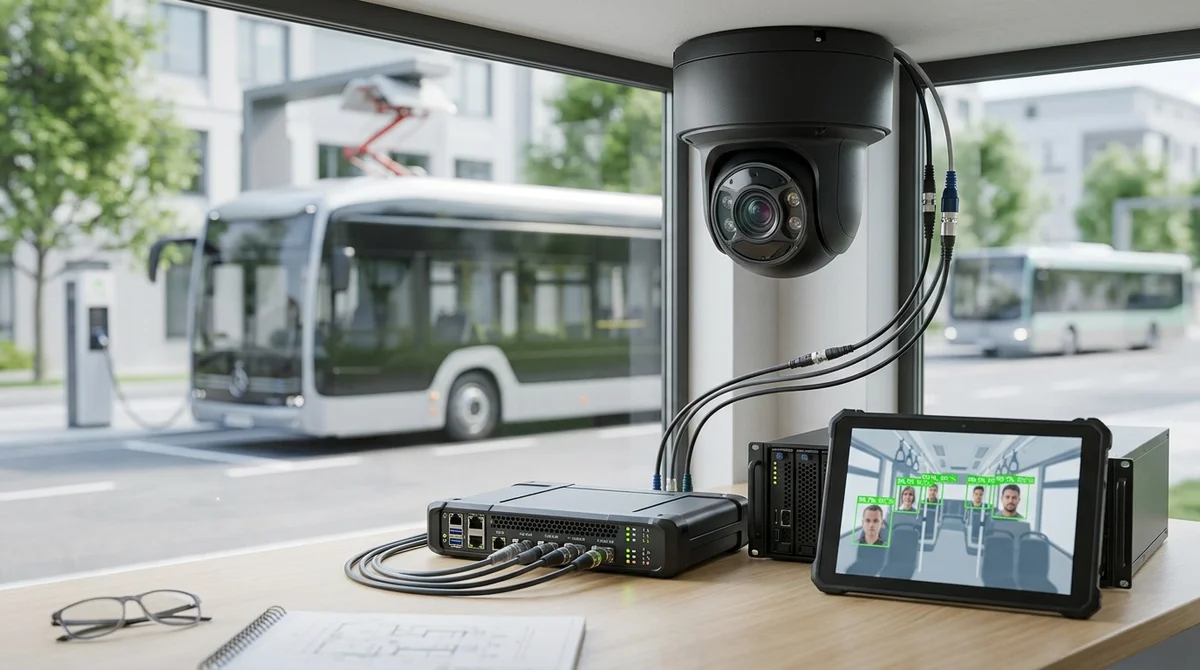
The facial-recognition AI system for electric buses now has a full technical and economic justification.
How accurate is the neural network at recognizing faces?
Above 99.5%, even in difficult scenarios such as boarding and exiting, when a face is in frame for only a second.
How many months does it take for AI cameras in transport to pay off?
14–23 months, with cameras placed at face level and a 120-degree field of view.
How does AI facial recognition work in electric buses?
The cameras are mounted at face level with a 120-degree field of view. This configuration captures passengers' faces as they board and exit, when a face is in frame for only a brief moment.
Can deploying this kind of AI pay for itself?
Yes. According to the technical justification, the system pays back in 14–23 months.
How are the recognition cameras positioned in the electric bus?
The cameras are placed at face level with a 120-degree field of view, which covers the critical boarding and exiting scenarios, when faces are in frame for one to two seconds and are blocked by the flow of people.
How long until the system pays for itself?
According to the calculations, with recognition accuracy above 99.5%, the system pays back in 14-23 months.
Key Questions Answered
How accurate is the neural network at recognizing faces?
Above 99.5%, even in difficult scenarios such as boarding and exiting, when a face is in frame for only a second.
How many months does it take for AI cameras in transport to pay off?
14–23 months, with cameras placed at face level and a 120-degree field of view.
How does AI facial recognition work in electric buses?
The cameras are mounted at face level with a 120-degree field of view. This configuration captures passengers' faces as they board and exit, when a face is in frame for only a brief moment.
Can deploying this kind of AI pay for itself?
Yes. According to the technical justification, the system pays back in 14–23 months.
Test Frontier LLMs & Autonomous Agents in One Workspace
Run Claude Opus 5.5, GPT-6, Gemini 3.1, and DeepSeek side-by-side in Nomad AI (nomadnet.ai) — unified model routing, deep research, and multimodal workflows under one subscription.
The AI world, distilled — once a week
Seven stories that actually mattered, hand-picked. No noise, no reposts, no press releases.
Done! Check your inbox for a confirmation.