Electric bus operators can recoup the cost of face recognition cameras in 14–23 months
The face recognition camera project for electric buses received a clear techno-economic justification. The cameras are proposed to be installed at face level with a 120° field of view to record passenger entry and exit with accuracy above 99.5%. For a fleet of 56 buses, the estimate puts costs at 23.7 million rubles and the payback period at 14–23 months. The next step is integration with access to electric bus systems.
AI-processed from Habr AI; edited by Hamidun News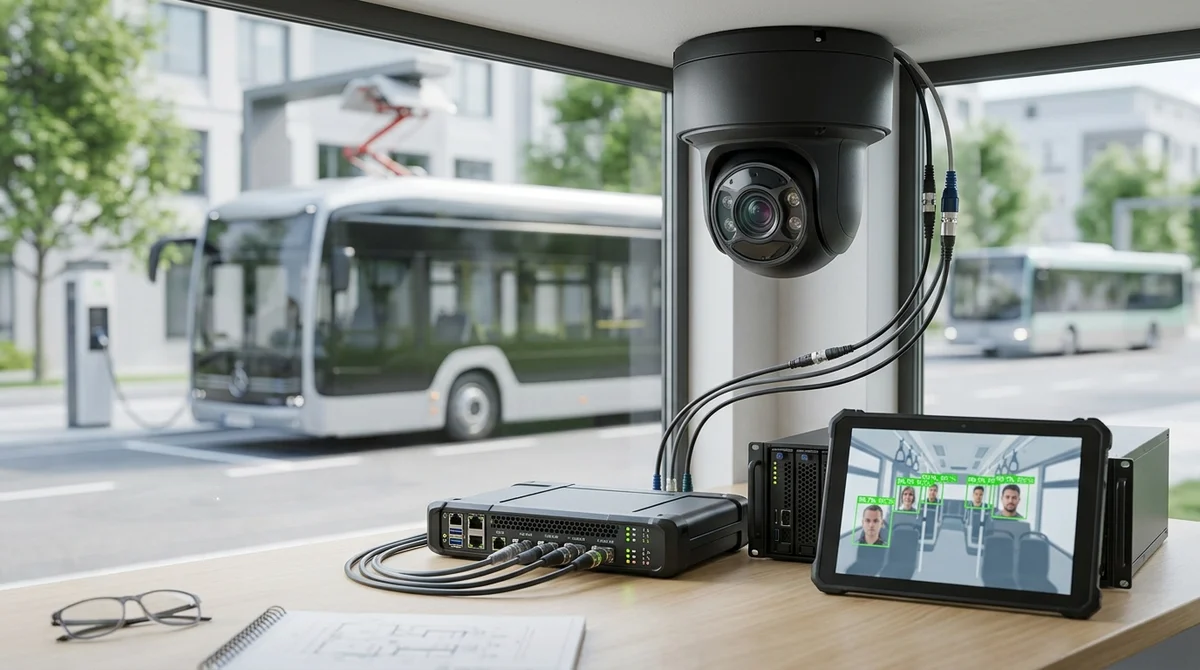
Electric bus operators can recoup facial recognition cameras in 14–23 months
The project to deploy cameras in electric buses received technical and economic justification. The author of the solution described how to achieve facial recognition accuracy above 99.5%, maintain DPDPA compliance, and achieve payback in less than two years.
How the system works
The key idea is to install cameras at face level with a 120-degree field of view. This configuration addresses two of the most problematic scenarios for public transport: passenger boarding and exit, when a face often appears in frame for only a second, and the flow of people creates overlaps. Installing cameras at face level should increase the probability of capturing a clean frame without complex cabin reconstruction. This makes it possible to avoid exotic mounting solutions and complex calibration.
According to the author's calculations, the system can deliver 99.5% or higher accuracy if cameras are properly positioned at entrances and exits. This is important not only for recognition quality but also for reducing the number of disputed triggers.
The fewer false matches and misses, the easier it is to defend the project before transport operators, security services, and lawyers who need clear metrics, not just a demonstration on a pilot without verification in daily operations. This is especially important in the transport environment, since shooting conditions there are worse than in a controlled office or at a checkpoint: lighting changes, people move quickly, faces are partially covered by hoods, glasses, scarves, and other passengers. That's why betting on the geometry of camera placement is almost as important as choosing the recognition model itself.
Otherwise, even a strong algorithm will constantly lose quality on a real data stream.
Data and economics
Special emphasis was placed on handling personal data. In the proposed scheme, images are stored for up to 90 days for debugging within DPDPA requirements, after which they are deleted. This approach is needed to resolve model errors while not turning the system into a permanent archive of biometric data, which creates unnecessary regulatory and reputational risks. For the client, this is an important signal: the project considers not just the model, but the data lifecycle.
For a fleet of 56 buses, the author provides the following economics:
- installation cost — 23.7 million rubles;
- expected effect of additional protection — 12–20 million rubles per year;
- projected ROI — 51–84% annually;
- payback period — 14 to 23 months;
- main intangible benefit — reduction in fine risks, fraud, and reputational losses.
These figures show that the project is being sold not as an experiment for the sake of technology itself, but as an infrastructure tool with clear financial logic. For a transport operator, this might be even more important than the claimed accuracy: cameras and models should not only work, but reduce losses and protect the system from abuses that are difficult to notice without automated monitoring. Without this, even an accurate system risks remaining an expensive pilot without scaling.
Next stage of integration
Currently, the project is in negotiations with a company that provides access to electric bus systems. If an agreement is reached, the team will have a more direct path to integration without excessive rework on each vehicle. This should expand the project's coverage and simplify scaling compared to a scenario where equipment has to be installed and configured almost manually.
This is especially important if the fleet is large and manual installation quickly undermines the project's economics. For this class of solutions, this is a critical stage. Pilot calculations and good metrics are often broken not by model quality, but by lack of access to onboard systems, maintenance processes, and installation budgets.
If integration is built at the supplier or platform partner level, the cost of implementation per transport unit could decrease, and launch in new fleets could accelerate. Based on the description, this seems to be the project's immediate goal.
What this means
The story with cameras for electric buses shows that the market is moving away from abstract conversations about computer vision toward a model where real-world accuracy, regulatory compliance, and implementation economics are paramount. If the integration negotiations succeed, such a solution will have a chance to move from pilot to a scalable transportation product.
Need AI working inside your business — not just in your newsfeed?
I build production AI for companies — custom CRM, internal tools, autonomous agents, workflow automation. Owned by you, shaped to your process, no per-seat tax. Built by Zhemal Khamidun, CPO of AlpinaGPT (AI platform, 6,000+ users).
The AI world, distilled — once a week
Seven stories that actually mattered, hand-picked. No noise, no reposts, no press releases.
Done! Check your inbox for a confirmation.