Russian scientists created a monitoring system for smoke and dust that is 20 times cheaper than a thermal imager
Russian scientists have developed a video surveillance system for extreme conditions: it recognizes a moving person in smoke and dust and, according to the team, can be deployed in just a couple of hours. The key difference is the price: the solution costs 15–20 times less than a thermal imager, making it significantly more accessible for industrial, construction, and emergency sites where such monitoring had previously been too expensive.
AI-processed from CNews AI; edited by Hamidun News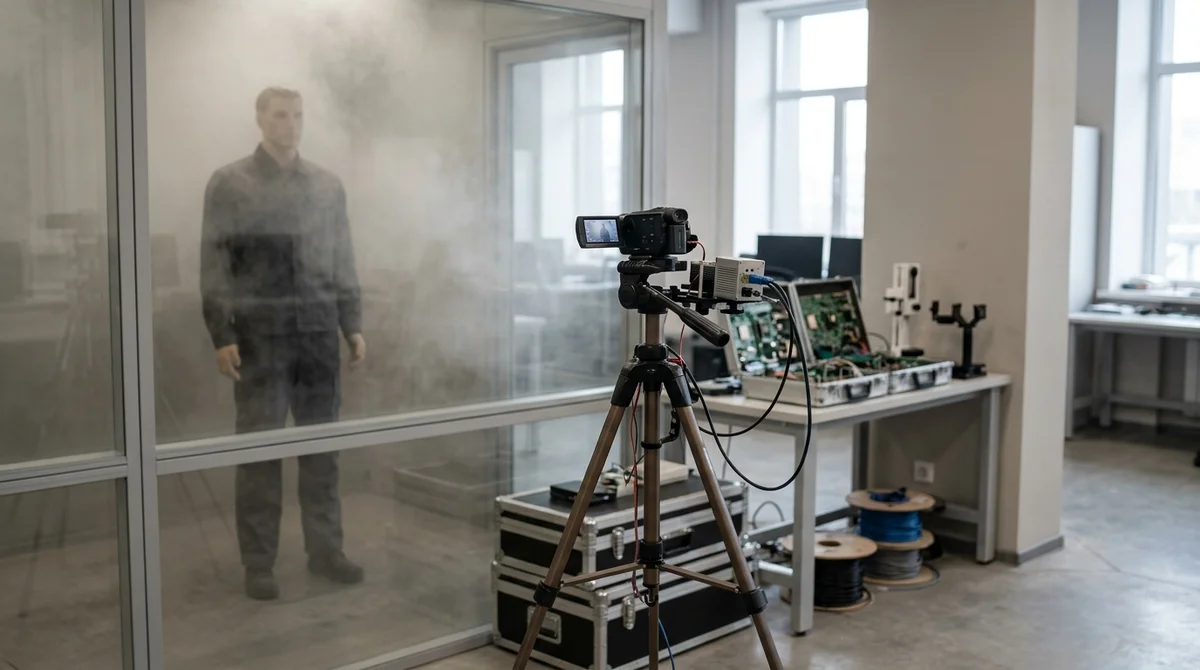
Russian scientists have presented a surveillance system for extreme conditions that can detect a moving person in smoke and dust. Developers claim that the solution deploys in just a couple of hours and costs 15–20 times less than a thermal camera.
How the Solution Works
The main task of such systems is not simply to transmit an image, but to maintain the ability to spot a person where an ordinary camera would be almost useless. Smoke, dust, and airborne particles quickly reduce contrast, blur outlines, and make observation unstable even with good lighting. In this development, AI is used precisely as a processing layer that helps highlight motion and recognize a person in a complex environment where an operator cannot rely on raw video.
The system can "see" a moving person in smoke and dust.
Judging by the description, the solution is designed not for laboratory demonstration but for rapid on-site deployment. This is an important point: in security tasks, speed of deployment is valued as much as accuracy. If the system can truly be installed in a couple of hours, it becomes easier to apply at temporary facilities, construction sites, emergency response zones, and industrial sites where conditions change literally between shifts. Another important aspect is working with a moving person specifically, because for security and industrial safety this is more practical than abstract image improvement.
Economics Instead of Thermal Cameras
The most notable claim is the price. Developers say their system costs 15–20 times less than a thermal camera. For the security market, this is not a cosmetic discount but a difference that could change the purchasing approach itself.
Thermal cameras remain an effective tool, but for many facilities they are too expensive, especially when talking not about one observation point but several cameras, backup systems, installation, and maintenance. From the description, one can conclude that key savings are achieved through more accessible hardware and shifting part of the task to software processing. This is why the solution could prove convenient for upgrading existing infrastructure.
Instead of completely replacing a system, an enterprise gets a chance to add a new analytics layer where it would previously have needed to buy separate thermal imaging complexes. For IT and security teams, this means a faster pilot, fewer budget approvals, and clearer implementation economics, especially when verification is needed across multiple sites at once. This also lowers the barrier to initial deployment and simplifies comparison with thermal camera alternatives.
- Detection of moving persons in smoke and dust
- System deployment in a couple of hours
- Cost 15–20 times lower than a thermal camera
- Potential for rapid scaling across multiple points
Possible Applications
Although the complete list of industries has not been disclosed, use cases are fairly obvious. These could include mines, production facilities, dust-filled warehouses, construction sites, energy infrastructure, and emergency rescue operations. Everywhere visibility is unstable, the task boils down to the same thing: to spot a person as early as possible and signal the operator without building an excessively expensive system around every hazardous area.
The low barrier to entry makes this technology convenient also for pilots, when businesses first test reliability at one facility and then decide whether to scale further. Interest can also be expected from customers who need temporary surveillance during repairs, commissioning, or emergency recovery. In such conditions, mobility, price, and speed of launch matter more than perfect visualization.
If developers have truly closed this bundle of requirements, the solution has a chance to occupy a niche between ordinary cameras and expensive thermal imaging systems, where customers previously often chose between poor visibility and prohibitively high cost.
What This Means
If the development confirms the claimed characteristics in real conditions, it will be a strong example of how AI solves not a flashy but a practical security problem. A cheaper alternative to thermal cameras could significantly expand the market for such systems and make monitoring in complex environments accessible not only to large enterprises with big budgets but also to those who previously simply could not afford such technologies. For the industry, this is a signal that computer vision is increasingly turning from an experiment into a working tool.
Need AI working inside your business — not just in your newsfeed?
I build production AI for companies — custom CRM, internal tools, autonomous agents, workflow automation. Owned by you, shaped to your process, no per-seat tax. Built by Zhemal Khamidun, CPO of AlpinaGPT (AI platform, 6,000+ users).
The AI world, distilled — once a week
Seven stories that actually mattered, hand-picked. No noise, no reposts, no press releases.
Done! Check your inbox for a confirmation.