Russian scientists propose cooling for AI data centers that cuts electricity use by up to 22%
Russian scientists have developed an approach to cooling data centers with AI workloads in which waste heat from server racks is not discarded, but integrated into an adsorption cooling cycle. The solution is based on mesoporous silica gel. According to the study, such a scheme can reduce the energy consumption of cooling systems by up to 22%, which is especially important for dense GPU racks and new facilities with high computing loads.
AI-processed from CNews AI; edited by Hamidun News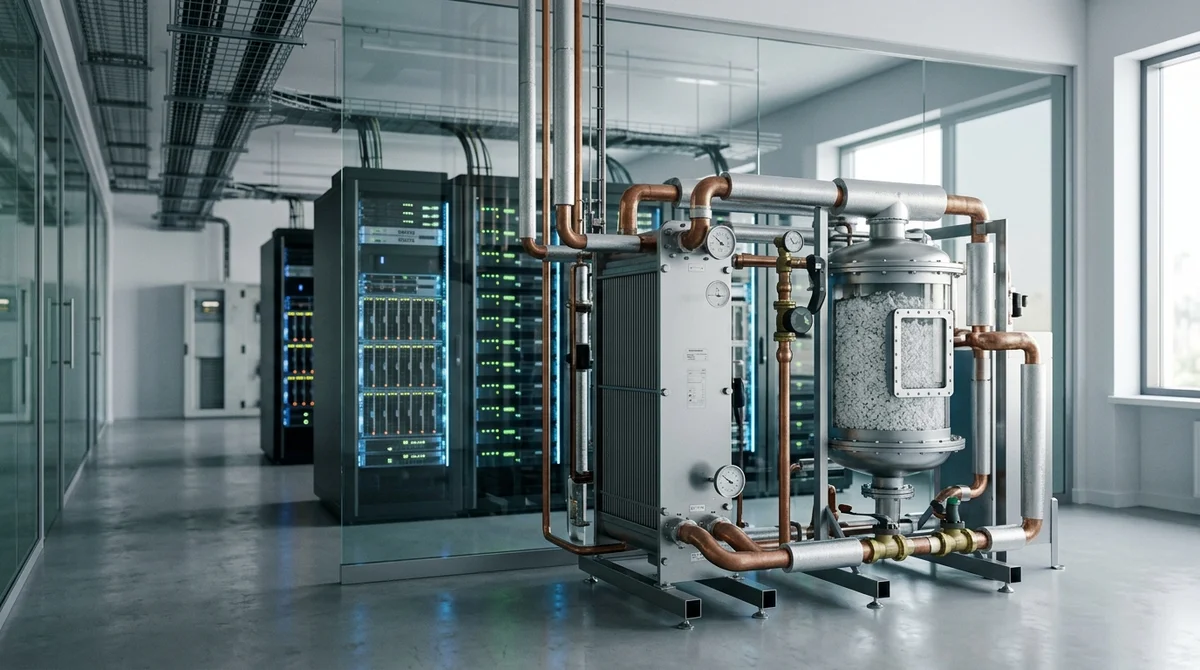
Russian scientists have proposed a new approach to cooling data centers where dense server racks operate for artificial intelligence tasks. Instead of simply removing excess heat outward, the system reuses it and can thereby reduce cooling energy consumption by up to 22%.
How the system works
The main idea is that heat from AI servers is not viewed as a side effect that must be eliminated at any cost, but rather as a useful resource. The approach is based on adsorption cooling using structures based on mesoporous silica gel. This material has a developed internal surface and is suitable for processes where the ability to efficiently bind and release the working medium in the cooling cycle is important. This makes it an interesting candidate for energy-efficient engineering systems.
To simplify, the system works like this: high-density server racks generate significant heat, which is directed into a cooling circuit and helps maintain the adsorption cycle. This removes some load from the more energy-intensive elements of traditional refrigeration infrastructure. For data centers with AI accelerators, this is particularly relevant, because cooling is increasingly becoming one of the main factors in operational expenses. The denser the equipment is packed, the more noticeable the effect of any engineering optimization.
Where the savings come from
Traditional cooling systems in data centers often require significant electricity costs, because they must continuously remove heat from servers and maintain stable equipment operation. In the new system, part of the energy is not spent anew, but is extracted from heat already accumulated within the object itself. According to the study, it is precisely this shift in logic — from "dump heat" to "reuse heat" — that gives the potential for savings of up to 22%. This is especially important where thermal load remains at a high level almost constantly.
- Reuse of waste heat from server racks
- Reduced load on traditional compressor-based cooling elements
- Higher efficiency in scenarios with dense AI equipment placement
- Potential reduction in operational electricity costs
That said, the 22% figure is not a universal guarantee for any data center. Final efficiency will depend on rack density, the architecture of engineering systems, external environment temperature, and how deeply the new system is integrated into existing infrastructure. But even the order of magnitude of the savings shows why the market is increasingly looking not only for more powerful chips, but also for new ways to manage their heat dissipation. For operators, this is no longer a theoretical topic, but a matter of scaling economics.
Where it's applicable
This development is most interesting for platforms where the share of computing for training and running AI models is growing. GPU servers and other accelerators create very high thermal load per unit area, so standard cooling approaches start to hit cost-of-operation limits. If part of this problem can be solved through materials and circuits that reuse internal heat, the economics of new facilities and racks become noticeably more attractive. This is especially important for projects where each additional megawatt of power quickly becomes a permanent expense.
It's also important to note that this is not yet about a mass-market ready product that could be deployed in any server room tomorrow, but rather about a technological approach confirmed by research. What typically follows are pilot deployments, reliability testing under continuous load, assessment of maintenance costs, and comparison with alternatives such as liquid cooling or more efficient chillers. But the direction looks practical: it addresses real pain points in AI infrastructure, not offering abstract optimization for presentation's sake. If pilots confirm the calculations, interest in such systems will quickly move beyond laboratories.
What it means
As AI data centers grow, cooling becomes as important a part of computational strategy as GPU selection or network architecture. If technologies like adsorption cooling based on mesoporous silica gel confirm their claimed effect in real-world operation, operators will be able to build denser and more cost-effective facilities without proportional increases in electricity bills. For the market, this is a signal: the push for AI efficiency is no longer just at the level of models and chips, but also at the level of engineering infrastructure.
Key Questions Answered
How the system works?
The main idea is that heat from AI servers is not viewed as a side effect that must be eliminated at any cost, but rather as a useful resource. The approach is based on adsorption cooling using structures based on mesoporous silica gel. This material has a developed internal surface and is suitable for processes where the ability to efficiently bind and release the working medium in the cooling cycle is important. This makes it an interesting candidate for energy-efficient engineering systems. To simplify, the system works like this: high-density server racks generate signi
Where the savings come from?
Traditional cooling systems in data centers often require significant electricity costs, because they must continuously remove heat from servers and maintain stable equipment operation. In the new system, part of the energy is not spent anew, but is extracted from heat already accumulated within the object itself. According to the study, it is precisely this shift in logic — from "dump heat" to "reuse heat" — that gives the potential for savings of up to 22%. This is especially important where thermal load remains at a high level almost constantly. Reuse of waste heat from
Where it's applicable?
This development is most interesting for platforms where the share of computing for training and running AI models is growing. GPU servers and other accelerators create very high thermal load per unit area, so standard cooling approaches start to hit cost-of-operation limits. If part of this problem can be solved through materials and circuits that reuse internal heat, the economics of new facilities and racks become noticeably more attractive. This is especially important for projects where each additional megawatt of power quickly becomes a permanent expense. It's also im
Build & Ship Production AI Agents Without Boilerplate Code
Start your free 72-hour trial at Hamidun Academy (academy.hamidun.com) — interactive lessons on Claude Code & Cursor, live Tech Radar, and production agent templates.
The AI world, distilled — once a week
Seven stories that actually mattered, hand-picked. No noise, no reposts, no press releases.
Done! Check your inbox for a confirmation.