Fujitsu to have Rapidus build a 1.4nm AI chip, aims to pair it with Nvidia GPUs in servers by 2030
Fujitsu is preparing a 1.4nm chip for AI infrastructure and wants Japan's Rapidus to manufacture it. The chip is a server NPU focused on high performance and low power consumption. The project is still at an early stage: Rapidus has not yet built a fab for this process node, but the Japanese government may cover up to two-thirds of development costs.
AI-processed from 3DNews AI; edited by Hamidun News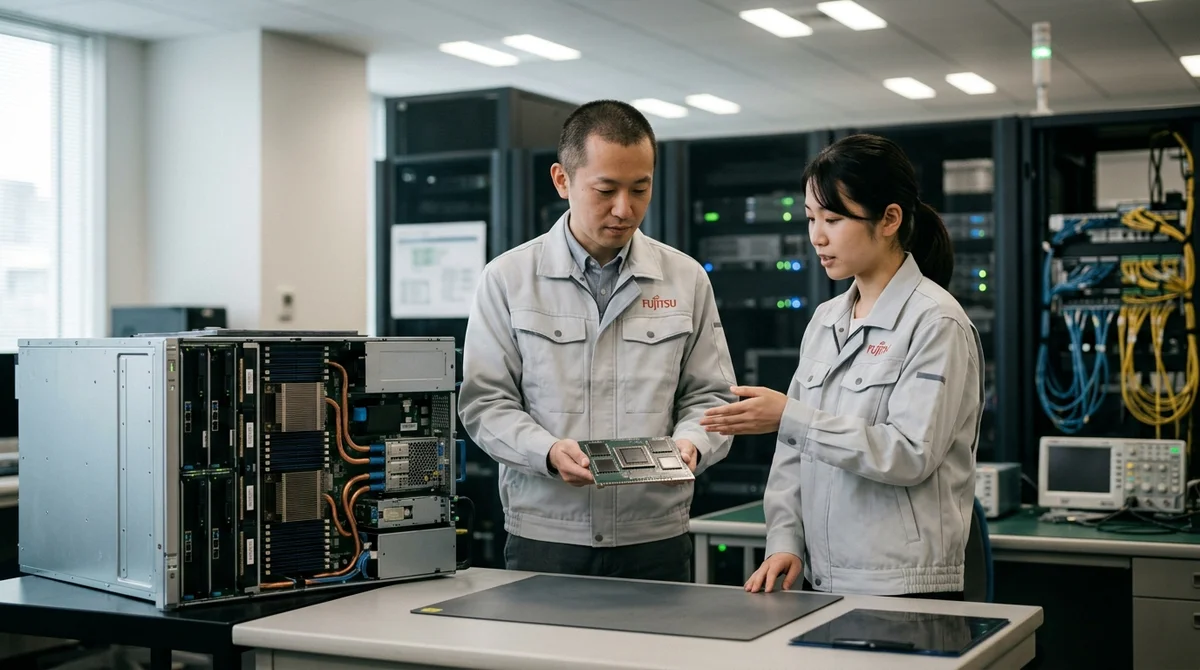
Fujitsu plans to develop a 1.4nm chip for AI infrastructure and have Japan's Rapidus manufacture it. If the project reaches production, it would be a rare case where both the design and the leading-edge fabrication of an AI chip stay inside Japan.
What Fujitsu is building
The company is betting not on a general-purpose processor but on a specialized neural accelerator for server systems. This NPU is meant to deliver high performance in AI workloads at more moderate power consumption, which matters especially for data centers, where the cost of power and cooling has already become one of the main constraints. The logic is clear: the market is gradually shifting from the race to train giant models toward mass-scale inference, where the winner is determined not only by raw speed but by efficiency per watt.
- 1.4nm process for the future AI chip
- Focus on server infrastructure, not consumer devices
- Emphasis on high performance at low power consumption
- Hardware data encryption as part of the architecture
Notably, Fujitsu is not trying to cut itself off completely from the American ecosystem. The company already works with AMD, and by 2030 it wants to combine its own chips with Nvidia GPUs on a single substrate. This looks less like a drive toward isolation and more like an attempt to secure a stronger position in the supply chain: keep a critical component in its own hands and embed it in familiar AI infrastructure, where GPUs still play the central role.
Where the weak points are
For now, the project is more a strategic plan than a product close to launch. Fujitsu is only about to start development, and the Rapidus facility capable of producing 1.4nm chips has not even been built yet. Moreover, Rapidus intends to begin building its second fab in Japan only in fiscal 2027. That means a long chain of technical, financial and organizational risks lies between today's announcements and actual deliveries, and schedules can slip at every link.
Then there is the money. The first stage of developing the 1.4nm chip for Fujitsu alone is estimated at roughly $363 million, and the Japanese government may cover two-thirds of that sum through the NEDO program. Such support shows this is not simply one company's commercial project. For the state, it is a question of technological sovereignty: if AI becomes the new baseline infrastructure, dependence on other countries' chips, fabs and roadmaps turns into a strategic vulnerability.
Why this matters to Rapidus
For Rapidus, the deal with Fujitsu matters no less than it does for the chip designer. The company was created as a national attempt to return Japan to the club of leaders in advanced semiconductor manufacturing, but any such ambitious plan comes down to one simple question: who will actually be the customer. Rapidus is already looking for orders among Japanese corporations tied to it through capital and the industrial ecosystem. Canon's interest in the 2nm process was the first signal, and the Fujitsu project could be a much more significant marker of trust.
The point is not only to fill the future fab. If Rapidus really wins an order to produce a 1.4nm AI chip, it will show that Japan is assembling a full chain of customer, designer, manufacturer and government funding. Given Nvidia's dominance in AI infrastructure, this bet looks pragmatic: competing head-on across the board is too expensive, but a narrowly specialized accelerator for inference, data security and energy savings in server racks is feasible.
What it means
Fujitsu and Rapidus are playing a long game: building not just another AI chip but a Japanese production chain for the next generation of accelerators. If the plan works, the country gets an important precedent for the era of AI infrastructure. If it does not, the market still gets a clear answer on how hard it is to catch up with the leaders, even with backing from the state and large corporations.
- Nov 1, 2026Local models lose to Opus and Codex: 0.21 on a MacBook versus 1.00 for Codex
- Nov 1, 2026Habr author fine-tunes YOLOv8l on dental X-rays and pushes mAP50 to 0.642
- Nov 1, 2026Voice bots built on LLMs turn to Jev, a fast classifier, for decisions in 200–500 ms
- Nov 1, 2026MoneyGate safety layer blocked all 42 fraudulent requests to local AI models
Key Questions Answered
What Fujitsu is building?
The company is betting not on a general-purpose processor but on a specialized neural accelerator for server systems. This NPU is meant to deliver high performance in AI workloads at more moderate power consumption, which matters especially for data centers, where the cost of power and cooling has already become one of the main constraints. The logic is clear: the market is gradually shifting from the race to train giant models toward mass-scale inference, where the winner is determined not only by raw speed but by efficiency per watt. 1.4nm process for the future AI chip F
Where the weak points are?
For now, the project is more a strategic plan than a product close to launch. Fujitsu is only about to start development, and the Rapidus facility capable of producing 1.4nm chips has not even been built yet. Moreover, Rapidus intends to begin building its second fab in Japan only in fiscal 2027. That means a long chain of technical, financial and organizational risks lies between today's announcements and actual deliveries, and schedules can slip at every link. Then there is the money. The first stage of developing the 1.4nm chip for Fujitsu alone is estimated at roughly $
Why this matters to Rapidus?
For Rapidus, the deal with Fujitsu matters no less than it does for the chip designer. The company was created as a national attempt to return Japan to the club of leaders in advanced semiconductor manufacturing, but any such ambitious plan comes down to one simple question: who will actually be the customer. Rapidus is already looking for orders among Japanese corporations tied to it through capital and the industrial ecosystem. Canon's interest in the 2nm process was the first signal, and the Fujitsu project could be a much more significant marker of trust. The point is n
Test Frontier LLMs & Autonomous Agents in One Workspace
Run Claude Opus 5.5, GPT-6, Gemini 3.1, and DeepSeek side-by-side in Nomad AI (nomadnet.ai) — unified model routing, deep research, and multimodal workflows under one subscription.
The AI world, distilled — once a week
Seven stories that actually mattered, hand-picked. No noise, no reposts, no press releases.
Done! Check your inbox for a confirmation.