Hermeus raises $350 million at $1 billion valuation to build autonomous hypersonic fighters
Hermeus has closed a $350 million round at a $1 billion valuation, making it the newest defense-tech unicorn. In March, the company flew an F-16-sized demonstrator, and it is now preparing a third aircraft. Its core bet is fast iteration. The team plans for hardware failures as a built-in part of the development cycle so it can move faster toward autonomous hypersonic platforms.
AI-processed from TNW; edited by Hamidun News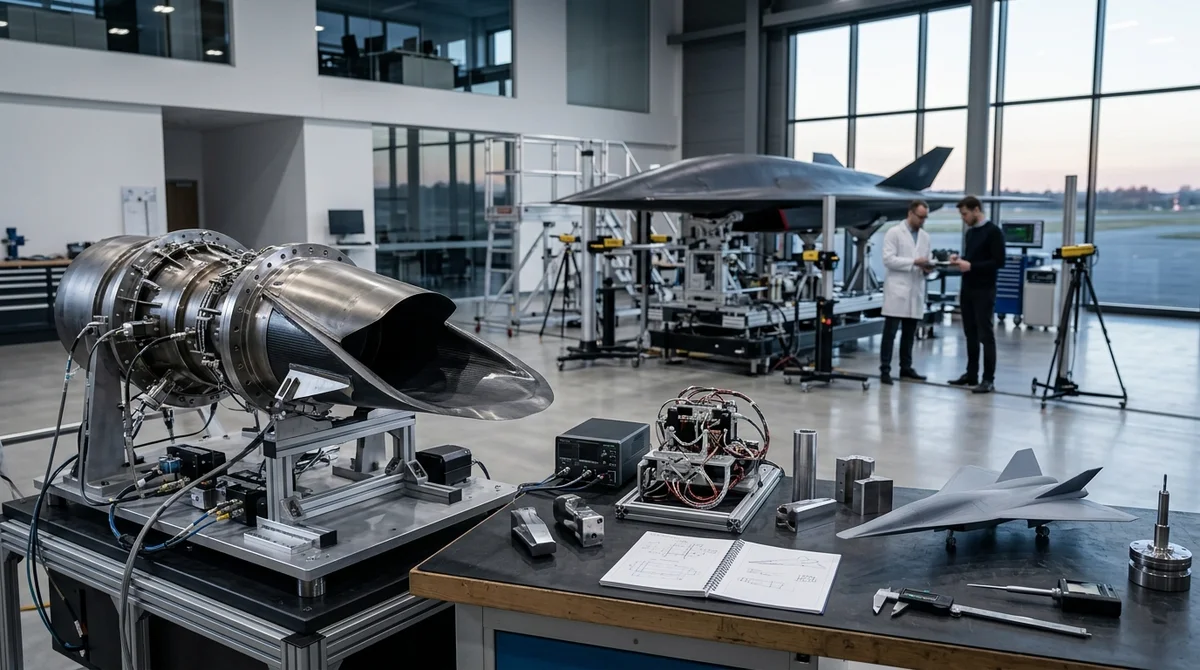
Hermeus has closed a $350 million round at a $1 billion valuation, joining the unicorn club. The money will fund development of autonomous hypersonic combat aircraft. The company already flew an F-16-sized demonstrator in March.
The round and the ambition
The Los Angeles startup works where aviation, defense technology and autonomous systems meet. The size of the round isn't the only thing that makes it significant. For Hermeus, it confirms that investors will back extremely difficult hardware if a team shows fast progress in real-world testing. The company has moved past pitch decks and renders: it has already flown a large demonstrator, and it is building a third aircraft at the same time.
The $1 billion valuation puts Hermeus among the most visible players in the new wave of defense-tech startups. The company aims to build aircraft that can operate autonomously and fly at hypersonic speeds, meaning faster than roughly five times the speed of sound. For systems in this class, the engine and materials matter, but so do flight control, stability, thermal protection and reliable onboard automation. That is why the market sees Hermeus as an attempt to radically compress the development cycle for combat aircraft, not just another experiment.
Betting on iteration
CEO AJ Piplica puts the approach bluntly: if you want to build hypersonic aircraft quickly, you have to accept up front that some hardware will break, and build that into the process. In aviation, and especially in defense programs, that is an almost countercultural position. The traditional model calls for long approval stages and minimizing risk as much as possible before the first serious test. Hermeus does the opposite and pulls risk forward. That way it finds weak points faster and doesn't spend years on perfect documentation with no flight data.
"If you build at this pace, you have to plan for hardware failure as
part of the plan."
Under this logic, the company already has a clear production rhythm:
- get a working demonstrator into the air first instead of waiting for a fully finished platform;
- build the next aircraft in parallel while the current one is still in testing;
- treat failed components as data for the next iteration, not as disasters;
- flight-test not a single component but the combination of airframe, controls, propulsion and autonomous functions.
This approach may look risky, but it is exactly what separates today's engineering race from the old 10-to-15-year defense cycles. That said, the March flight of an F-16-sized demonstrator does not yet prove a ready autonomous hypersonic fighter. It is better read as a signal that the company can already build, test and scale real aircraft quickly, not just individual subsystems in a lab.
What the March flight tested
The flight of an F-16-sized aircraft matters on its own terms. This isn't a small test-stand article; it's a platform close in size to a full combat aircraft. For a startup, that's a strong argument when talking to investors and potential customers.
Another key marker: the third aircraft is already in development. That means Hermeus isn't building a one-off prototype for headlines. It is building a sequential test lineup in which each airframe sets up the next step.
The main question now is how quickly the company can turn its prototyping pace into a mature system. Hypersonic flight has a high complexity bar: extreme heating, structural loads, control stability at high speeds and autonomy requirements in combat environments. But if Hermeus keeps its current speed and testing discipline, it has a chance to set a new norm in a market where large programs often stalled before a flying article ever appeared.
What it means
The Hermeus round shows that investors are increasingly willing to fund defense startups that prove progress with hardware in the air, not promises. If the model works, developing complex military aircraft will look more like a fast cycle of engineering iterations than a closed, decade-long megaproject.
- Nov 2, 2026Karpathy builds a YouTube clone with 6454 videos from Hacker News recommendations in two hours
- Nov 2, 2026Karpathy used Claude to build HackerTube from 6,454 videos recommended on Hacker News
- Nov 2, 2026Arca gives AI agents finance tasks lasting up to 10 days, but leaves the trades to humans
- Nov 2, 2026DeepSeek open-sources Super-agent prototype: p95 task completion time of 15.7 minutes vs. 29.5
Key Questions Answered
What are the key details on The round and the ambition?
The Los Angeles startup works where aviation, defense technology and autonomous systems meet. The size of the round isn't the only thing that makes it significant. For Hermeus, it confirms that investors will back extremely difficult hardware if a team shows fast progress in real-world testing. The company has moved past pitch decks and renders: it has already flown a large demonstrator, and it is building a third aircraft at the same time. The $1 billion valuation puts Hermeus among the most visible players in the new wave of defense-tech startups. The company aims to buil
What are the key details on Betting on iteration?
CEO AJ Piplica puts the approach bluntly: if you want to build hypersonic aircraft quickly, you have to accept up front that some hardware will break, and build that into the process. In aviation, and especially in defense programs, that is an almost countercultural position. The traditional model calls for long approval stages and minimizing risk as much as possible before the first serious test. Hermeus does the opposite and pulls risk forward. That way it finds weak points faster and doesn't spend years on perfect documentation with no flight data. "If you build at this
What the March flight tested?
The flight of an F-16-sized aircraft matters on its own terms. This isn't a small test-stand article; it's a platform close in size to a full combat aircraft. For a startup, that's a strong argument when talking to investors and potential customers. Another key marker: the third aircraft is already in development. That means Hermeus isn't building a one-off prototype for headlines. It is building a sequential test lineup in which each airframe sets up the next step. The main question now is how quickly the company can turn its prototyping pace into a mature system. Hyperson
Ship AI Faster with Founders, Engineers & Weekly Architecture Reviews
Inside Vibe Club (hamidun.com/club) — weekly live masterminds with Zhemal Khamidun, Tech Radar, full LMS access, and 370+ production Claude Code skills.
The AI world, distilled — once a week
Seven stories that actually mattered, hand-picked. No noise, no reposts, no press releases.
Done! Check your inbox for a confirmation.