OpenClaw gets a Go reimplementation: one 35 MB binary instead of 800 MB of dependencies
A standalone Go version of OpenClaw has appeared, called GoClaw. Instead of a Node.js stack and hundreds of megabytes of dependencies, it runs as a single 35 MB binary, uses 3–5 times less RAM and suits low-end VPS better. The ecosystem is another matter: the project is young and not compatible with Skills from the original OpenClaw.
AI-processed from Habr AI; edited by Hamidun News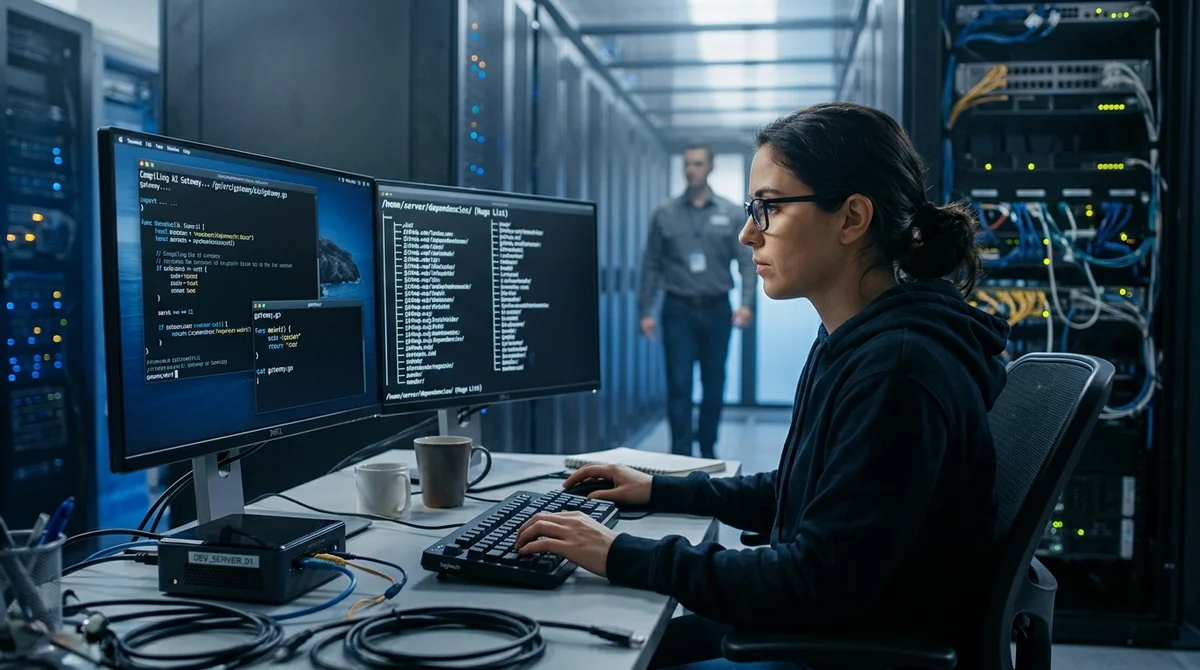
OpenClaw, which has collected about 180 thousand stars on GitHub, now has an independent reimplementation in Go. The new project, called GoClaw, promises to remove the main pain points of the Node.js version: heavy dependencies, an extra runtime and complicated deployment on weak servers.
Why GoClaw exists
The main complaint about OpenClaw is not about features but about packaging. To run the original project you need Node.js, npm, the repository itself and a large set of installed dependencies that can grow to 500–800 MB. In practice this means a slow first launch, version conflicts, problems with native modules and more points of failure when you need to deploy the service quickly on a VPS, a mini PC or a Raspberry Pi.
GoClaw solves this as directly as possible: instead of an ecosystem of a runtime and node_modules, the user gets a single statically built binary of about 35 MB. You can simply download it, make it executable and start using it right away. For tools that must sit in the background 24/7 and wait for messages from Telegram, Discord or other channels, this format noticeably lowers the barrier to entry and simplifies maintenance.
How the project is built
GoClaw is not a fork or a thin wrapper around the original, but a version of the multi-agent AI gateway rewritten from scratch. The project connects to messengers, works with several LLM providers and bets on Go's built-in concurrency. The article presents this as a more natural foundation for agent scenarios with many parallel requests, waits for API responses and coordination between roles.
- A single binary of about 35 MB
- Support for 11+ LLM providers
- Works through 5 communication channels, including Telegram and Discord
- Multi-agent system with delegation and orchestration
- Kanban board for managing agent tasks
The architecture is built around several specialized agents. One designs the solution, another writes code, a third checks tests and a fourth handles review. A high-level task is decomposed automatically, and the stages are then placed on an internal kanban board. This looks natural in Go: goroutines and channels let you keep many parallel chains running without extra complexity, whereas in Node.js this is usually tied to the event loop and promises.
Gains and limitations
GoClaw offers not only compactness but also cheaper operation. The material reports memory consumption 3–5 times lower than the Node.js version with comparable functionality. This matters especially for cheap VPS plans with 512 MB or 1 GB of RAM, where every always-running process quickly eats up resources. Containerization also benefits: an image with a Go application can be built from almost just the binary, whereas a Node.js service usually drags along a heavier base and the entire dependency directory.
But the switch has a price. OpenClaw is strong not only in code but in a mature ecosystem: a large community, 180K+ stars, established plugins, Skills and integrations. GoClaw is still young, with fewer users and less production testing. There is almost no compatibility between the ecosystems: existing Skills from OpenClaw cannot simply be picked up and moved over.
So the choice depends on the task: if you need a minimalist service for background work, the Go version looks sensible; if plugins, customization and community matter, the original is for now clearly stronger.
What this means
The GoClaw story shows a broader trend: AI tools are increasingly judged not only by model quality but by the cost of running them. If an agent must work reliably in the background, deploy quickly and not require hundreds of megabytes of dependencies, Go becomes an ever more practical choice.
But the language's win is not absolute: ecosystem and product maturity can still outweigh pure engineering efficiency.
- Nov 27, 2026OpenAI Fixes Codex Limit Bug: Quotas Are 25–40% Smaller
- Nov 27, 2026An AI agent turned a 200-line feature into 8,391 lines: boredom no longer stops overengineering
- Nov 27, 2026Deft Library Gives AI Agents Hundreds of Design Skills from 142 Authors Across 27 Categories
- Nov 27, 2026From February 2027, AI agents can reach Gmail only through Google's MCP servers, and they can't send email
Key Questions Answered
Why GoClaw exists?
The main complaint about OpenClaw is not about features but about packaging. To run the original project you need Node.js, npm, the repository itself and a large set of installed dependencies that can grow to 500–800 MB. In practice this means a slow first launch, version conflicts, problems with native modules and more points of failure when you need to deploy the service quickly on a VPS, a mini PC or a Raspberry Pi.
How the project is built?
GoClaw is not a fork or a thin wrapper around the original, but a version of the multi-agent AI gateway rewritten from scratch. The project connects to messengers, works with several LLM providers and bets on Go's built-in concurrency. The article presents this as a more natural foundation for agent scenarios with many parallel requests, waits for API responses and coordination between roles.
What are the key details on Gains and limitations?
GoClaw offers not only compactness but also cheaper operation. The material reports memory consumption 3–5 times lower than the Node.js version with comparable functionality. This matters especially for cheap VPS plans with 512 MB or 1 GB of RAM, where every always-running process quickly eats up resources. Containerization also benefits: an image with a Go application can be built from almost just the binary, whereas a Node.js service usually drags along a heavier base and the entire dependency directory.
Free 2-Day Vibecoding & AI Agents Intensive
Day 1: the autonomous Hermes + DeepSeek AI agent — vibecoding and development on par with Claude Code / Codex / Gemini. Led by Jemal Hamidun, Head of AI at Alpina Digital and academic supervisor at MIPT. Right after you register with our bot Nika: the recording + 11 materials from the previous intensive.
Daily 60-sec AI Voice Brief + Weekly Production AI Agent Playbook
Listen to a 60-second AI news brief every morning and get a weekly hands-on playbook for shipping AI agents to production — tools, MCP servers and patterns that work. Curated by Jemal Hamidun, Head of AI at Alpina Digital.
