Alibaba leads 2 billion yuan round for ShengShu in China's AI video race
Alibaba Cloud led a 2 billion yuan round, or about $293 million, for ShengShu Technology, a young player in the AI video market. The deal gives the startup a substantial cushion for compute, hiring and product launches. For China's market, it is a signal: video generation is entering a phase of big infrastructure bets, where winners are decided not only by ideas but by access to cloud capacity and capital.
AI-processed from Bloomberg Tech; edited by Hamidun News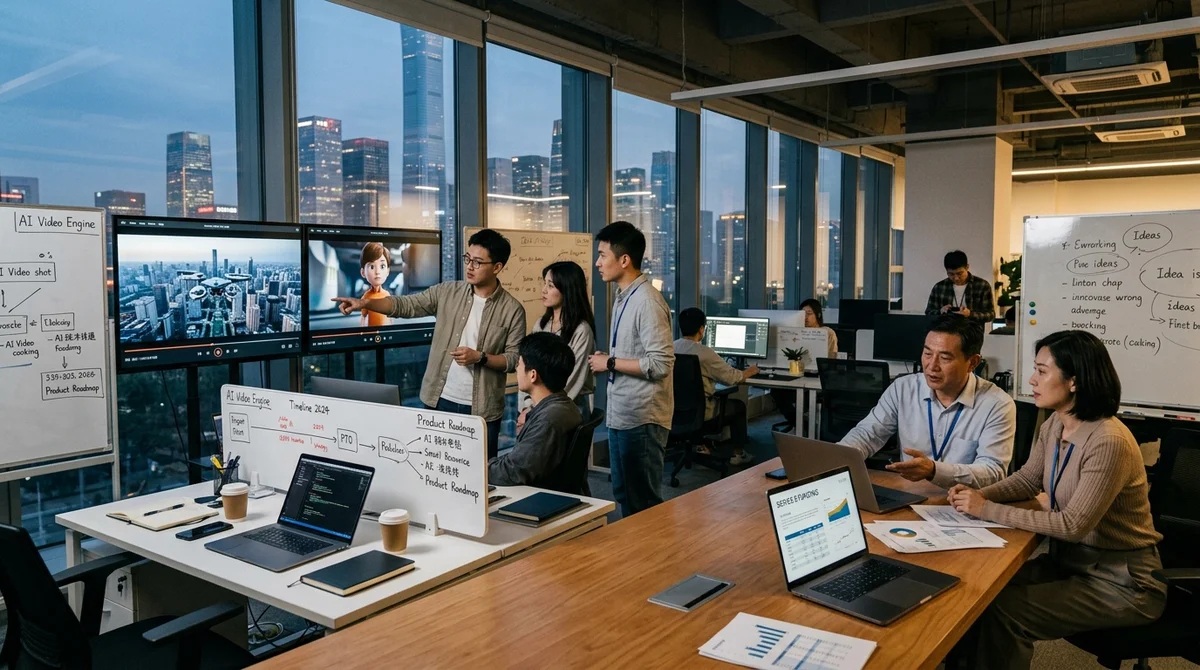
Alibaba Cloud led a 2 billion yuan funding round, or about $293 million, for ShengShu Technology, a young player in China's AI video market. The deal shows that the fight over video generation in China is quickly moving from experiments to big budgets, infrastructure alliances and fierce competition on scale.
Alibaba's big bet
The round was led by the cloud arm of Alibaba Group Holding, and that detail matters on its own. When an AI startup is backed not by a pure financial investor but by a major cloud player, the story is usually about more than capital. Such a partner can provide access to compute, commercial channels and a technical ecosystem, without which AI video is hard to scale today.
For ShengShu, this means more than a topped-up bank account. It means a stronger starting position in a race where speed to market often matters more than a polished demo reel.
The amount also says a lot. Two billion yuan is a round that gives the company a meaningful buffer against the high cost of developing generative video models. Training, inference, data storage, quality optimization and latency reduction all demand large, ongoing spending. For a young company, this kind of capital means not having to survive from one stage to the next, but being able to plan several moves ahead: expand the team, build up compute and bring the technology to a commercial product faster.
Where the money will go
The article itself does not disclose a detailed breakdown of spending, but the logic of such rounds is fairly clear. AI video is one of the heaviest segments of the generative market in terms of infrastructure costs, quality datasets, inference acceleration and constant model fine-tuning. So the funds will most likely help ShengShu strengthen its technology base, handle growing request volumes and move into a broader market faster, without constantly cutting corners on key parts of the product.
- renting or buying compute for training and serving video models
- hiring engineers, researchers and product teams who can improve generation quality faster
- launching new features and pricing tiers for commercial customers, if the company moves toward B2B monetization
- deeper integration with Alibaba's cloud infrastructure and partner ecosystem
It is also worth noting that in this sector, money is not just fuel for research. It buys time, flexibility and the right to several product iterations in a row. In an overheated market, that is critical: the company can test use cases for longer, avoid trimming its ambitions because of GPU costs, withstand price pressure and avoid losing to rivals simply because they got access to large compute resources earlier.
An overheated video market
China's AI video market already looks like a space where a technology race and a fight for capital run in parallel. In these conditions, the winner is not necessarily the one who first showed an impressive clip. What matters far more is who can hold quality on longer videos, cut the cost of generation, scale the service to a flood of requests and quickly turn a model into a clear product. That is why Alibaba Cloud's participation can be read as a bet not only on ShengShu's technology but on its chances of keeping up with the market's pace.
For Alibaba itself, the move also looks strategic. Cloud providers want strong AI applications growing next to their infrastructure, creating steady demand for compute. Backing a promising video developer gives Alibaba a way to gain a foothold in one of the most resource-hungry segments of generative AI. For ShengShu, this in turn may mean faster access to scale, and for other players, a new signal that they will have to compete not only with ideas but with access to major technology partners.
What it means
ShengShu's round shows that China's AI video market is entering a phase where the winners are not the loudest demos but teams with money, infrastructure and partnerships. Alibaba Cloud's backing gives the company weight in this race and also confirms a broader trend: video generation is becoming a separate, major category of AI business, one decided not only by models but by the ability to quickly turn them into a large-scale service.
- Nov 2, 2026The Verge reviewer builds a $50 Meta Muse Charm alternative with Claude Code
- Nov 2, 20268 Skills for video in Claude Code: from 244 pixel effects to rough-cut editing
- Nov 1, 2026Pika Labs releases open video model H3 Flex: 6 steps instead of 50
- Nov 1, 2026Google's StreamVibe video agent beats other models by 10.7% on response timing and quality
Key Questions Answered
What are the key details on Alibaba's big bet?
The round was led by the cloud arm of Alibaba Group Holding, and that detail matters on its own. When an AI startup is backed not by a pure financial investor but by a major cloud player, the story is usually about more than capital. Such a partner can provide access to compute, commercial channels and a technical ecosystem, without which AI video is hard to scale today. For ShengShu, this means more than a topped-up bank account. It means a stronger starting position in a race where speed to market often matters more than a polished demo reel. The amount also says a lot. T
Where the money will go?
The article itself does not disclose a detailed breakdown of spending, but the logic of such rounds is fairly clear. AI video is one of the heaviest segments of the generative market in terms of infrastructure costs, quality datasets, inference acceleration and constant model fine-tuning. So the funds will most likely help ShengShu strengthen its technology base, handle growing request volumes and move into a broader market faster, without constantly cutting corners on key parts of the product. renting or buying compute for training and serving video models hiring engineers
What are the key details on An overheated video market?
China's AI video market already looks like a space where a technology race and a fight for capital run in parallel. In these conditions, the winner is not necessarily the one who first showed an impressive clip. What matters far more is who can hold quality on longer videos, cut the cost of generation, scale the service to a flood of requests and quickly turn a model into a clear product. That is why Alibaba Cloud's participation can be read as a bet not only on ShengShu's technology but on its chances of keeping up with the market's pace. For Alibaba itself, the move also
Test Frontier LLMs & Autonomous Agents in One Workspace
Run Claude Opus 5.5, GPT-6, Gemini 3.1, and DeepSeek side-by-side in Nomad AI (nomadnet.ai) — unified model routing, deep research, and multimodal workflows under one subscription.
The AI world, distilled — once a week
Seven stories that actually mattered, hand-picked. No noise, no reposts, no press releases.
Done! Check your inbox for a confirmation.