Oxford developed an AI tool to predict heart failure five years in advance
An Oxford team presented an AI tool that detects early signs of heart failure from routine cardiac CT scans. In a study of 72,000 patients in England, the system predicted five-year risk with 86% accuracy. The developers say this assessment could help doctors monitor high-risk patients earlier and choose treatment intensity more precisely.
AI-processed from Guardian; edited by Hamidun News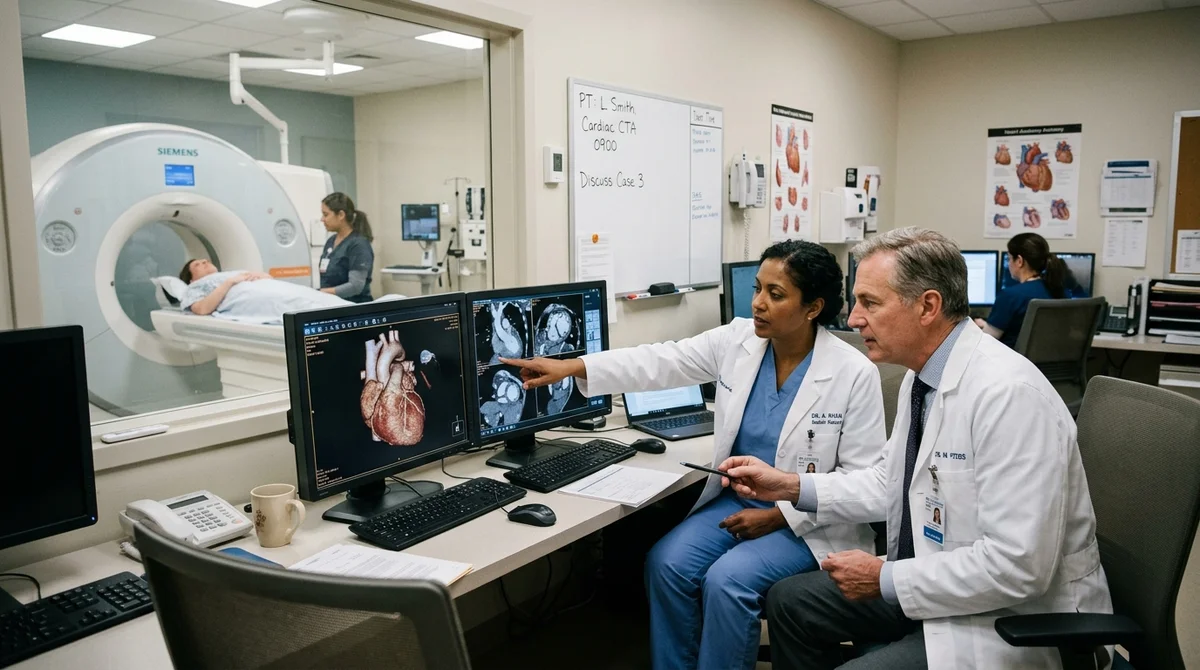
Scientists from Oxford have presented an AI tool that can assess the risk of heart failure at least five years before it develops. The system operates on data from routine cardiac CT scans and, according to research on patients in England, predicts such risk with 86% accuracy.
How it works
The development analyzes not the heart muscle itself, but changes in fatty tissue surrounding the heart. Researchers from Oxford proceed from the assumption that this tissue serves as an early "sensor" of problems: when the heart is inflamed or gradually loses normal function, the structure and composition of the surrounding fat also change. On ordinary scans, a doctor cannot see such microscopic signals, but the algorithm can detect textural patterns and convert them into a numerical risk assessment.
An important detail is that the system does not require rare examinations or a separate complex test. It uses data from standard cardiological CT scans, which in British hospitals are already performed on patients with chest pain and suspected problems with coronary arteries. The algorithm automatically calculates absolute risk without manual input, then provides the doctor with a guideline: who needs closer monitoring, who should have their treatment strategy changed earlier, and who can remain under standard control.
What the research showed
The team trained the model on de-identified CT results from more than 59,000 people from England, and then separately tested it on another 13,424 patients. In total, the study included over 72,000 people from nine NHS hospital trusts, who were monitored for ten years after scanning. Results were published in the Journal of the American College of Cardiology. This design allowed verification not only of concordance with the patient's current state, but also the real ability of the algorithm to predict the development of heart failure several years in advance.
- More than 72,000 patients in the total sample
- 9 NHS hospital trusts in England
- 86% accuracy of risk prediction for five years
- Patients in the top risk group had the disease 20 times more often
- In the maximum risk group, the probability of developing heart failure within five years was about 25%
According to the researchers, it is precisely the patients in the top risk group who can benefit the most: heart failure in them is often detected too late, already after serious damage to the heart muscle. Now the doctor receives not a vague suspicion, but a specific risk assessment that can be used in planning monitoring and treatment. This is particularly important for a condition that affects more than 60 million people worldwide and over one million in the United Kingdom.
"This tool will allow doctors to more accurately decide who needs the most intensive monitoring," says lead researcher
Charalambos Antoniades.
Next implementation stage
The Oxford team is already seeking regulatory approval to integrate the tool into the standard CT analysis process in NHS radiology departments. The idea is pragmatic: not to create a new patient pathway, but to add another layer of interpretation to already existing examinations. According to the researchers, in the United Kingdom alone, approximately 350,000 cardiac CT scans are performed annually, so even partial implementation could provide the health system with a large flow of early signals.
Separately, the developers are working on making the algorithm applicable not only to specialized cardiac CT scans, but also to any chest CT scan performed for another reason. If adaptation to lung CTs is truly ready in the coming months, this would expand the coverage: the risk of heart failure could be detected incidentally, even when a person is examined, for example, due to breathing problems or as part of lung screening.
What this means
Such systems show where medical AI is truly moving: not toward abstract promises, but toward integration into already existing clinical processes. If the Oxford tool receives approval and enters routine practice, ordinary CT scans could work not only as an image for the current complaint, but also as an early warning about a serious disease that previously was often noticed too late, already at the stage of hospitalization or pronounced symptoms.
Need AI working inside your business — not just in your newsfeed?
I build production AI for companies — custom CRM, internal tools, autonomous agents, workflow automation. Owned by you, shaped to your process, no per-seat tax. Built by Zhemal Khamidun, CPO of AlpinaGPT (AI platform, 6,000+ users).
The AI world, distilled — once a week
Seven stories that actually mattered, hand-picked. No noise, no reposts, no press releases.
Done! Check your inbox for a confirmation.