PhenMap and the NHS: AI Flags Bowel Cancer Patients Unlikely to Respond to Bevacizumab
The NHS has only just started using bevacizumab for advanced bowel cancer, and researchers have already shown how AI can screen out patients with no chance of responding. The PhenMap system analyzed data from 117 patients and identified a high-risk group in which the treatment worked for no one. If the method is confirmed, doctors could avoid unnecessary toxicity and move to alternatives faster.
AI-processed from Guardian; edited by Hamidun News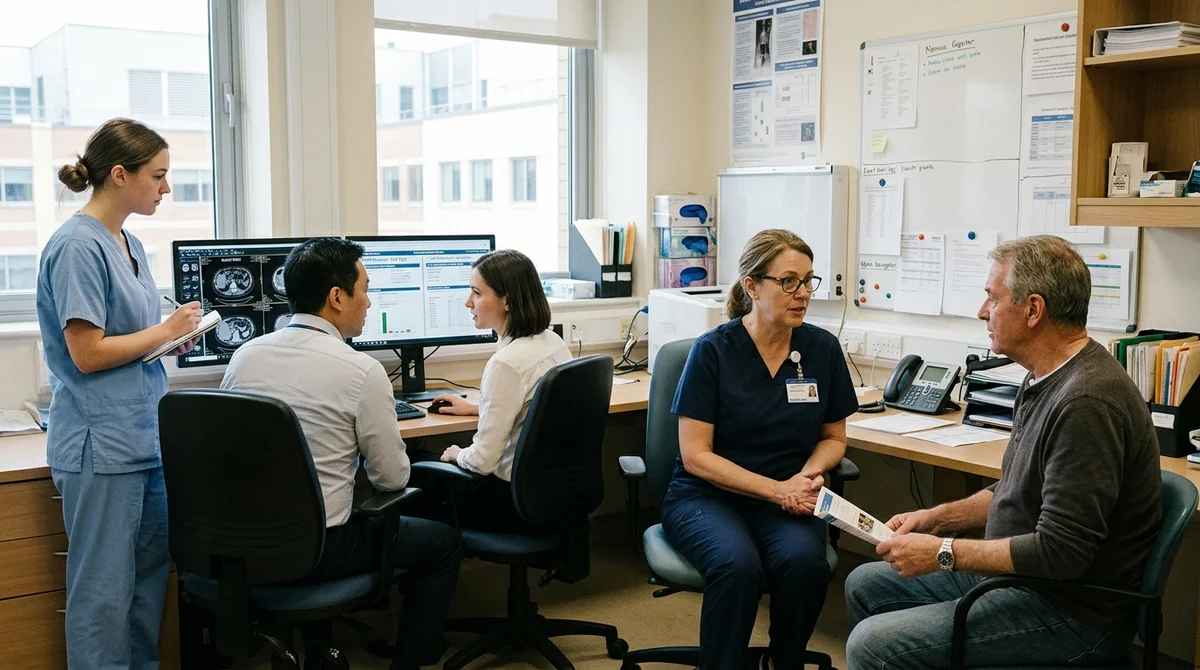
British and Irish researchers have presented an AI approach that helps predict in advance whether bevacizumab will work for a patient with advanced bowel cancer. If the method holds up in larger samples, doctors could prescribe a toxic and expensive treatment less often to people it almost certainly will not help.
How the method works
The Institute of Cancer Research in London and RCSI in Dublin developed the system. Their tool, PhenMap, combines several types of data: the tumor's genetic profile, the patient's clinical parameters and features of the disease itself, including age, sex and the part of the bowel where the tumor sits. Unlike conventional stratification into a few subtypes, the model tries to capture more complex combinations of features and turn them into a practical prediction for an individual patient.
The researchers then ran a second model on top of PhenMap. It assigns each patient a risk group after therapy with bevacizumab combined with chemotherapy. The system sorts patients into high, moderate and low risk, and it estimates not simply the overall severity of the disease but the likelihood that this particular treatment regimen will prove useless. That matters for personalized oncology: the task is not only to find those the drug will help, but also to remove unnecessary treatment from everyone else's care pathway.
What the study found
The team analyzed data from 117 European patients with metastatic colorectal cancer who had already received bevacizumab with chemotherapy. The work was published in Scientific Reports. The model found biomarkers linked to poor treatment response and used them to form prognostic groups. The high-risk group contained no patients who responded to therapy, whereas in the low-risk group 10 of 12 patients responded.
Among the signals the AI picked out, a mutation in the BRAF gene stood out: patients with it landed in the high-risk group and had worse outcomes. The researchers also linked poor prognosis to two chromosomal deletions and used these features as the basis for a future test. The idea is to see, before treatment starts, not only the diagnosis but the molecular profile of a specific tumor's resistance.
For clinicians, this could look like the following:
- before prescribing therapy, the doctor gets not a general "average" prognosis but an individual risk profile
- patients with a high probability of non-response may avoid unnecessary toxicity
- the hospital saves time and resources on treatment that will not work
- for some patients, the path to other regimens or clinical trials opens sooner
Why it matters
The NHS approved bevacizumab for patients with advanced bowel cancer in December, but the drug works in only a limited share of people and can cause serious side effects, including hypertension, gastrointestinal problems and blood clots. England identifies almost 10 thousand cases of this stage each year, and treatment options after the tumor has spread are noticeably fewer. So even a rough preliminary filter based on the likelihood of response already has clinical value.
"Until now, we have not been able to identify in advance the patients for whom the drug is most likely not to work," says
Professor Anguraj Sadanandam.
The authors stress that this is not yet a ready diagnostic test for hospitals. The results must be confirmed in a larger cohort and then tested in a prospective clinical trial. Only after such validation can the model be used for real therapy decisions. In parallel, the team wants to find out whether the same approach can predict response to other targeted drugs and be transferred to other tumor types.
What this means
AI in medicine is increasingly used not for abstract "doctor support" but for a very specific decision: who should not be given heavy therapy with no chance of benefit. If PhenMap passes validation, oncologists will gain a tool that makes treatment more precise, gentler on the patient and more rational for the healthcare system. For the NHS and other systems, it is also a rare case where AI can reduce harm, speed up regimen choice and cut unnecessary costs at the same time.
Key Questions Answered
How the method works?
The Institute of Cancer Research in London and RCSI in Dublin developed the system. Their tool, PhenMap, combines several types of data: the tumor's genetic profile, the patient's clinical parameters and features of the disease itself, including age, sex and the part of the bowel where the tumor sits. Unlike conventional stratification into a few subtypes, the model tries to capture more complex combinations of features and turn them into a practical prediction for an individual patient. The researchers then ran a second model on top of PhenMap. It assigns each patient a ri
What the study found?
The team analyzed data from 117 European patients with metastatic colorectal cancer who had already received bevacizumab with chemotherapy. The work was published in Scientific Reports. The model found biomarkers linked to poor treatment response and used them to form prognostic groups. The high-risk group contained no patients who responded to therapy, whereas in the low-risk group 10 of 12 patients responded. Among the signals the AI picked out, a mutation in the BRAF gene stood out: patients with it landed in the high-risk group and had worse outcomes. The researchers al
Why it matters?
The NHS approved bevacizumab for patients with advanced bowel cancer in December, but the drug works in only a limited share of people and can cause serious side effects, including hypertension, gastrointestinal problems and blood clots. England identifies almost 10 thousand cases of this stage each year, and treatment options after the tumor has spread are noticeably fewer. So even a rough preliminary filter based on the likelihood of response already has clinical value. "Until now, we have not been able to identify in advance the patients for whom the drug is most likely
Test Frontier LLMs & Autonomous Agents in One Workspace
Run Claude Opus 5.5, GPT-6, Gemini 3.1, and DeepSeek side-by-side in Nomad AI (nomadnet.ai) — unified model routing, deep research, and multimodal workflows under one subscription.
The AI world, distilled — once a week
Seven stories that actually mattered, hand-picked. No noise, no reposts, no press releases.
Done! Check your inbox for a confirmation.