Singapore introduces AI in primary school, and Asia debates its benefits
Singapore wants to introduce children to AI as early as primary school, but the cautious rollout has only intensified the debate. Critics note: AI delivers quick answers and short-term results, but may weaken retention, replace real learning, and deepen dependence on screens. Against this backdrop, calls are growing to teach such tools not to younger pupils, but to adults for specific work tasks.
AI-processed from Habr AI; edited by Hamidun News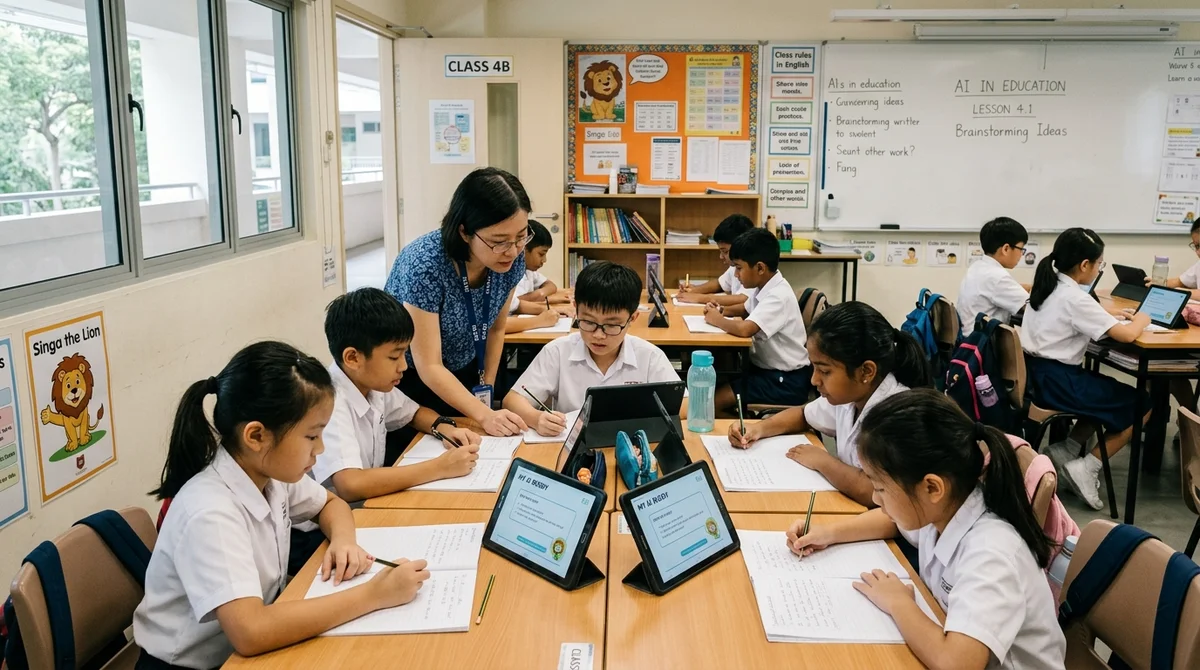
Singapore is planning to introduce children to AI starting from the fourth year of primary school — with the caveat that use will be limited and conducted under teacher supervision. Against the backdrop of similar initiatives across Asia, this once again raises an uncomfortable question: does AI help learning or does it remove too early the mental effort that forms the foundation of education itself.
Why the dispute intensified
The trigger was a statement from Singapore's education minister: schoolchildren are planning to be introduced to AI already in primary school, but in a "strictly controlled" format and with minimal use. In parallel, Beijing is already pushing AI courses for primary and secondary school students as part of the state AI Plus program. For governments, this looks like an attempt not to fall behind in the technology race and to prepare children in advance for a job market where generative models will likely become an everyday tool.
"Under strict control and with minimal use."
But it is precisely in Asia that this discussion is particularly acute. The region has spent many years building economic growth on a strong school system, discipline, and high academic standards. Asian countries regularly top the PISA rankings in mathematics, reading, and natural sciences, and Singapore without school AI already shows one of the best results in the world. So the question here is not just about fashion for a new technology, but about whether education systems will begin to break what was already working better than many others.
Where the system is stuck
The first signals are already there. In South Korea, the AI-assisted learning program was wound down just four months after launch due to resistance from teachers, parents, and students themselves. In Japan, a pilot in one primary school caused more alarm than a sense of progress.
Against this backdrop, the gap between the political desire to appear modern and schools' actual readiness to integrate such tools without compromising basic skills is becoming increasingly noticeable. Criticism is not only rooted in cultural conservatism. The crux of the matter lies in the contradiction itself: AI promises convenience and quick results, while learning requires repetition, friction, errors, and independent assembly of understanding.
Research cited by discussion authors shows that ChatGPT users may perform better on a task here and now, but retain the material worse later. In one test, after 45 days, such participants showed noticeably weaker results than those who learned through conventional study groups and traditional methods.
Who benefits more from AI
The main argument against early implementation is not that AI is useless, but that for children the cost of error is too high. If technology truly reduces the effort needed for deep mastery, then school risks substituting learning with its imitation: there will be answers, but no solid understanding. At the same time, the benefit may go not so much to students as to edtech companies, for which schools are becoming an almost guaranteed market.
In this logic, adult AI education with a practical task looks far more convincing — for example, elderly convicts in Singapore, for whom such skills could help them find work after release. Here the goal is clear and measurable, and the learners themselves are already cognitively formed and can use the tool as an add-on rather than a replacement for thinking. This is a completely different scenario: not early digital socialization, but concrete preparation for returning to the job market and life after isolation.
- Practical digital literacy for adults
- Skills that help with employment after release
- Controlled use of AI as a work tool
- Focus on those who need technology for a specific profession
At the same time, another fear persists: if children are not taught AI, they will supposedly become uncompetitive. But as automation increases, not only technical skills are valued more highly. Critical thinking, communication, attention, the ability to argue, formulate positions, and understand other people become equally important. These are precisely the qualities that are hardest to develop through machines — and they become more important when answers can be generated in seconds. Therefore, school can give children much more if it first strengthens basic cognitive and social skills.
What this means
The debate around Singapore shows that the question is no longer whether AI will appear in education, but at what stage and for what purpose this should be done. For primary school, the arguments for caution currently appear stronger: children need more to learn how to think, remember, and understand on their own than to receive ahead of time yet another tool that makes everything simpler.
Need AI working inside your business — not just in your newsfeed?
I build production AI for companies — custom CRM, internal tools, autonomous agents, workflow automation. Owned by you, shaped to your process, no per-seat tax. Built by Zhemal Khamidun, CPO of AlpinaGPT (AI platform, 6,000+ users).
The AI world, distilled — once a week
Seven stories that actually mattered, hand-picked. No noise, no reposts, no press releases.
Done! Check your inbox for a confirmation.