Amazon adds conversational food ordering to Alexa+ via Uber Eats and Grubhub
Amazon has added food ordering through Uber Eats and Grubhub to Alexa+, in the form of an ordinary conversation. Users can pick a cuisine or a restaurant, change dishes and quantities as they talk, and then immediately see a cart with prices. The feature is launching first on the Echo Show 8 and larger devices, where the order is easy to confirm on the screen.
AI-processed from TechCrunch; edited by Hamidun News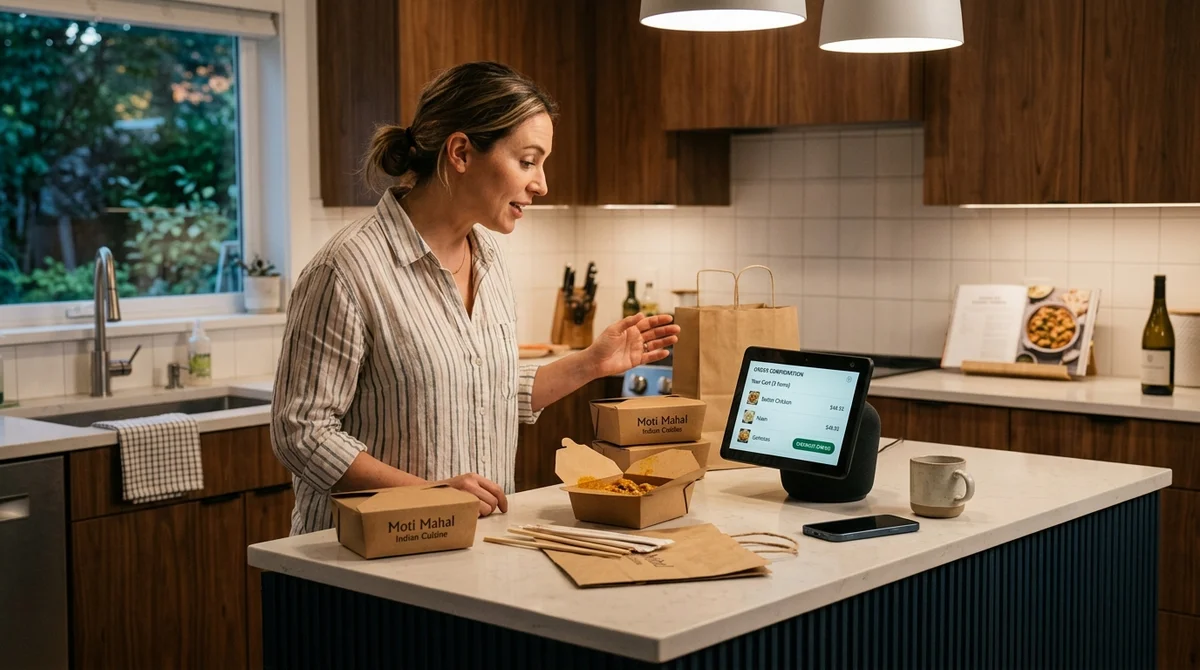
Amazon has expanded Alexa+: the assistant can now order food from Uber Eats and Grubhub through ordinary conversation, without a rigid script of commands. The user picks a cuisine, clarifies the details of the order and changes it as the dialogue goes on, while the system immediately shows the final cart.
How ordering works
The new feature turns voice ordering into one continuous flow. Instead of a series of short commands, the user can say what they want, for example Italian food for delivery, and Alexa+ will suggest suitable restaurants and walk them through the menu. During the conversation, users can ask questions about dishes, ask to see desserts, add items, and change ingredients and quantities. Amazon compares the experience not to an ordinary voice assistant but to talking with a waiter or ordering at a drive-through.
To enable the feature, users need to link their Uber Eats or Grubhub account in the Alexa app. Past orders are then pulled into the system, so users can quickly repeat a usual order or start from scratch. The screen shows exactly what has gone into the cart: dish names, quantities, the price of each item and the total. After checkout, Alexa+ can show the delivery status and answer the question of where the food is right now.
What is different
Amazon is betting on more than yet another integration with delivery services: it is betting on a new type of interface for Alexa+. Older voice assistants usually work in question-and-answer mode: the user gives one command, the system performs one step and waits for the next instruction. Here Amazon is pushing a different logic: a long conversation in which intent changes along the way. That matters for tasks where people rarely know the whole order in advance and often decide as they go.
- Choose a cuisine or a specific restaurant
- Build an order for one person or for a group
- Change the dish, ingredients and quantity during the conversation
- Ask to see desserts, popular items or options for kids
- Check the cart total and the delivery status after payment
Customers can simply describe what they feel like eating, ask
questions and build an order in real time.
That is roughly how Amazon's partners describe the idea. For the company, this is the first practical case of a so-called adaptive interaction model: Alexa+ is supposed to adjust its dialogue style to the task. Ordering food calls for one scenario, a weather forecast for another, smart home control for a third. Looking ahead, Amazon wants to carry this approach into other categories, including grocery shopping and trip planning.
Where the risks are
The launch does not look like a mass rollout in every sense. The new scenario is starting to appear for Alexa+ customers on the Echo Show 8 and larger models, meaning Amazon is first testing the format where there is a screen and the contents of the cart can be confirmed visually. That makes sense: when ordering food, voice alone is often not enough, because people want to see the menu, substitutions, add-ons and the final price before they press the buy button.
There is also a more general risk: AI in food service has already earned a reputation as a technology that looks impressive in demos but easily makes mistakes in real orders. The market remembers cases where automation at fast-food outlets added extra items or got confused by details. So the key question for Amazon is not whether Alexa+ can hold a pleasant conversation, but how accurately it will build the cart, especially for long, multi-part orders for a family or group.
What this means
Amazon is using food delivery as a testing ground for a more ambitious idea: turning Alexa+ from an assistant with a set of commands into a service that understands the context of a task and guides the user to the result. If the experience proves accurate and convenient, such conversational scenarios could quickly move beyond restaurants into shopping, bookings and other everyday tasks where people today still have to jump between apps.
- Oct 31, 2026Worldwide Express hands disputed invoices to AI agents and cuts unresolved disputes by 75%
- Oct 30, 2026AWS gives coding agents a live site preview straight from an isolated session
- Oct 30, 2026MoEngage Opens 400 Private APIs to AI Agents Through AgentCore Gateway, Without Building Its Own MCP Servers
- Oct 29, 2026NVIDIA Nemotron 3.5 Super VL: 120B Parameters, 12B Active, Running on AWS
Key Questions Answered
How ordering works?
The new feature turns voice ordering into one continuous flow. Instead of a series of short commands, the user can say what they want, for example Italian food for delivery, and Alexa+ will suggest suitable restaurants and walk them through the menu. During the conversation, users can ask questions about dishes, ask to see desserts, add items, and change ingredients and quantities. Amazon compares the experience not to an ordinary voice assistant but to talking with a waiter or ordering at a drive-through. To enable the feature, users need to link their Uber Eats or Grubhub
What is different?
Amazon is betting on more than yet another integration with delivery services: it is betting on a new type of interface for Alexa+. Older voice assistants usually work in question-and-answer mode: the user gives one command, the system performs one step and waits for the next instruction. Here Amazon is pushing a different logic: a long conversation in which intent changes along the way. That matters for tasks where people rarely know the whole order in advance and often decide as they go. Choose a cuisine or a specific restaurant Build an order for one person or for a grou
Where the risks are?
The launch does not look like a mass rollout in every sense. The new scenario is starting to appear for Alexa+ customers on the Echo Show 8 and larger models, meaning Amazon is first testing the format where there is a screen and the contents of the cart can be confirmed visually. That makes sense: when ordering food, voice alone is often not enough, because people want to see the menu, substitutions, add-ons and the final price before they press the buy button. There is also a more general risk: AI in food service has already earned a reputation as a technology that looks
Ship AI Faster with Founders, Engineers & Weekly Architecture Reviews
Inside Vibe Club (hamidun.com/club) — weekly live masterminds with Zhemal Khamidun, Tech Radar, full LMS access, and 370+ production Claude Code skills.
The AI world, distilled — once a week
Seven stories that actually mattered, hand-picked. No noise, no reposts, no press releases.
Done! Check your inbox for a confirmation.