OpenGrall unveils "Engineer" mode: the robot writes its own drivers and configures modules
OpenGrall has described an "Engineer" mode in which a robot can, on command, build a plugin for a new module on its own, from a camera servo to a sensor. The agent reads the project, looks for examples, and writes and tests code in a sandbox, while a human confirms the architecture, the calibration and the final integration. The design splits the system into a local "Pilot" and a cloud-based "Engineer", and makes a backup before every edit.
AI-processed from Habr AI; edited by Hamidun News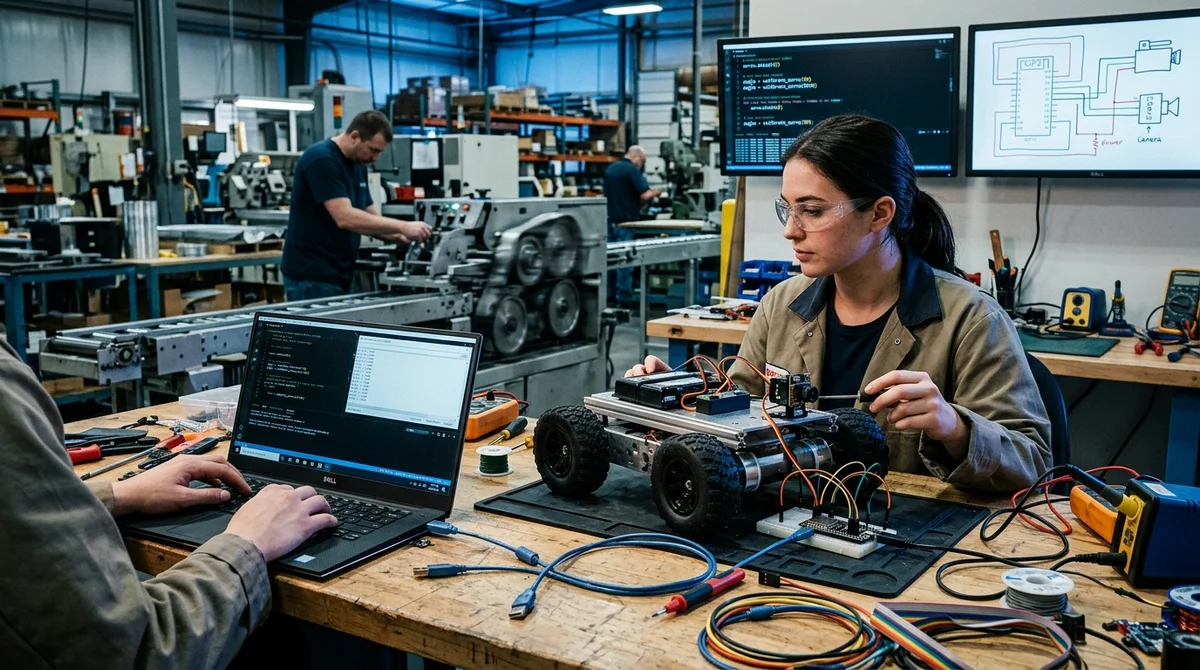
OpenGrall has described an "Engineer" mode: an architecture in which a robot can, from a text command, create plugins, write drivers and adapt code to new hardware by itself. The idea is not full autonomy at any cost, but handing routine integration work to an LLM while keeping a human in control.
How the roles are split
In the OpenGrall project, the robot's intelligence is divided into two loops. The "Pilot" is a local model that runs on board, makes fast decisions and controls motion in real time. It sees the sensors, reads project files and can update memory, but it is not allowed to change system code. This mode exists so that the robot does not depend on the cloud for basic tasks and does not break its own logic during normal operation.
The "Engineer" switches on only on request, or when a task requires access to development tools. This is a cloud LLM that is given access to the project's code, configurations and documentation. It does not simply generate a fragment at random; it acts as a separate agent: it studies the plugin structure, looks for examples, edits files, runs code in a sandbox and asks the owner clarifying questions. If the command is something like "turn left", the Pilot handles it; if it is "configure the manipulator", the baton passes to the Engineer.
How the Engineer works
The main idea of the mode is to avoid writing everything by hand for each new module. If, say, a camera servo on an ESP32 is connected to the robot over WebSocket, the owner only needs to describe the device and its available commands in a self-description file. The Engineer then reads the project, compares the existing plugins and creates a new module for that specific hardware. OpenGrall has built a dedicated toolset for this:
- searching the web for documentation and working examples
- reading articles, specifications and project files
- analyzing the directory structure and existing plugins
- making targeted code edits and creating new files
- running and checking the written code in an isolated sandbox
What follows is not "one-button magic" but a managed development cycle. First the model builds a class skeleton and can show it to a human before generating the full file. Then the methods are filled in step by step in streaming mode, so the module does not have to be regenerated whole and context is not lost. For calibration, the Engineer can bring a human into the loop: ask them to place an object in front of the camera, measure the distance to the chassis, or confirm that the servo has reached the required angle. This matters most where a purely text description is not enough.
The author is betting not only on connecting new modules but also on deeper restructuring of the system. The article gives a navigator example: a basic manual version of roughly 1.5 thousand lines of code can be replaced with a far larger implementation with smooth trajectories, on-the-fly route replanning and fewer jerks. In other words, this is no longer about generating a single driver, but about an attempt to give the robot a tool for rewriting its own subsystems for a new task.
"The final decision stays with the human."
Safety rests on three simple mechanisms: a sandbox for code execution, automatic backups before every change, and staged generation with checks on the result. Code runs with a timeout and without system calls, a copy of the file is made before any edit, and integration into the main loop does not happen automatically. Even if the model makes a mistake or goes down the wrong architectural path, a human can stop the process, roll back the changes and make the final decision manually.
Where the approach hits its limits
The OpenGrall authors say outright that the first generated code should not be idealized. LLMs still have the same chronic problems: outdated APIs, unnecessary dependencies, wrong wrappers and incompatibility with the environment. The difference is that the agent can read logs, rerun tests and make fixes itself until the module works. In practice, though, this autonomous debugging can take not minutes but hours of real time, especially if the hardware is unusual or the documentation is rough.
There are also harder architectural limits. For setting up a manipulator, a camera or a lidar, this mode looks logical: the model sees the description, understands the geometry of the task and can assemble a working interface on top of existing commands. But for controlling a hexapod's gait, or other tasks with strict requirements for speed and adaptivity, self-generated Python code alone is no longer enough. There, in the author's view, different approaches are needed, such as TinyML and training in simulation, where behavior is developed over millions of iterations rather than written superficially from a text prompt.
What this means
OpenGrall shows an interesting shift: the robot starts to be seen not as a rigidly flashed device but as a platform that can be further trained and extended with text commands. Fully independent robotics is still far off, but for integrating sensors, plugins and individual subsystems, such an "Engineer" can already noticeably cut manual work, provided the final kill switch stays in human hands.
- Nov 2, 2026DeepSeek open-sources Super-agent prototype: p95 task completion time of 15.7 minutes vs. 29.5
- Nov 2, 2026Bun creator uses Claude Code to port 750K lines from Zig to Rust in 11 days
- Nov 2, 2026Microsoft releases 4B model Mage-VL-Cowork, which solves 66.0% of OSWorld-Verified tasks
- Nov 2, 2026Meta's Muse assistant keeps dossiers on loved ones and gets root on Ubuntu by default
Key Questions Answered
How the roles are split?
In the OpenGrall project, the robot's intelligence is divided into two loops. The "Pilot" is a local model that runs on board, makes fast decisions and controls motion in real time. It sees the sensors, reads project files and can update memory, but it is not allowed to change system code. This mode exists so that the robot does not depend on the cloud for basic tasks and does not break its own logic during normal operation. The "Engineer" switches on only on request, or when a task requires access to development tools. This is a cloud LLM that is given access to the projec
How the Engineer works?
The main idea of the mode is to avoid writing everything by hand for each new module. If, say, a camera servo on an ESP32 is connected to the robot over WebSocket, the owner only needs to describe the device and its available commands in a self-description file. The Engineer then reads the project, compares the existing plugins and creates a new module for that specific hardware. OpenGrall has built a dedicated toolset for this: searching the web for documentation and working examples reading articles, specifications and project files analyzing the directory structure and e
Where the approach hits its limits?
The OpenGrall authors say outright that the first generated code should not be idealized. LLMs still have the same chronic problems: outdated APIs, unnecessary dependencies, wrong wrappers and incompatibility with the environment. The difference is that the agent can read logs, rerun tests and make fixes itself until the module works. In practice, though, this autonomous debugging can take not minutes but hours of real time, especially if the hardware is unusual or the documentation is rough. There are also harder architectural limits. For setting up a manipulator, a camera
Test Frontier LLMs & Autonomous Agents in One Workspace
Run Claude Opus 5.5, GPT-6, Gemini 3.1, and DeepSeek side-by-side in Nomad AI (nomadnet.ai) — unified model routing, deep research, and multimodal workflows under one subscription.
The AI world, distilled — once a week
Seven stories that actually mattered, hand-picked. No noise, no reposts, no press releases.
Done! Check your inbox for a confirmation.