Western with a digital Val Kilmer gets first trailer, sparks debate
The western As Deep As the Grave has released its first trailer, and it features an authorized digital version of Val Kilmer. The actor was cast in the film but died in April 2025, before shooting began. The team rebuilt his voice from archival recordings together with Sonantic. The project has already become a test of where the film industry draws the line on AI.
AI-processed from Guardian; edited by Hamidun News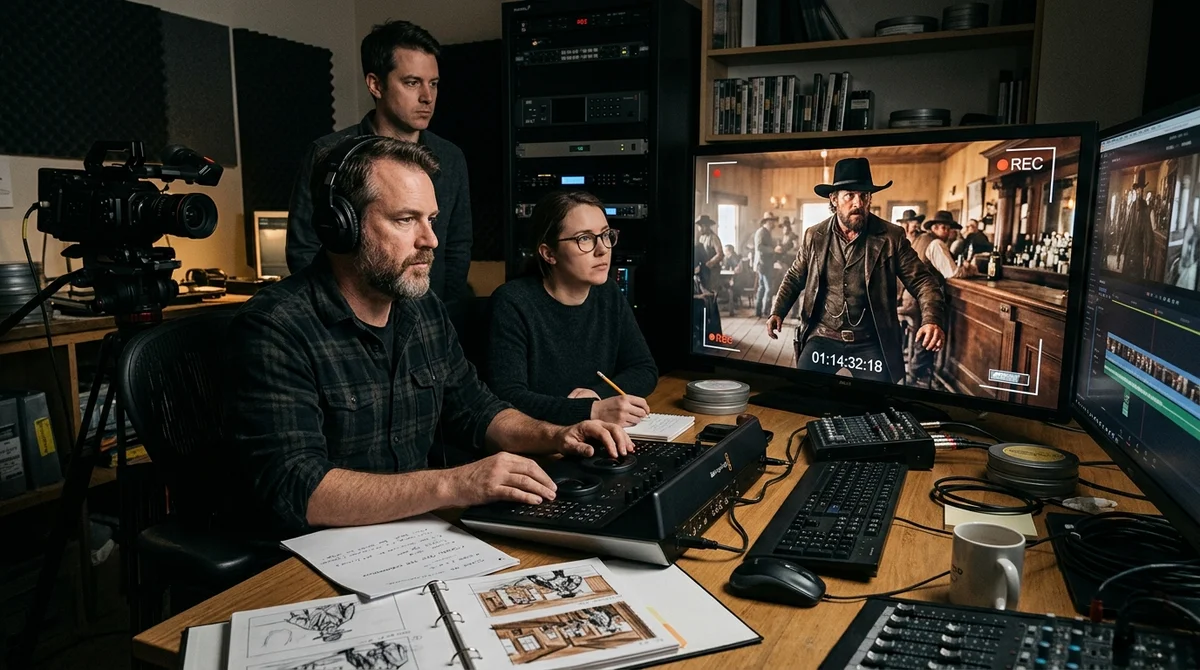
The western As Deep As the Grave has its first trailer, and it is not just promotion for a new release. The film is the first known case of a feature built around an authorized, generative-AI digital version of a major Hollywood actor: Val Kilmer, who died in April 2025.
How the role was brought back
Kilmer was cast in one of the roles in As Deep As the Grave while he was still alive, but because of production delays he never shot a single scene. After the actor's death, the team did not abandon the project. They chose to finish it differently, using an approved digital reconstruction of his likeness and voice. That is the footage now shown in the first trailer, which was presented in the US.
According to the project's description, the creators worked with the British company Sonantic to recreate the sound of the actor's voice from old recordings. This detail matters: it is not a casual imitation of a celebrity but a production decision inside a film already underway, in which the actor was meant to appear from the start. The visual part was also created as an authorized deepfake, that is, with permission, not as a fan experiment or a viral clip.
Why this is a precedent
Hollywood is used to digital de-aging, stand-ins and CGI characters, but this situation is different. At the center of the film is not a processed shot or a restored fragment but a full digital version of an actor who did not physically take part in filming. So the trailer's release immediately turns As Deep As the Grave into a test case for the whole industry: what audiences are willing to accept as an admissible continuation of a role after the performer's death.
Several factors coincide here, which is why the project will be scrutinized closely:
- Kilmer was officially cast before his death
- the film does not use a random archival clip but completes a role that was never shot
- the voice was created from the actor's earlier recordings with Sonantic's involvement
- the visual likeness is presented as an authorized digital reconstruction
- the trailer moves this practice from behind-the-scenes production into public view
That is why the news matters not only to Kilmer's fans but to producers as well. Until now, discussions of AI in film were often theoretical; the industry now has a concrete commercial example: a film whose marketing relies directly on the digital presence of a deceased actor. The debate therefore shifts from "can this be done?" to "where is the line, and who sets it?"
Where the line falls
Even in the most careful scenario, this technology does not resolve the ethical and legal questions. Who is the author of an on-screen performance if the actor never spoke the lines on set? Is the consent of rights holders enough if viewers perceive the performance as new, live work by the actor? And how do you separate a respectful completion of a project from exploitation of a recognizable face after death?
The trailer does not answer these questions, but that is exactly why it became an event.
There is one more nuance. Kilmer's case may look comparatively safe to studios, because it rests on an existing casting and on an attempt to finish a specific role, not on inserting a digital copy of an actor into any new script. But once the market accepts this approach, the next step will almost inevitably be wider use: more digital doubles, more contracts for posthumous use of likeness, more disputes over where memory ends and licensable IP begins.
What this means
As Deep As the Grave will likely go down in history not only as an unusual western but as an early marker of a new norm for cinema. If audiences and the market accept the digital Val Kilmer as a legitimate part of the film, studios will get a signal that generative AI can be used not only for de-aging and post-production but to actually bring actors back to the screen after death.
Key Questions Answered
How the role was brought back?
Kilmer was cast in one of the roles in As Deep As the Grave while he was still alive, but because of production delays he never shot a single scene. After the actor's death, the team did not abandon the project. They chose to finish it differently, using an approved digital reconstruction of his likeness and voice. That is the footage now shown in the first trailer, which was presented in the US. According to the project's description, the creators worked with the British company Sonantic to recreate the sound of the actor's voice from old recordings. This detail matters: i
Why this is a precedent?
Hollywood is used to digital de-aging, stand-ins and CGI characters, but this situation is different. At the center of the film is not a processed shot or a restored fragment but a full digital version of an actor who did not physically take part in filming. So the trailer's release immediately turns As Deep As the Grave into a test case for the whole industry: what audiences are willing to accept as an admissible continuation of a role after the performer's death. Several factors coincide here, which is why the project will be scrutinized closely: Kilmer was officially cas
Where the line falls?
Even in the most careful scenario, this technology does not resolve the ethical and legal questions. Who is the author of an on-screen performance if the actor never spoke the lines on set? Is the consent of rights holders enough if viewers perceive the performance as new, live work by the actor? And how do you separate a respectful completion of a project from exploitation of a recognizable face after death? The trailer does not answer these questions, but that is exactly why it became an event. There is one more nuance. Kilmer's case may look comparatively safe to studios
Test Frontier LLMs & Autonomous Agents in One Workspace
Run Claude Opus 5.5, GPT-6, Gemini 3.1, and DeepSeek side-by-side in Nomad AI (nomadnet.ai) — unified model routing, deep research, and multimodal workflows under one subscription.
The AI world, distilled — once a week
Seven stories that actually mattered, hand-picked. No noise, no reposts, no press releases.
Done! Check your inbox for a confirmation.