Falkon Tech shows how its Moscow video monitoring system grew out of parking enforcement
Falkon Tech has detailed how its computer vision system for the urban environment works. It started with parking control and grew into a scalable platform for Moscow that processes data from thousands of hardware-software units. The system logs violations, estimates infrastructure load and reduces the volume of manual review. It must, however, hold up in bad weather, at night and with awkward camera angles.
AI-processed from Habr AI; edited by Hamidun News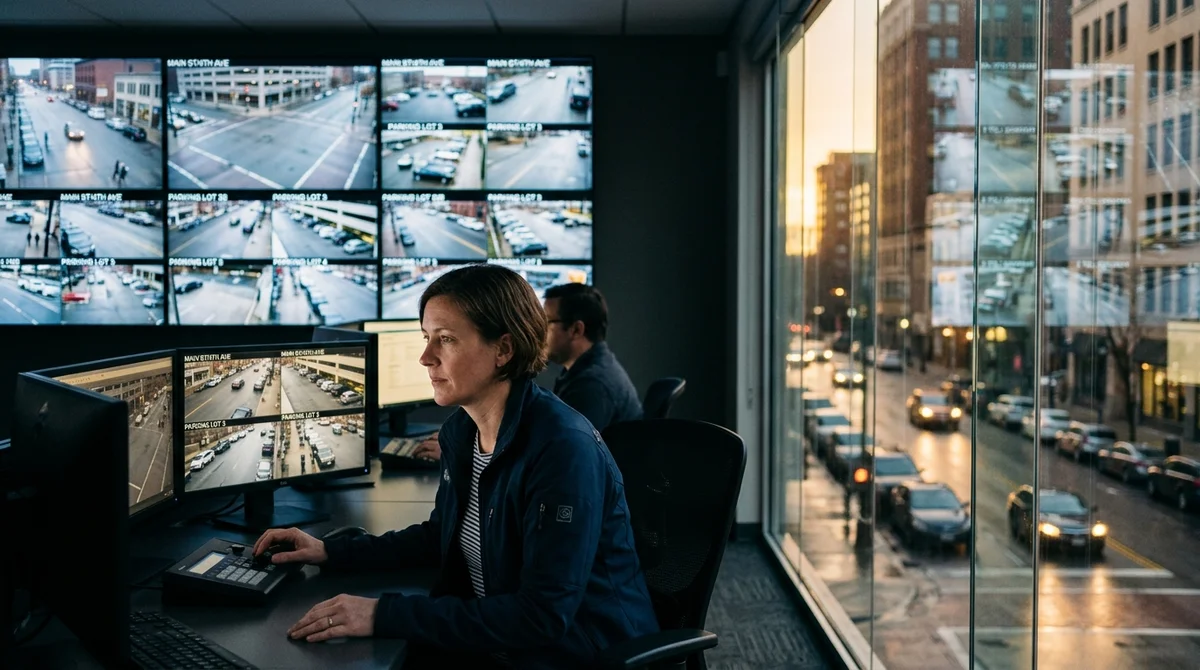
Falkon Tech has shown what a "smart city" looks like without the excess theory: not a showcase of sensors, but a working video monitoring system that helps track parking, roads and urban infrastructure in real time. The company described how a narrow task grew into a scalable platform for Moscow, capable of processing a stream of data from thousands of hardware-software units.
From parking to a platform
The project did not begin with an attempt to digitize the whole city at once. It began with a clear, practical task: automating parking control and removing part of the manual checking. That starting point matters. Urban AI systems rarely launch as a "single loop" on day one; they usually appear where an effect can quickly be shown in numbers: less time spent on monitoring, faster logging of violations, a better view of the real situation at a site.
The local scenario then turned into a scalable solution. According to the company, the system is already used in Moscow and works with data coming from thousands of hardware-software units. This changes the approach to urban analytics itself: instead of spot checks, there is a constant stream of observations that can be used not only to react to individual incidents, but also to understand how different parts of the urban environment are loaded throughout the day.
How the system works
The solution is built on machine vision, which analyzes the video stream and picks out events that matter to operators and city services. In this setup the camera is only the first layer. The system then has to recognize objects in the frame, understand the context of the scene, separate useful signal from noise and deliver the result in a form that is convenient to work with. The more cameras and scenarios there are, the more important it is to have not just an accurate model but a resilient processing chain.
At the applied level, the system's value is defined not by fashionable vocabulary but by a set of repeatable operations it can handle without constant human involvement. This matters especially in a city setting: operators are few, video streams are many, and events cannot be missed even briefly. So the platform has to help log violations, account for traffic dynamics and quickly raise an alarm where a human is needed.
- Control of parking zones and logging of violations
- Counting and classification of objects in the frame
- Assessment of urban infrastructure load
- Automatic handoff of events to an operator for review
The main value is not that AI "sees the city", but that it takes routine video-watching off people's hands. An operator does not have to stare at screens endlessly waiting for an event: the system itself picks out suspicious or significant episodes. Manual control does not disappear entirely, but it becomes targeted and noticeably more efficient, especially when thousands of data sources are involved at once.
Where the difficulties arise
The most awkward part of such projects is not the presentation but the real environment. Urban video is almost never ideal: rain, snow, night shooting, glare, dense traffic, occluded objects and unstable viewing angles quickly break the "lab" accuracy of models. So the engineering work goes not only into the neural network, but also into the quality of the source signal, camera setup, choice of scenarios and constant checking of errors on real cases.
A separate problem is complex scenes, where an object must not just be spotted but interpreted correctly. For an urban system it is not enough to see a car or a person: it must understand what is actually happening in the context of place and time. The same frame can mean a violation, a normal stop or temporary congestion at a site. So the maturity of such solutions is defined not by polished demos, but by how stably they work in a heterogeneous urban environment and how carefully they reduce false positives.
What this means
The Falkon Tech case shows that a "smart city" today is first of all a practical infrastructure for observation and analysis, not an abstract set of AI promises. If the system really withstands the scale of Moscow and the stream from thousands of units, computer vision becomes for the city not an experiment but a working tool that helps spot problems faster and use human resources more rationally.
- Nov 1, 2026Pika Labs releases open video model H3 Flex: 6 steps instead of 50
- Nov 1, 2026Google's StreamVibe video agent beats other models by 10.7% on response timing and quality
- Oct 31, 2026AI cartoon series: a 24-second episode built ten ways, the best cost 162 credits
- Oct 31, 2026Anthropic: Fold Subagents Back Into a Single Loop — One Customer's Tasks Ran Twice as Fast
Key Questions Answered
What are the key details on From parking to a platform?
The project did not begin with an attempt to digitize the whole city at once. It began with a clear, practical task: automating parking control and removing part of the manual checking. That starting point matters. Urban AI systems rarely launch as a "single loop" on day one; they usually appear where an effect can quickly be shown in numbers: less time spent on monitoring, faster logging of violations, a better view of the real situation at a site. The local scenario then turned into a scalable solution. According to the company, the system is already used in Moscow and wo
How the system works?
The solution is built on machine vision, which analyzes the video stream and picks out events that matter to operators and city services. In this setup the camera is only the first layer. The system then has to recognize objects in the frame, understand the context of the scene, separate useful signal from noise and deliver the result in a form that is convenient to work with. The more cameras and scenarios there are, the more important it is to have not just an accurate model but a resilient processing chain. At the applied level, the system's value is defined not by fashi
Where the difficulties arise?
The most awkward part of such projects is not the presentation but the real environment. Urban video is almost never ideal: rain, snow, night shooting, glare, dense traffic, occluded objects and unstable viewing angles quickly break the "lab" accuracy of models. So the engineering work goes not only into the neural network, but also into the quality of the source signal, camera setup, choice of scenarios and constant checking of errors on real cases. A separate problem is complex scenes, where an object must not just be spotted but interpreted correctly. For an urban system
Ship AI Faster with Founders, Engineers & Weekly Architecture Reviews
Inside Vibe Club (hamidun.com/club) — weekly live masterminds with Zhemal Khamidun, Tech Radar, full LMS access, and 370+ production Claude Code skills.
The AI world, distilled — once a week
Seven stories that actually mattered, hand-picked. No noise, no reposts, no press releases.
Done! Check your inbox for a confirmation.