DroneDash and Geodnet build an ag drone for large farms that skips re-mapping the field
DroneDash and Geodnet have created Geodash Aerosystems, a joint venture to build an agricultural drone for large farm holdings. The core idea is to remove two painful steps before treating a field: re-mapping the plot and rebuilding the flight plan before each flight. If the product reaches serial production, ag operators could cover large areas faster and cut the share of manual preparation.
AI-processed from AI News; edited by Hamidun News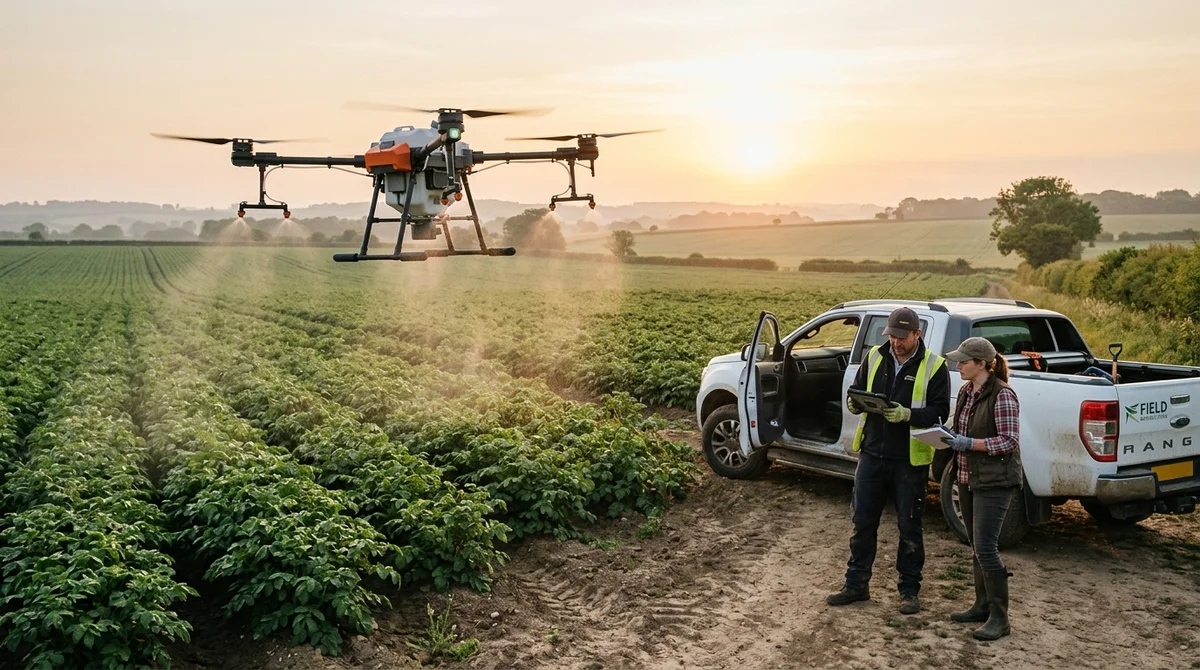
Singapore-based DroneDash Technologies and Geodnet have announced the launch of a joint venture, Geodash Aerosystems. The companies are developing a near-production spraying drone for large agricultural holdings, intended to shorten pre-flight preparation and remove some manual routine.
Why a new drone
For large industrial farms, the main problem is not always the flight itself but the preparation for it. Before treating a field, an operator often has to re-map the plot, check its boundaries and rebuild the route for the specific task. With large areas and frequent flights, these steps become a constant drain on time, and any delay postpones the spraying itself and adds extra load on the team.
This is exactly where DroneDash and Geodnet are aiming. Their joint venture, Geodash Aerosystems, is being set up to develop an agricultural drone designed for large industrial farms. The key promise is pragmatic: eliminate the need to rebuild the field map before every flight and spare operators from reassembling the flight plan. For the market, this matters more than yet another abstract claim about smart AI, because savings in agriculture often come not from new features but from cutting repetitive operations.
What changes in the workflow
If the technology works the way the companies describe, it changes not the idea of aerial surveying or spraying but the daily workflow. Preparation gets shorter, and the drone moves closer to a tool that can be launched quickly, without a separate, lengthy setup cycle before each run. For large farms this matters most when the treatment window is short and decisions must be made fast.
- No need to re-map the field before every flight
- No need to rebuild the flight route each time
- Easier to resume treatment of large plots after a pause
- Less manual preparation before a series of flights
The original description does not yet make clear which technical solutions are under the hood or what hardware the drone is built on. Even without those details, it is clear that Geodash Aerosystems is betting not on a flashy demo but on reducing operational friction. For agribusiness, that is often the main measure of value: equipment should not impress in presentations but save hours of work in the field.
Why the focus on large holdings
The phrase "large farm holdings" shows that the project targets neither small farms nor an experimental market. Large farms feel the cost of every extra operation more acutely, because scale quickly turns minutes into hours and hours into money. If the same mapping must be repeated and the route rebuilt before every flight, costs pile up faster than on a small farm with a few plots.
This is also not a distant concept but near-production technology, meaning a development close to the production stage. That is an important nuance: the companies are not merely describing an idea but presenting it as a solution approaching practical use. There is no data yet on price, delivery times, tank capacity, spray width or first launch markets. Even so, the news shows where the agricultural drone segment is heading: toward more autonomous preparation and less dependence on manual re-planning.
What this means
The agricultural drone market is gradually shifting from the simple fact of automation to a contest over the efficiency of the full work cycle. If Geodash Aerosystems brings the idea to a serial product, large farms will get not just another drone but a faster and more predictable process for treating fields.
- Nov 1, 2026Local models lose to Opus and Codex: 0.21 on a MacBook versus 1.00 for Codex
- Nov 1, 2026Adobe's EditAgent judge picks a usable edit 81.3% of the time, versus 74.8% for EditScore
- Nov 1, 202616 models tested on 7 search tools: Exa averaged 10.5 out of 14, SearXNG about 3
- Nov 1, 2026Google's StreamVibe video agent beats other models by 10.7% on response timing and quality
Key Questions Answered
Why a new drone?
For large industrial farms, the main problem is not always the flight itself but the preparation for it. Before treating a field, an operator often has to re-map the plot, check its boundaries and rebuild the route for the specific task. With large areas and frequent flights, these steps become a constant drain on time, and any delay postpones the spraying itself and adds extra load on the team. This is exactly where DroneDash and Geodnet are aiming. Their joint venture, Geodash Aerosystems, is being set up to develop an agricultural drone designed for large industrial farm
What changes in the workflow?
If the technology works the way the companies describe, it changes not the idea of aerial surveying or spraying but the daily workflow. Preparation gets shorter, and the drone moves closer to a tool that can be launched quickly, without a separate, lengthy setup cycle before each run. For large farms this matters most when the treatment window is short and decisions must be made fast. No need to re-map the field before every flight No need to rebuild the flight route each time Easier to resume treatment of large plots after a pause Less manual preparation before a series of
Why the focus on large holdings?
The phrase "large farm holdings" shows that the project targets neither small farms nor an experimental market. Large farms feel the cost of every extra operation more acutely, because scale quickly turns minutes into hours and hours into money. If the same mapping must be repeated and the route rebuilt before every flight, costs pile up faster than on a small farm with a few plots. This is also not a distant concept but near-production technology, meaning a development close to the production stage. That is an important nuance: the companies are not merely describing an id
Test Frontier LLMs & Autonomous Agents in One Workspace
Run Claude Opus 5.5, GPT-6, Gemini 3.1, and DeepSeek side-by-side in Nomad AI (nomadnet.ai) — unified model routing, deep research, and multimodal workflows under one subscription.
The AI world, distilled — once a week
Seven stories that actually mattered, hand-picked. No noise, no reposts, no press releases.
Done! Check your inbox for a confirmation.