Musk's team speeds up Terafab and talks to suppliers about chip production
Elon Musk's team has started discussing the Terafab project with Applied Materials, Tokyo Electron and Lam Research. Terafab is a potential fab for making advanced chips. It is still an early stage, but the supplier list alone shows the scale of the ambition: Musk does not just want to buy AI accelerators, he wants to enter the hardest part of the semiconductor chain, which is manufacturing them.
AI-processed from Bloomberg Tech; edited by Hamidun News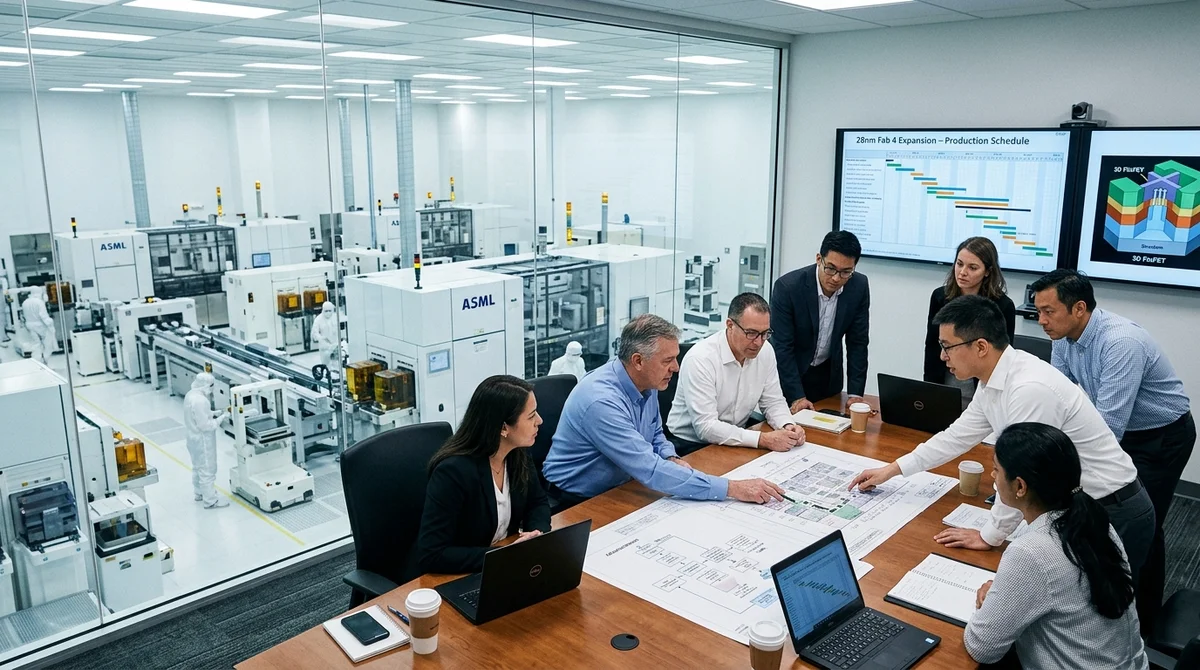
Elon Musk's team has opened talks with the largest semiconductor equipment suppliers about the Terafab project. It is one of the first clear signals that the entrepreneur may try to move beyond developing AI systems and servers into producing the most complex chips.
An early move into chips
Musk's lieutenants have contacted Applied Materials, Tokyo Electron and Lam Research, companies without which it is almost impossible today to imagine launching a modern chip fab. So far this is not about a finished plant or confirmed construction, but about the early outline of a future project.
Still, the choice of counterparts shows the scale of the idea: Terafab is conceived not as an experimental line but as an attempt to enter the advanced manufacturing segment, where the barrier to entry is measured not only in money but in access to scarce engineering expertise.
The name Terafab fits the logic of Musk's other projects: first set an ambition at the limit of the industry, then assemble a chain of partners, suppliers and a team around it. If these talks move into a practical phase, this could become a new point of control over a critical resource for AI: compute chips. For companies building large models, a chip is no longer just a component but a limit on the pace of growth.
"We need to move at the speed of light."
Why this is hard
Advanced chips are made in fabs that cost tens of billions of dollars and require synchronizing hundreds of processes: material deposition, etching, cleaning, defect inspection, packaging and testing. Even having capital is not enough. It takes years to tune the process chain, hire specialists and reach acceptable yield, the share of working dies, without which a fab's economics simply do not add up.
So early contact with suppliers is an important step, but still very far from volume production.
The market for advanced process nodes is also long past empty. It is dominated by players that spent decades accumulating experience, building supplier relationships and learning to raise yield step by step. Any newcomer must not only buy equipment but also plug into a complex global system of materials, servicing, design and logistics. For Musk, this would mean entering one of the most capital-intensive and technologically demanding industries in the world.
Why suppliers matter
The companies Musk's people approached hold key positions in the fab equipment chain. Without such partners it is impossible to assemble a production line even on paper, let alone launch a real plant. At this early stage their involvement is needed not only to estimate prices and timelines, but also to understand which technology routes are achievable at all within a reasonable horizon.
- Applied Materials is one of the main suppliers of equipment for depositing and processing materials on wafers.
- Tokyo Electron is an important player in deposition, etching and cleaning at different stages of production.
- Lam Research is one of the key suppliers of etching and wafer preparation systems.
- Working with such vendors helps estimate in advance the cost of a line, delivery times and integration complexity.
For Musk, the point of this move may go beyond a new business. His companies already depend on access to powerful accelerators and server infrastructure, and demand for AI compute continues to grow faster than supply. If Terafab is conceived as vertical integration, the goal is clear: reduce dependence on other companies' roadmaps, control supply better and, possibly, over time design and produce critical components for its own needs.
What it means
Even if Terafab remains a long and difficult project, the fact of the talks shows a shift: the biggest AI players no longer want to be limited to buying chips on the market. The next stage of competition may be fought not only over models and data centers, but over control of fabs, equipment and the entire production chain.
Key Questions Answered
What are the key details on An early move into chips?
Musk's lieutenants have contacted Applied Materials, Tokyo Electron and Lam Research, companies without which it is almost impossible today to imagine launching a modern chip fab. So far this is not about a finished plant or confirmed construction, but about the early outline of a future project. Still, the choice of counterparts shows the scale of the idea: Terafab is conceived not as an experimental line but as an attempt to enter the advanced manufacturing segment, where the barrier to entry is measured not only in money but in access to scarce engineering expertise. The
Why this is hard?
Advanced chips are made in fabs that cost tens of billions of dollars and require synchronizing hundreds of processes: material deposition, etching, cleaning, defect inspection, packaging and testing. Even having capital is not enough. It takes years to tune the process chain, hire specialists and reach acceptable yield, the share of working dies, without which a fab's economics simply do not add up. So early contact with suppliers is an important step, but still very far from volume production. The market for advanced process nodes is also long past empty. It is dominated
Why suppliers matter?
The companies Musk's people approached hold key positions in the fab equipment chain. Without such partners it is impossible to assemble a production line even on paper, let alone launch a real plant. At this early stage their involvement is needed not only to estimate prices and timelines, but also to understand which technology routes are achievable at all within a reasonable horizon. Applied Materials is one of the main suppliers of equipment for depositing and processing materials on wafers. Tokyo Electron is an important player in deposition, etching and cleaning at di
Test Frontier LLMs & Autonomous Agents in One Workspace
Run Claude Opus 5.5, GPT-6, Gemini 3.1, and DeepSeek side-by-side in Nomad AI (nomadnet.ai) — unified model routing, deep research, and multimodal workflows under one subscription.
The AI world, distilled — once a week
Seven stories that actually mattered, hand-picked. No noise, no reposts, no press releases.
Done! Check your inbox for a confirmation.