Victory Giant raises $2.6 billion in Hong Kong, betting on five years of AI growth
Victory Giant had a strong Hong Kong listing: the printed circuit board maker raised $2.6 billion, and its shares climbed sharply on the first day of trading. Founder Chen Tao says at least five years of fast growth lie ahead. The company's main bet is demand for boards used in AI infrastructure, servers, networking equipment and other high-performance hardware, driven by the global AI boom.
AI-processed from Bloomberg Tech; edited by Hamidun News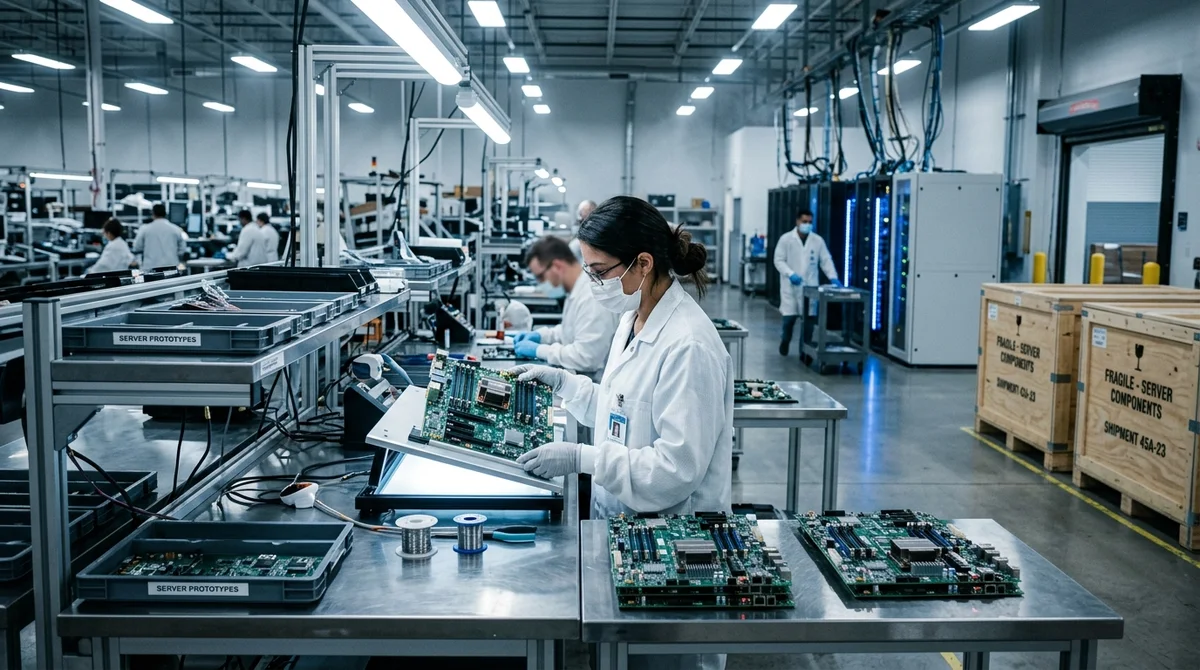
Victory Giant Technology Huizhou has listed in Hong Kong and got off to a strong start: after raising $2.6 billion, its shares rose in debut trading. The printed circuit board maker ties its near-term prospects directly to the AI boom and expects accelerated growth over the next five years.
Exchange debut
For the hardware sector, this is a notable listing. Victory Giant does not make end-user AI products for the mass market and does not build its own models, but without companies like it, neither servers, nor accelerators, nor complex industrial electronics work. The market responded immediately: after the Hong Kong IPO, investors backed a growth story built not on a polished narrative but on the company's clear role in the hardware supply chain.
The $2.6 billion raise itself shows that interest in infrastructure players in the AI market remains high. Attention is now focused not only on chip designers and cloud platforms, but also on component makers needed to scale up computing. Printed circuit boards are one of those foundational layers. The more data centers, server racks and high-performance systems come online, the greater the demand for reliable, sophisticated PCB products.
The debut also looks telling for the Hong Kong exchange itself. Investors are looking for ways into the AI theme not only through the expensive shares of market leaders, but also through second-tier companies that profit from the expansion of the whole ecosystem. Victory Giant fits that logic: it sells not the promise of a distant future, but components without which that future cannot physically be assembled. That makes the case easy to grasp even for more conservative capital.
A bet on AI demand
Before the listing, founder Chen Tao said Victory Giant expects "high-speed growth" over the next five years. The wording matters: it points not to a short burst of orders but to a bet on a long cycle of AI infrastructure expansion. If large technology companies keep investing in model training, putting services into production and building new capacity, hardware suppliers can grow alongside them.
"High-speed growth" over the next five years.
For Victory Giant, this means a chance to establish itself as a beneficiary not only of current demand but of the market's next stage, when AI stops being an experiment and becomes a standard business workload. In that scenario, printed circuit board makers win on volume, product complexity and quality requirements. The higher the compute density and power consumption of equipment in enterprise and cloud infrastructure, the more board-level component reliability matters.
Where the company makes money
When the market talks about the AI boom, attention usually goes to big names in models and chips. But money flows through the entire production chain, and part of the growth lands with suppliers that handle the physical assembly of systems. Every new compute cluster needs not only GPUs but also a large volume of basic hardware components. It is at this level of the market that the scale of such players' future revenue is often underestimated.
- Multilayer boards for servers and compute nodes
- Components for high-speed interconnects inside AI systems
- Boards for networking equipment that links clusters
- Solutions for industrial electronics and related infrastructure
That is why a five-year forecast looks plausible to investors. AI demand depends not on one category of devices but on a whole ecosystem: from servers and networks to power, cooling and production lines. Such companies also face limits: they depend on customers' capital spending, technology cycles, and competition on quality and price. But for now, the market believes this cycle is only gathering pace.
What it means
Victory Giant's story shows that the AI race lifts not only model builders but also less visible makers in the hardware chain. For the market, it is a signal: investors are willing to back companies that supply critical components for computing infrastructure, if they see a clear role in AI growth and several years of demand in reserve. Such issuers become a convenient way to bet on growth without competing directly in the world of models.
Key Questions Answered
What are the key details on Exchange debut?
For the hardware sector, this is a notable listing. Victory Giant does not make end-user AI products for the mass market and does not build its own models, but without companies like it, neither servers, nor accelerators, nor complex industrial electronics work. The market responded immediately: after the Hong Kong IPO, investors backed a growth story built not on a polished narrative but on the company's clear role in the hardware supply chain. The $2.6 billion raise itself shows that interest in infrastructure players in the AI market remains high. Attention is now focuse
What are the key details on A bet on AI demand?
Before the listing, founder Chen Tao said Victory Giant expects "high-speed growth" over the next five years. The wording matters: it points not to a short burst of orders but to a bet on a long cycle of AI infrastructure expansion. If large technology companies keep investing in model training, putting services into production and building new capacity, hardware suppliers can grow alongside them. "High-speed growth" over the next five years. For Victory Giant, this means a chance to establish itself as a beneficiary not only of current demand but of the market's next stage
Where the company makes money?
When the market talks about the AI boom, attention usually goes to big names in models and chips. But money flows through the entire production chain, and part of the growth lands with suppliers that handle the physical assembly of systems. Every new compute cluster needs not only GPUs but also a large volume of basic hardware components. It is at this level of the market that the scale of such players' future revenue is often underestimated. Multilayer boards for servers and compute nodes Components for high-speed interconnects inside AI systems Boards for networking equip
Ship AI Faster with Founders, Engineers & Weekly Architecture Reviews
Inside Vibe Club (hamidun.com/club) — weekly live masterminds with Zhemal Khamidun, Tech Radar, full LMS access, and 370+ production Claude Code skills.
The AI world, distilled — once a week
Seven stories that actually mattered, hand-picked. No noise, no reposts, no press releases.
Done! Check your inbox for a confirmation.