NeuralSet and Deep Learning: Decoding Language Features from Brain MEG Signals
A walkthrough of NeuralSet lays out an end-to-end pipeline that turns MEG signals into predictions of language features. In the example, the model estimates word length from the brain's response, covering everything from loading and cleaning the data to training a deep learning network in practice. This is not a flashy consumer product. It is a practical tutorial for neuroengineers, research labs and teams building neuroAI systems on real biosignals.
AI-processed from MarkTechPost; edited by Hamidun News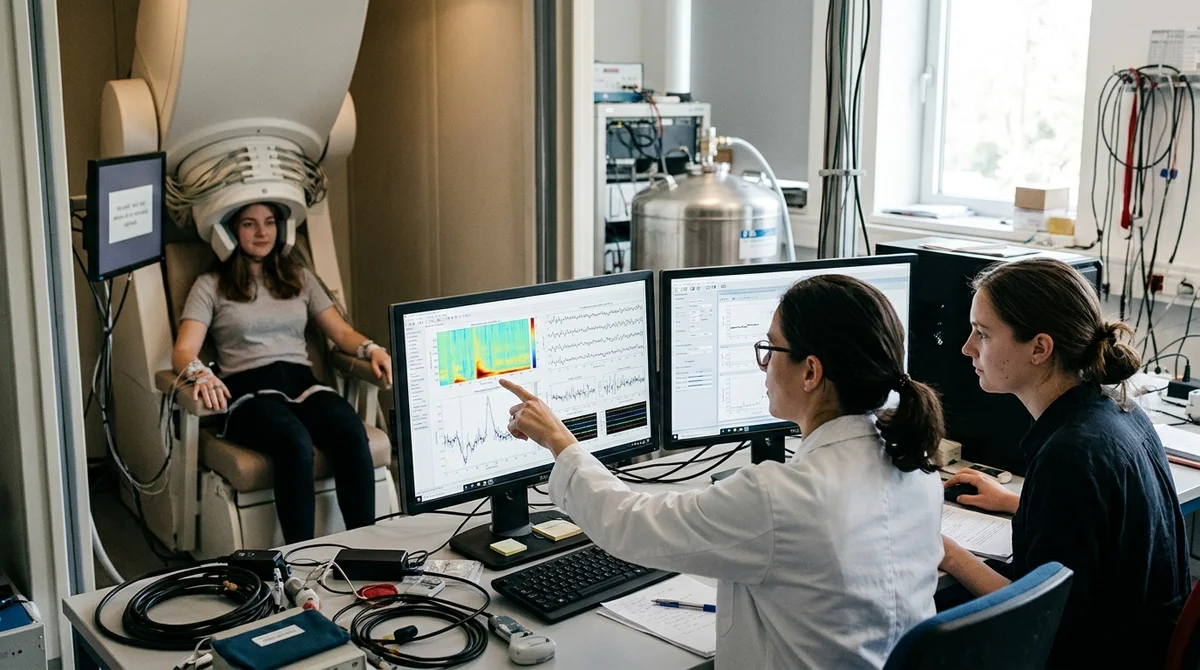
A new technical walkthrough demonstrates a neuroAI pipeline that extracts language features directly from MEG signals. As a demonstration, a system built on NeuralSet and deep learning tries to predict word length from the brain's response to a language stimulus.
How the pipeline works
The material is interesting because it shows not an isolated piece of research but an almost complete engineering chain, from setting up the environment to training a model on neural signals. At its center is MEG, a method for recording the magnetic fields produced by neuronal activity. The data then follows the standard neuroAI route: loading, cleaning, synchronization with stimuli, building training examples, and feeding them into a network that must link patterns of brain activity to a specific language property.
The target task is fairly down-to-earth but telling: the system estimates the length of a word a person perceived, relying only on the brain's response. This is an important caveat. It is not about free-form "mind reading" but about predicting one strictly defined feature in a controlled experiment.
This format makes the pipeline useful for developers and researchers: it lets them test whether an end-to-end approach can extract meaning from raw or minimally processed biosignals at all, without splitting the process into dozens of manual steps.
Why MEG matters
For language tasks, MEG is especially convenient because of its high temporal precision. While fMRI shows well where activity occurs, MEG is better suited to answering when exactly the brain reacts to a word, a sound or an individual feature of a stimulus. For tasks involving word length, character order or early semantic processing, this millisecond-level dynamics often matters more than a coarse spatial map. That is why interest in such pipelines is growing not only among neuroscientists but also among teams working at the intersection of AI and brain-computer interfaces.
It is also worth noting that the walkthrough uses NeuralSet as the foundation for organizing both the data and the model. In practice this is more useful than a dry description of an architecture on paper: the reader sees how to build a reproducible process, not just the final idea. In this field, reproducibility is usually what slows progress. Even a good model accomplishes little if a team cannot quickly set up the environment, feed MEG recordings in a unified format and repeat the experiment on its own sample without assembling every step by hand.
What the implementation includes
By its description, the tutorial covers the key steps needed for a first working prototype. It is not an abstract overview of "neural networks for the brain" but a code implementation that shows how neural data becomes a supervised task. For engineers, the value lies in this grounded approach: you can take the foundation, swap the target feature, plug in a different dataset and quickly check whether the same approach works on a new problem.
- setting up the Python environment and dependencies for the neuroAI pipeline
- loading MEG data and basic signal preprocessing
- linking brain responses to language stimuli
- training a deep learning model to predict word length
- evaluating results and checking how much useful linguistic signal the data carries
This format is especially useful now, as the AI tools market is rapidly moving from purely text-based models toward multimodal and biosignal interfaces. Even if the word-length task looks narrow, it addresses a more general question: can structured features be extracted reliably from a complex brain signal without heavy manual engineering? If the answer is even partly positive, the same approach can be extended to phonetics, word category, semantic classes and other levels of language analysis.
What this means
The practical value of this publication lies not in bold promises but in lowering the barrier to entry into neuroAI. When developers get reproducible code for working with MEG and language features, the field moves faster from polished research slides to verifiable systems. For the industry, this is not yet a finished product, but it is already a clear route toward future brain-computer interfaces and new tools for studying speech.
Key Questions Answered
How the pipeline works?
The material is interesting because it shows not an isolated piece of research but an almost complete engineering chain, from setting up the environment to training a model on neural signals. At its center is MEG, a method for recording the magnetic fields produced by neuronal activity. The data then follows the standard neuroAI route: loading, cleaning, synchronization with stimuli, building training examples, and feeding them into a network that must link patterns of brain activity to a specific language property. The target task is fairly down-to-earth but telling: the s
Why MEG matters?
For language tasks, MEG is especially convenient because of its high temporal precision. While fMRI shows well where activity occurs, MEG is better suited to answering when exactly the brain reacts to a word, a sound or an individual feature of a stimulus. For tasks involving word length, character order or early semantic processing, this millisecond-level dynamics often matters more than a coarse spatial map. That is why interest in such pipelines is growing not only among neuroscientists but also among teams working at the intersection of AI and brain-computer interfaces.
What the implementation includes?
By its description, the tutorial covers the key steps needed for a first working prototype. It is not an abstract overview of "neural networks for the brain" but a code implementation that shows how neural data becomes a supervised task. For engineers, the value lies in this grounded approach: you can take the foundation, swap the target feature, plug in a different dataset and quickly check whether the same approach works on a new problem. setting up the Python environment and dependencies for the neuroAI pipeline loading MEG data and basic signal preprocessing linking bra
Build & Ship Production AI Agents Without Boilerplate Code
Start your free 72-hour trial at Hamidun Academy (academy.hamidun.com) — interactive lessons on Claude Code & Cursor, live Tech Radar, and production agent templates.
The AI world, distilled — once a week
Seven stories that actually mattered, hand-picked. No noise, no reposts, no press releases.
Done! Check your inbox for a confirmation.