Meta buys Assured Robot Intelligence to strengthen AI models for humanoid robots
Meta has bought the startup Assured Robot Intelligence to strengthen its AI models for humanoid robots. For the company, this is not just an acqui-hire but a way to speed up the shift from conventional AI services to systems that can see space, plan movements and operate in the real world. The stronger such a stack gets, the closer mass-market robot assistants come, and the safer their deployment. *Meta is designated an extremist organization and banned in Russia.
AI-processed from TechCrunch; edited by Hamidun News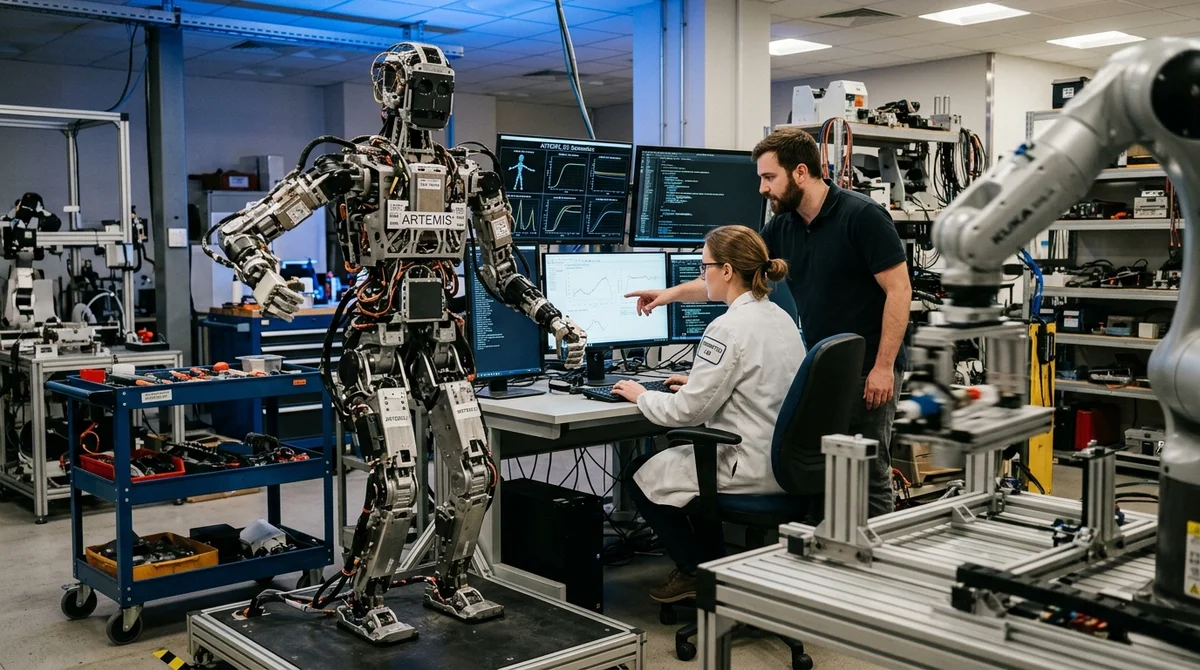
Meta has bought Assured Robot Intelligence, a startup working on humanoid robotics. The company explicitly ties the deal to the goal of strengthening its AI models for robots and bringing closer the moment when such systems can act confidently in the physical world, not just answer queries in chats.
Why Meta needs the deal
The AI market is shifting quickly from generating text and images to systems that can perceive their surroundings, make decisions and carry out actions. This matters especially for robots: understanding language is not enough. They must see space, judge distances, choose a safe movement and correct it in real time. So for Meta, buying a specialized startup looks less like a side experiment and more like an attempt to assemble missing expertise in-house faster.
The deal also has a practical logic. Building humanoid systems takes not only strong models but also a team that can connect training, computer vision, actuator control and testing on real hardware. An acquisition often delivers all of it at once: engineers, prior work, data and an understanding of where a model behaves confidently and where it breaks on simple household tasks. For Meta, it is a way to shorten the path from research to working robots.
What the company gets
The main takeaway from Meta's brief announcement is that the company needs stronger AI models specifically for robots. That detail matters because in robotics, value is usually not created by mechanics alone. The software layer that links perception, planning and action matters far more. If Meta is betting on the humanoid form factor, it needs a stack that can transfer knowledge from a model to physical tasks: pick up an object, walk across a room, open a door, avoid touching a person and fix a mistake after a failed movement.
Training data is a separate question. Text models can be scaled on huge datasets, but robots need observations from the real environment: how objects slip, how grip changes, how a hand misses and how the system corrects its trajectory. That is why robotics teams are worth no less than the models themselves. They bring experience that is hard to buy by hiring piece by piece. For Meta, this is a speedup that internal research alone would struggle to deliver.
With this purchase, Meta may gain several advantages at once:
- a team that has already worked with humanoid platforms and their limitations
- data from real-world scenarios, which large models always lack
- a faster loop between model training, simulation and hardware testing
- a foundation for its own products or research platforms in embodied AI
The humanoid format appeals to big companies for an obvious reason: the world is already built for humans. Stairs, doors, shelves, tools and workplaces do not need to be redesigned for each machine. But that is exactly why expectations for such robots are higher. They must be reliable, safe and trainable enough to work in an environment where people are constantly nearby. Improving the models may matter more here than any single hardware novelty.
What it means
The purchase of Assured Robot Intelligence shows that Meta sees robotics as the next level for its AI systems. Competition is shifting from a model that answers well to a model that can perceive the world and act in it without constant manual tuning. If Meta really can combine its work on large models with the expertise of the acquired startup, it will strengthen its position in the race for mass-market assistant robots. For the market, it is a signal that embodied AI and humanoid platforms are moving from the category of distant experiments into the zone of real product bets.
*Meta is designated an extremist organization and banned in Russia.
- Nov 1, 2026MoneyGate safety layer blocked all 42 fraudulent requests to local AI models
- Oct 31, 2026Open-source LLM gateway KTMS 1.0 plugs your own GPUs into the cloud and survives outages
- Oct 31, 202622B-Parameter LTX-2.5 Runs on a 10 GB RTX 3080, but Takes 5 Minutes per Shot
- Oct 29, 2026T-Tech Introduces LIMe, a Method That Trains Language Models With 15% Less Compute
Key Questions Answered
Why Meta needs the deal?
The AI market is shifting quickly from generating text and images to systems that can perceive their surroundings, make decisions and carry out actions. This matters especially for robots: understanding language is not enough. They must see space, judge distances, choose a safe movement and correct it in real time. So for Meta, buying a specialized startup looks less like a side experiment and more like an attempt to assemble missing expertise in-house faster. The deal also has a practical logic. Building humanoid systems takes not only strong models but also a team that ca
What the company gets?
The main takeaway from Meta's brief announcement is that the company needs stronger AI models specifically for robots. That detail matters because in robotics, value is usually not created by mechanics alone. The software layer that links perception, planning and action matters far more. If Meta is betting on the humanoid form factor, it needs a stack that can transfer knowledge from a model to physical tasks: pick up an object, walk across a room, open a door, avoid touching a person and fix a mistake after a failed movement. Training data is a separate question. Text mode
What it means?
The purchase of Assured Robot Intelligence shows that Meta sees robotics as the next level for its AI systems. Competition is shifting from a model that answers well to a model that can perceive the world and act in it without constant manual tuning. If Meta really can combine its work on large models with the expertise of the acquired startup, it will strengthen its position in the race for mass-market assistant robots. For the market, it is a signal that embodied AI and humanoid platforms are moving from the category of distant experiments into the zone of real product be
Test Frontier LLMs & Autonomous Agents in One Workspace
Run Claude Opus 5.5, GPT-6, Gemini 3.1, and DeepSeek side-by-side in Nomad AI (nomadnet.ai) — unified model routing, deep research, and multimodal workflows under one subscription.
The AI world, distilled — once a week
Seven stories that actually mattered, hand-picked. No noise, no reposts, no press releases.
Done! Check your inbox for a confirmation.