MIT explained how artificial intelligence and the mathematical and physical sciences reinforce each other
MIT published a vision for the future of AI at the intersection of physics, mathematics, chemistry, and materials science. Professor Jesse Thaler describes a…
AI-processed from MIT News; edited by Hamidun News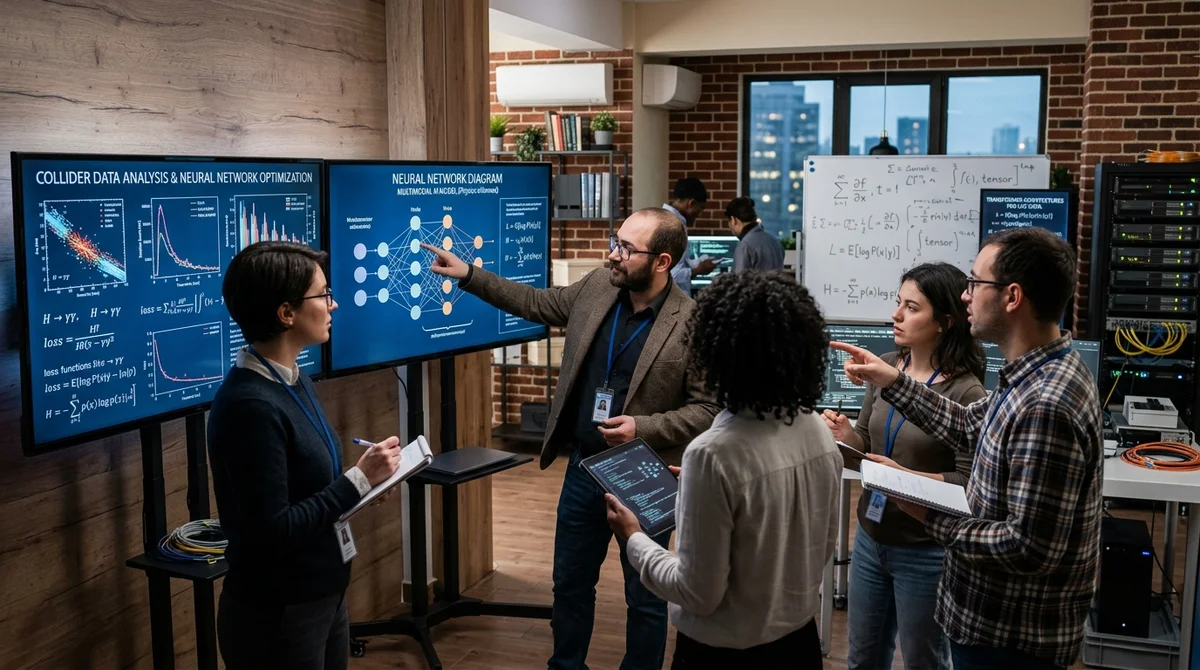
MIT has explained how artificial intelligence and fundamental sciences can strengthen each other rather than develop separately. According to Professor Jesse Thaler, the next stage of AI depends not only on implementing models in science but also on how science itself will help understand, improve, and control these systems.
The Logic of a Two-Way Bridge
The conversation was prompted by the AI+MPS workshop that MIT held in 2025 together with researchers from physics, mathematics, chemistry, materials science, and astronomy. From these discussions grew a white paper with recommendations for universities, researchers, and funding agencies, later published in the journal Machine Learning: Science and Technology.
The main conclusion: AI already owes much to mathematical and physical sciences, because they provided the complex problems, high-quality data, and ideas upon which modern machine learning methods were built.
Thaler proposes looking at the connection more broadly. It's not just about neural networks helping find new materials, analyze collider data, or solve mathematical problems. Scientific approaches can also improve AI itself: explain model behavior, suggest new architectures, and make systems more manageable.
MIT believes that at the intersection of these two worlds, a separate field is currently forming that will influence both the pace of scientific discovery and the quality of future intelligent systems.
"This should be a movement in both directions."
What Science Gives to AI
MIT calls this the science of AI — a scientific perspective on intelligent systems themselves. In his paper, Thaler divides it into three directions: science as a foundation for AI, science as a source of new algorithms, and science as a tool for explaining how models work.
For fundamental disciplines, this is not abstract theory but a practical route that can simultaneously accelerate discoveries and improve AI reliability, especially where models are expected not just to be accurate but also interpretable.
From the discussions of five scientific communities, consensus quickly emerged: the bridge between AI and science cannot be built through separate laboratories or one-off experiments. Common conditions are needed that will work across different disciplines and be sustainably supported at the institutional level.
Workshop participants narrowed this basic set to several practical priorities important for universities, funding agencies, and research teams themselves:
- investments in computational infrastructure and data infrastructure;
- interdisciplinary research methods;
- more rigorous training of specialists at the intersection of fields;
- long-term support for projects where AI and science develop together.
A separate example is high-energy physics. There, researchers build real-time algorithms to handle the data stream from colliders. Such solutions are needed for discovering new physics but can then extend far beyond a single discipline and influence the broader AI stack. The logic here is simple: the more rigorous the scientific problem, the higher the chance that methods created for it will prove useful in other areas, from signal processing to more efficient model training.
Personnel and Strategy at MIT
The second overarching thesis is that models and computing alone are not enough. For real progress, we need people who are equally confident in computing and in their scientific discipline. Thaler calls them "centaur-scientists."
This is not about rare universal individuals but about systematic training: from integrated courses for students to interdisciplinary PhD tracks, joint faculty hiring, and special postdoc positions where young researchers can work between fields without career penalty for such hybridity.
MIT believes it already has some of this infrastructure. Thaler gives IAIFI, the A3D3 institute, and university programs that teach students to be "bilingual" in computing and their base specialty as examples.
A particular emphasis is on a systemic approach: universities that coordinate hiring, education, computational resources, and research funding as a unified strategy will benefit. As a sign of this approach, MIT has already launched the first joint faculty search between the Schwarzman College of Computing and the Department of Physics.
What This Means
From MIT's position, it's clear that the next wave of AI is increasingly tied not just to products and model scaling but to fundamental science. For the market and universities, this is a signal: competitive advantage will increasingly belong to those who know how to combine algorithms, scientific expertise, data, infrastructure, and training of interdisciplinary teams.
Want to stop reading about AI and start using it?
AI News is a curated feed of AI/tech news. Hamidun Academy teaches you to use AI systematically in your work.