Perplexity unveils Personal Computer, an AI agent for Mac mini and teams
Perplexity showed Personal Computer, software for the Mac mini that gives AI persistent access to local files, apps and tasks. The company also launched Computer for enterprise with SOC 2, SAML and Slack integration, and opened more than 40 live financial data tools. The bet is simple: sell not a single model but the orchestration of an entire AI infrastructure for business and analytics.
AI-processed from TNW; edited by Hamidun News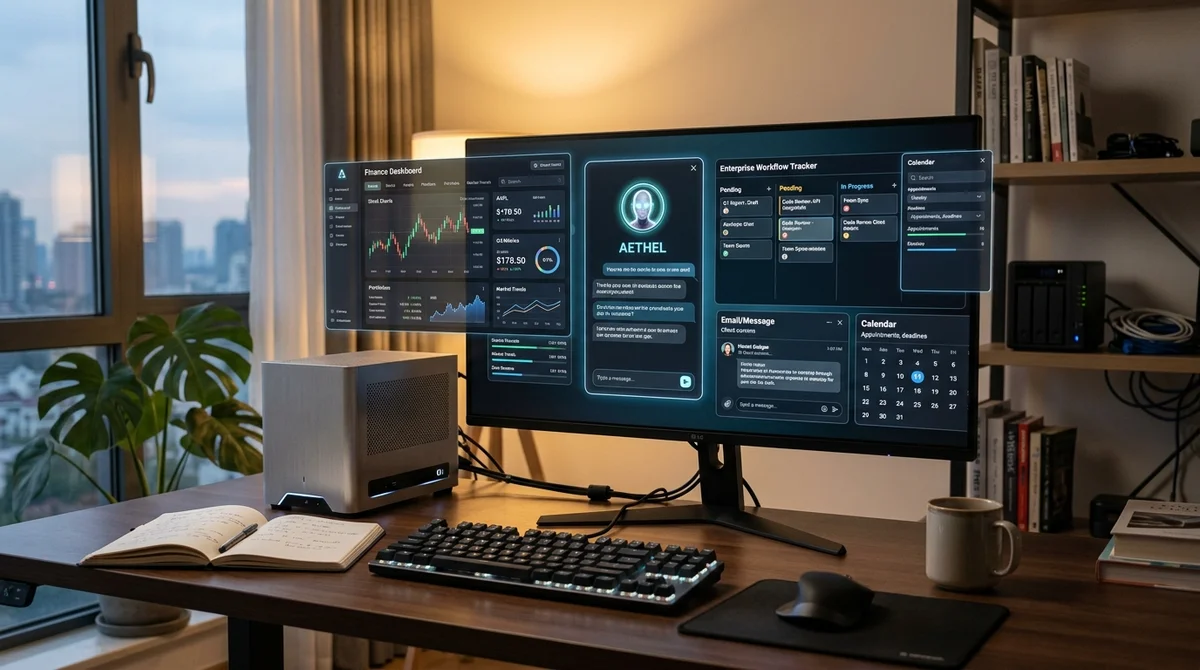
Perplexity is trying to redefine what a computer is: no longer just an interface for launching programs, but an AI agent that runs around the clock. At its Ask 2026 conference, the company showed Personal Computer for the Mac mini, an enterprise version of Computer, and an expansion of its financial tools.
How Personal Computer works
The main announcement is Personal Computer. It is not a new Perplexity device but software installed on a dedicated Mac mini, linking local files, apps and active sessions to the cloud-based Computer agent. As designed, the Mac mini acts as an always-on host: the AI gets access to the working environment, watches for events and continues tasks without the user's involvement. It can be controlled remotely from any device, and the system is meant to be available around the clock.
- access to local files and apps
- launching and continuing tasks 24/7
- remote control from any device
- manual confirmation of sensitive actions
Perplexity stresses that this mode has safeguards. Sensitive operations require explicit user approval, every session leaves a full audit trail, and an emergency kill switch can stop the agent instantly.
At launch, Personal Computer is available only to Max subscribers at $200 per month, with a package of 10,000 compute credits. The launch is Mac-only, and a waitlist is already open for early users.
Moving into the enterprise
The second big step is bringing Computer into the corporate environment. The business version gets SOC 2 Type II, SAML SSO, action auditing and an isolated sandbox for each request. It connects natively to Snowflake, Salesforce, HubSpot and hundreds of other platforms, so teams can pull data from warehouses, take context from the CRM and build models without queuing for analysts or the data team. In essence, it is an attempt to eliminate the manual glue between disparate corporate systems.
Perplexity is also betting on fitting into existing workflows. Computer can be used directly from Slack, in direct messages or shared channels. The idea is that the agent should not live in a separate tab: it becomes another participant in the work loop, able to write queries, assemble structured results, update documents and run recurring scenarios. For companies, this looks less like yet another chatbot and more like an automation layer on top of their current set of services.
The company's argument about models is also interesting. According to its internal data, in January 2025, 90% of enterprise queries went to just two models, and by December no single model accounted for more than 25% of usage. That is a good indicator of how quickly the market is moving away from the idea of "one provider for everything." Perplexity is selling not its own frontier model but orchestration: a system that picks the best AI stack for a given task.
Finance and APIs
At the same conference, the company markedly strengthened Perplexity Finance. By its figures, 75% of users ask financial questions every month, so Computer got direct access to more than 40 live data tools. Sources include SEC filings, FactSet, S&P Global, Coinbase, LSEG and Quartr. This matters to users for two reasons: no separate API key or license is needed for each source, and every figure can be traced back to the original data.
The practical scenario is fairly direct: Computer can build interactive dashboards, create Excel models and even help create full-fledged financial applications for external teams.
Perplexity also announced new APIs for developers, though without a detailed specification in the public post. The overall logic is clear: the company wants to expand not just the user interface but the programmable surface of its platform. It is a logical continuation of February's launch of the usage-based API for Computer.
"A traditional operating system gets instructions; an AI operating
system gets objectives."
With this line, CEO Aravind Srinivas effectively described Perplexity's entire product thesis. The user specifies not a sequence of actions but an outcome, and the system decides which models, tools and steps to use next. This is where the company builds its difference from the large AI providers: competing not only on model quality but on how conveniently it ties together the web, the local computer, corporate systems and specialized data tools in a single interface.
What this means
Perplexity is moving ever more aggressively away from its image as an AI search engine and trying to claim the position of an operating layer on top of models, data and work services. If the bet pays off, the value will come not from the company's own models but from its ability to combine other vendors' models, corporate data and a local computer into one practical agent.
For the market, it is another signal: the next stage of AI competition is no longer only about answer quality, but about who is better at carrying a task through to a result.
- Oct 29, 2026Claude in Houdini on Windows: Two Bugs in the Agent Panel and a 31-Node Geode
- Oct 28, 2026NVIDIA Releases 120B Nemotron 3.5 Super VL and Bolt Models for Local Agents
- Oct 28, 2026Modal Raises $750M at a $15.75B Valuation and Reaches $1B in ARR
- Oct 27, 2026Meta opens Muse Spark at 816B, Reflection releases Beam under Apache 2.0
Key Questions Answered
How Personal Computer works?
The main announcement is Personal Computer. It is not a new Perplexity device but software installed on a dedicated Mac mini, linking local files, apps and active sessions to the cloud-based Computer agent. As designed, the Mac mini acts as an always-on host: the AI gets access to the working environment, watches for events and continues tasks without the user's involvement. It can be controlled remotely from any device, and the system is meant to be available around the clock. access to local files and apps launching and continuing tasks 24/7 remote control from any device
What are the key details on Moving into the enterprise?
The second big step is bringing Computer into the corporate environment. The business version gets SOC 2 Type II, SAML SSO, action auditing and an isolated sandbox for each request. It connects natively to Snowflake, Salesforce, HubSpot and hundreds of other platforms, so teams can pull data from warehouses, take context from the CRM and build models without queuing for analysts or the data team. In essence, it is an attempt to eliminate the manual glue between disparate corporate systems. Perplexity is also betting on fitting into existing workflows. Computer can be used d
What are the key details on Finance and APIs?
At the same conference, the company markedly strengthened Perplexity Finance. By its figures, 75% of users ask financial questions every month, so Computer got direct access to more than 40 live data tools. Sources include SEC filings, FactSet, S&P Global, Coinbase, LSEG and Quartr. This matters to users for two reasons: no separate API key or license is needed for each source, and every figure can be traced back to the original data. The practical scenario is fairly direct: Computer can build interactive dashboards, create Excel models and even help create full-fledged fin
Test Frontier LLMs & Autonomous Agents in One Workspace
Run Claude Opus 5.5, GPT-6, Gemini 3.1, and DeepSeek side-by-side in Nomad AI (nomadnet.ai) — unified model routing, deep research, and multimodal workflows under one subscription.
The AI world, distilled — once a week
Seven stories that actually mattered, hand-picked. No noise, no reposts, no press releases.
Done! Check your inbox for a confirmation.