How Del Complex, a fake floating AI data center with H100, fooled X and major tech media
In 2023, the Del Complex project passed itself off as an independent floating AI data center with 10,000 Nvidia H100 in international waters. The idea…
AI-processed from Habr AI; edited by Hamidun News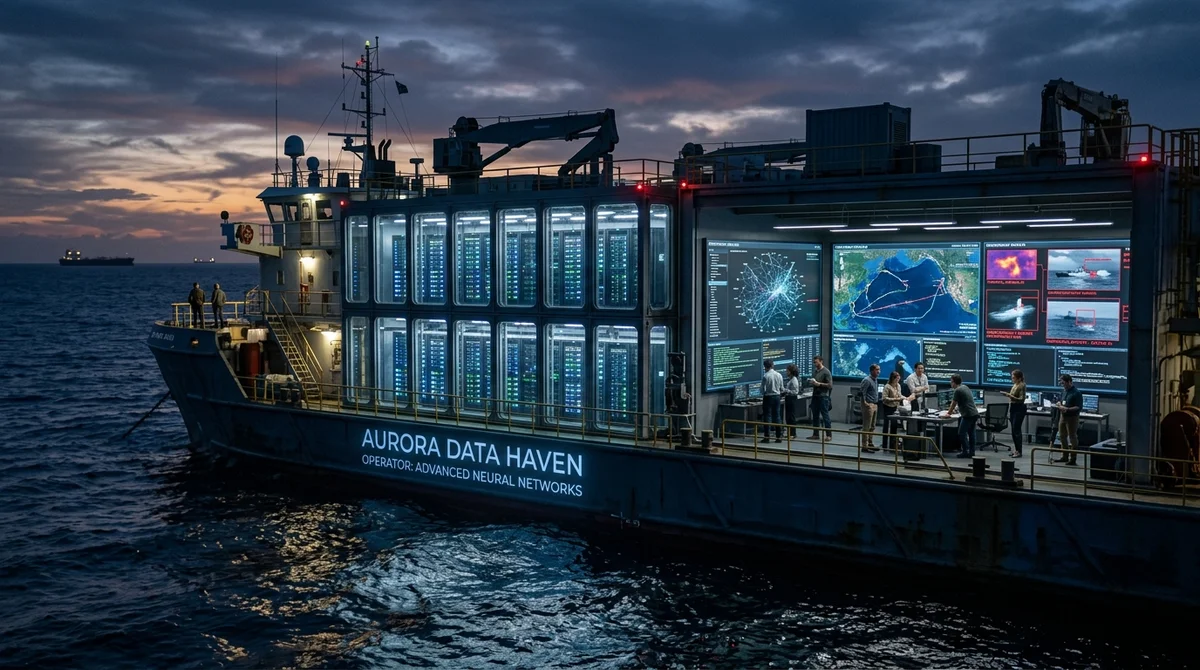
In late 2023, the Del Complex project convinced part of the tech internet that an independent floating AI data center with 10 thousand Nvidia H100s was about to launch in international waters. The story looked like a mix of engineering audacity, legal hacking, and good visual production — which is exactly why it was believed not only by X users, but also by well-known media outlets.
How Del Complex Appeared
On October 31, 2023, a presentation of BlueSea Frontier appeared on the Del Complex website — an autonomous barge with a huge GPU cluster on board. According to the narrative, the vessel was supposed to venture into international waters and become the foundation for a new offshore AI infrastructure. The idea was built on the premise that outside the jurisdiction of any particular state, one could sell computing power without pressure from national regulators and deploy projects related to artificial intelligence faster.
The concept looked especially impressive against the backdrop of US and other governments beginning to seriously discuss AI control. Del Complex referenced international maritime law, painted a picture of an independent technological territory, and added expensive setting to it: cutting-edge accelerators, armed security, laboratories, underground bases, and ambitions on the level of private DARPA. For an audience in late 2023, this sounded insane, but not impossible — more like a daring startup at the intersection of infrastructure, politics, and sci-fi.
Why the Story Took Off
Several factors worked at once. First, in 2023, the public wasn't yet trained to recognize AI images and staged tech stories the way it is now. Second, Del Complex didn't have just one viral post, but a full digital shell: website, visualizations, social media accounts, job listings, and even geographical traces. All this created the sense that people were dealing not with a meme, but with a secret, but real infrastructure project.
- 10 thousand H100s sounded like an insane, but understandable power metric
- International waters added political and legal conflict to the narrative
- AI images then seemed strange, but were often still perceived as real
- The story was picked up by X and major tech media, amplifying the effect of authenticity
- The project spoke in the language of engineers, investors, and visionaries all at once
Additional credibility came from the fact that Del Complex didn't limit itself to a beautiful idea. On the website, the company talked about other directions — neurointerfaces, robotics, clean energy, fundamental research. As a result, an image was created of an organization that allegedly had been around for a long time and was running several breakthrough programs at once. When a legend is detailed enough, people start checking not the foundation of the story itself, but secondary details — and it's at this stage that a fake often goes further than it should.
How the Fake Was Exposed
The exposure came from the most boring side — through physics and attention to detail. If you roughly calculate the power consumption of 10 thousand H100s along with accompanying equipment and cooling, you get around 12 MW. For such a load, solar generation alone would require areas of tens of thousands of square meters, incompatible with a typical barge.
Add to this corrosion from salt aerosol, vibrations on water, cooling complexity, maintenance logistics, and constant staff rotation. The further journalists and skeptics moved away from the beautiful presentation toward operational details, the less reality remained in the story. Visual materials didn't hold up to scrutiny either.
The images contained typical generation artifacts: strange faces, unnatural objects, blurry details, and inconsistencies between different scenes. Journalists were also unable to find convincing legal traces of the company itself: no proper registry presence, no understandable corporate history, no independent confirmations of the claimed facilities. A symbolic detail was the signature in the project's account.
"Corporation of Alternative Reality"
Later it turned out that behind Del Complex was artist and developer Sterling Crispin. He admitted that the project was an artistic experiment and a test of how easily media and the public pick up a technology myth if it's packaged correctly. And in that sense, the experiment worked: it revealed not only weakness in editorial fact-checking, but also how quickly AI visualization can turn an absurd idea into a plausible news story.
What This Means
The Del Complex story became an early demonstration of a new media reality: plausibility is now assembled not only from facts, but also from interface, style, and speed of distribution. The good news is that the audience has since become more attentive to AI content. The bad news — the next similar hoax will be made even more carefully, so the habit of checking basic things like energy, legal entities, and primary sources becomes mandatory.
Want to stop reading about AI and start using it?
AI News is a curated feed of AI/tech news. Hamidun Academy teaches you to use AI systematically in your work.