Claude turned into a personal health analyst with access to sleep data and lab results
Claude can work as a personal health analyst if you give it access to Notion, Oura, nutrition logs and weight data. The author built a system where the AI sees sleep, heart rate, blood test results, medications and workouts in real time. The model then answers practical questions: how sleep deprivation affects heart rate, whether nutrition keeps up with training load, and which patterns are hard to spot manually.
AI-processed from Habr AI; edited by Hamidun News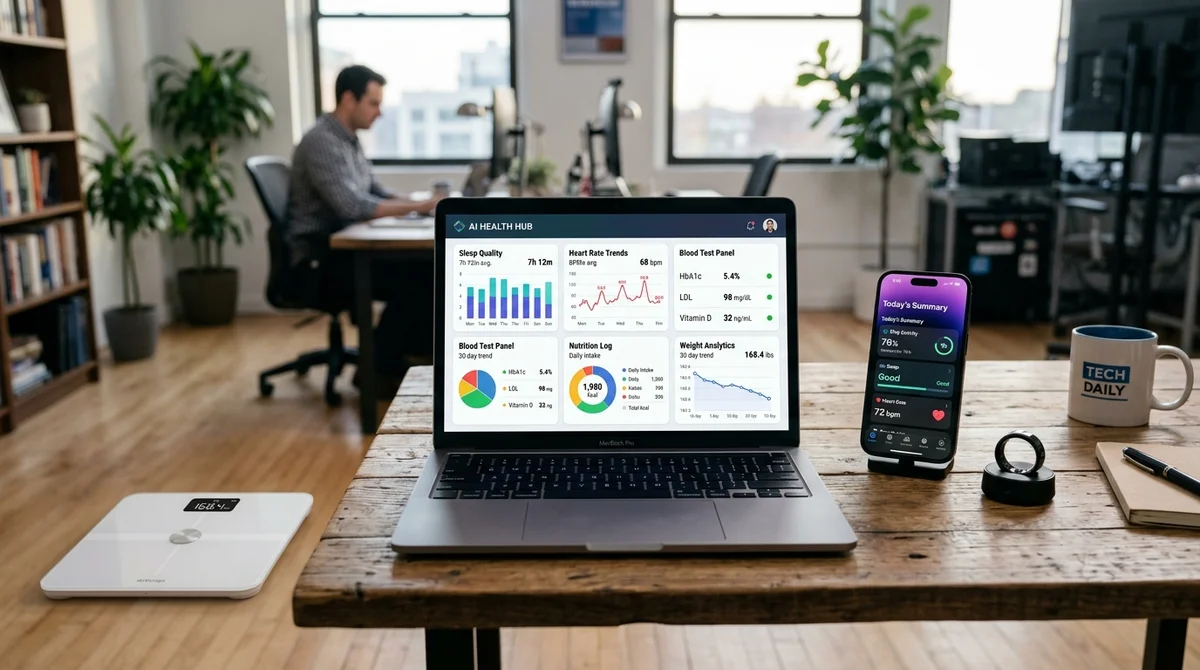
Claude can go from a regular chatbot to a personal health analyst once you connect it to biometrics, nutrition, weight and medical documents. The author of the experiment built this setup on Claude Integrations and showed how the model starts to see links between sleep, heart rate, diet and blood tests almost in real time.
How the setup works
Claude sits at the center of the system and pulls data from several sources at once rather than from a single app. An Oura Ring covers sleep, resting heart rate, HRV and activity. Nutrition comes from FoodTrack, a Telegram bot: you send it a photo of your meal and get back calories, protein, fat and carbs. Weight and body composition flow from Xiaomi scales through a chain of Zepp Life, Apple Health and Health2Notion.
Notion forms a separate layer, holding lab results, doctor consultations, medications and historical records. Instead of a scattered pile of notes, the model gets a single digital map of the person's health. Claude can match "raw" signals from wearables against rarer but important medical events: lab results, weight changes, prescriptions and manual notes.
This is where the real value shows up. The AI doesn't just answer individual questions; it looks for correlations across several data streams that are hard to notice by hand, even with a carefully kept diary.
How it was connected
Part of the setup uses built-in tools. Notion is already one of Claude's standard connectors, so you only need to grant access to the pages with medical data. Oura was harder: the author used an open-source project from GitHub, deployed it on his own server and added it to Claude as a custom connector. FoodTrack connects the same way: the bot returns a unique MCP address, which Claude then uses as another data source.
The author specifically highlights the role of the system prompt in Custom Instructions. In it, he briefly described what each connector is for: Oura for real-time metrics, Notion for history and documents, FoodTrack for nutrition. With that in place, Claude stops guessing where to look and goes straight to the right source. This instruction layer looks like a minor detail, but in practice it significantly improves the analysis and cuts down on unnecessary clarifying questions.
What insights it delivers
The most interesting part of the setup isn't the integration itself but the kinds of questions it lets you ask. The author doesn't ask the model for abstract advice on "how to get healthier"; he uses it as an analyst on top of his own dataset. For example, Claude can check whether resting heart rate rises after a short night's sleep, whether calories and protein cover the current training load, or how blood biomarkers changed alongside medications, stress and daily routine.
- The link between sleep duration and next-day resting heart rate
- Whether nutrition is sufficient for training volume and recovery
- Weight and body composition trends alongside activity and diet
- Changes in lab values in the context of medications and lifestyle
This approach turns an LLM from a generator of generic recommendations into an interface to a personal medical timeline. The article cites a sample answer that isn't a vague "get more sleep" but points to a concrete pattern: on days after poor sleep, the next day's resting heart rate is consistently higher. It's not magic and not a diagnosis, just a convenient way to quickly pull a hypothesis out of your own data.
"It's not a replacement for a doctor, but a tool that helps you ask
the right questions."
What it means
The story shows clearly where consumer AI tools are heading: from a general-purpose chat toward personal analytics layers on top of scattered services. If users have good-quality data and a clear access setup, the model can become a useful assistant for self-tracking and for preparing for a doctor's visit. But the cost of errors, privacy risks and misinterpretations grows along with it, so these systems are best treated as a second opinion, not a medical diagnosis.
- Nov 1, 2026OpenAI Rewrites GPT Behavior Rules: Five Values and a Chain of Command
- Nov 1, 2026Google admits AI Mode cuts search revenue, shares fall 15%
- Oct 31, 2026Author puts his script before an AI jury: the verdict cost 850 thousand tokens
- Oct 31, 2026Anthropic: Fold Subagents Back Into a Single Loop — One Customer's Tasks Ran Twice as Fast
Key Questions Answered
How the setup works?
Claude sits at the center of the system and pulls data from several sources at once rather than from a single app. An Oura Ring covers sleep, resting heart rate, HRV and activity. Nutrition comes from FoodTrack, a Telegram bot: you send it a photo of your meal and get back calories, protein, fat and carbs. Weight and body composition flow from Xiaomi scales through a chain of Zepp Life, Apple Health and Health2Notion. Notion forms a separate layer, holding lab results, doctor consultations, medications and historical records. Instead of a scattered pile of notes, the model
How it was connected?
Part of the setup uses built-in tools. Notion is already one of Claude's standard connectors, so you only need to grant access to the pages with medical data. Oura was harder: the author used an open-source project from GitHub, deployed it on his own server and added it to Claude as a custom connector. FoodTrack connects the same way: the bot returns a unique MCP address, which Claude then uses as another data source. The author specifically highlights the role of the system prompt in Custom Instructions. In it, he briefly described what each connector is for: Oura for real
What insights it delivers?
The most interesting part of the setup isn't the integration itself but the kinds of questions it lets you ask. The author doesn't ask the model for abstract advice on "how to get healthier"; he uses it as an analyst on top of his own dataset. For example, Claude can check whether resting heart rate rises after a short night's sleep, whether calories and protein cover the current training load, or how blood biomarkers changed alongside medications, stress and daily routine. The link between sleep duration and next-day resting heart rate Whether nutrition is sufficient for t
Test Frontier LLMs & Autonomous Agents in One Workspace
Run Claude Opus 5.5, GPT-6, Gemini 3.1, and DeepSeek side-by-side in Nomad AI (nomadnet.ai) — unified model routing, deep research, and multimodal workflows under one subscription.
The AI world, distilled — once a week
Seven stories that actually mattered, hand-picked. No noise, no reposts, no press releases.
Done! Check your inbox for a confirmation.