MIT Technology Review: 90% of engineering companies will increase AI investment, but without rushing
AI is moving deeper into the development of machinery, home appliances, and medical devices, but engineers are deploying it incrementally and in narrow use cases. Nine out of ten product engineering leaders will increase investment over the next 1–2 years, most often moderately—by up to 25%. The main areas are predictive analytics, simulations, and validation, while the key metrics are product quality and resilience.
AI-processed from MIT Technology Review; edited by Hamidun News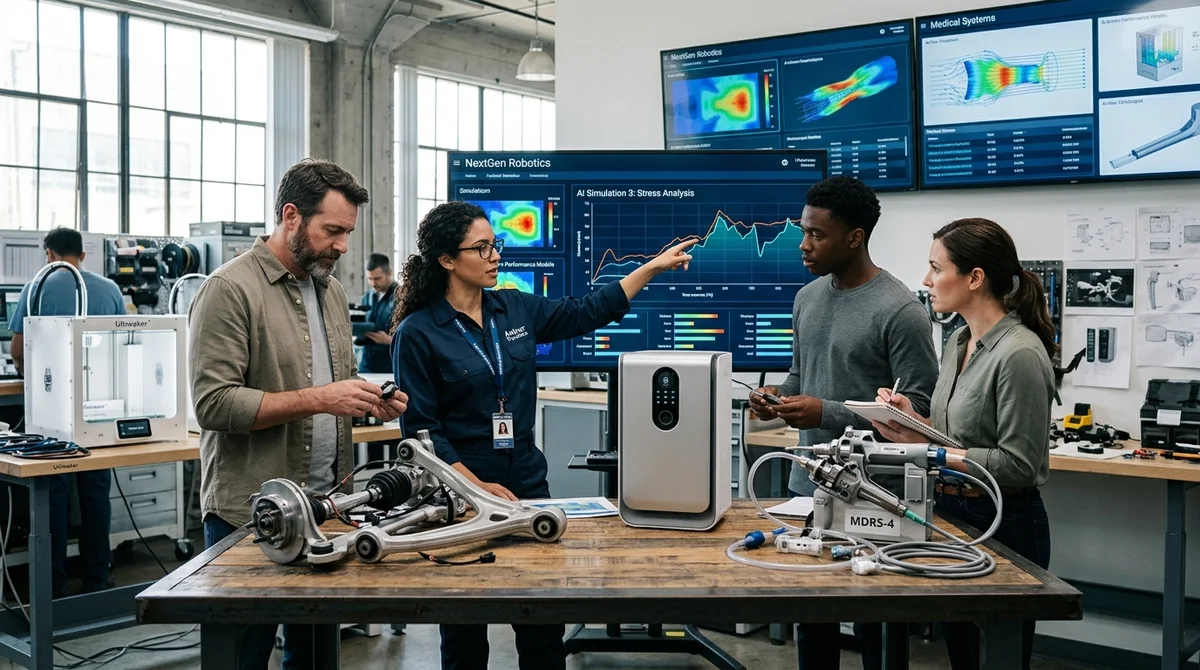
AI is increasingly affecting not just software, but things that work in the physical world: cars, household appliances, and medical devices. Research by MIT Technology Review Insights and L&T Technology Services shows that engineers are ready to expand AI applications, but they do so not driven by hype logic, but by logic of risk, verification, and measurable results.
Why the Cost of Error Is High
In product engineering, a model error costs differently than in a digital service. If a wrong chatbot answer can be fixed with an update, a defect in design, an embedded system, or a production solution can lead to product recalls, accidents, or regulatory issues. Therefore, teams implementing AI in the design and manufacture of physical products are not ready to trust general-purpose models as they are.
They build processes with different levels of trust, mandatory verification, and clear human accountability. The study's authors emphasize: here what matters is not demonstration magic, but first-time-right — the ability to get a correct result on the first try or as close as possible. For companies that produce machinery, electronics, or medical devices, such a metric is more important than loud claims about transformation.
This is why AI implementation happens in layers: first in areas where the effect can be verified, then — deeper into the product lifecycle. This is exactly how companies reduce the risk of costly mistakes and build trust in new tools.
"Where AI results affect a physical system and cannot be rolled back,
reliability and measurability are the priority."
Where Budgets Are Going
The survey covered 300 executives responsible for product engineering, development, and technology from the United States. All represent companies with revenue from $500 million across 16 industries, and interviews complemented the views of senior management and industry experts. Nine out of ten respondents plan to increase investments in AI over the next one to two years, but they are not planning a sharp leap. 45% expect spending to grow by a maximum of 25%, about a third — by 26–50%, and only 15% are ready to increase the budget immediately by 51–100%.
Priorities are also pragmatic: not smart assistants for their own sake lead, but tools that are easier to verify, protect before regulators, and tie to ROI. Front and center are analytics, simulations, and validation — areas where engineers have clear feedback and historical data. Such tasks are easier to audit, align, and defend to business stakeholders.
The study highlights several directions around which current demand is being built:
- Predictive analytics for early detection of defects and weaknesses
- AI simulations and validation before production launch
- Multi-level model and result verification
- Specialized, auditable tools instead of general-purpose systems
What's Changing in Teams
A separate conclusion concerns people. 73% of executives expect AI to take on routine engineering work. This does not mean specialists become less important; the center of gravity itself shifts. Within companies, value moves from manual execution of repetitive operations to architectural decisions, systems thinking, and strategic assessment of trade-offs. The more operational work goes into tools, the more important people who understand model boundaries and are responsible for the final choice become. Meanwhile, the role of external partners and specialized vendors is growing. If some execution shifts to third-party ecosystems, then ownership of key logic, data, and decision-making rules becomes a matter of control.
The authors note another shift: companies measure success not just by speed of bringing a product to market. Higher on the list of goals are product quality and resilience — metrics that customers, investors, and regulators see. While cost reduction and team satisfaction move lower in priorities.
What This Means
For the market, this is a signal: AI in the engineering of the physical world enters not through flashy demos, but through verifiable narrow scenarios with clear ROI. Winners will not be those who promise revolution loudest, but those who faster integrate AI into simulations, quality control, and engineering decision-making without losing trust, safety, and accountability. This cautious model, it seems, will become the main implementation template in the coming years.
Want to stop reading about AI and start using it?
AI News is a curated feed of AI/tech news. Hamidun Academy teaches you to use AI systematically in your work.
The AI world, distilled — once a week
Seven stories that actually mattered, hand-picked. No noise, no reposts, no press releases.
Done! Check your inbox for a confirmation.