Singapore has put over S$1 billion into AI, but AI Singapore sees a shortage of people who can build it
Singapore has already committed more than S$1 billion to AI development, but alarm is sounding inside the ecosystem: the country lacks not users of AI tools, but people who can build the systems themselves. AI Singapore warns that formal training programs are updated too slowly, and the labor market already shows the effect: the share of graduates in permanent employment fell noticeably within a year.
AI-processed from Bloomberg Tech; edited by Hamidun News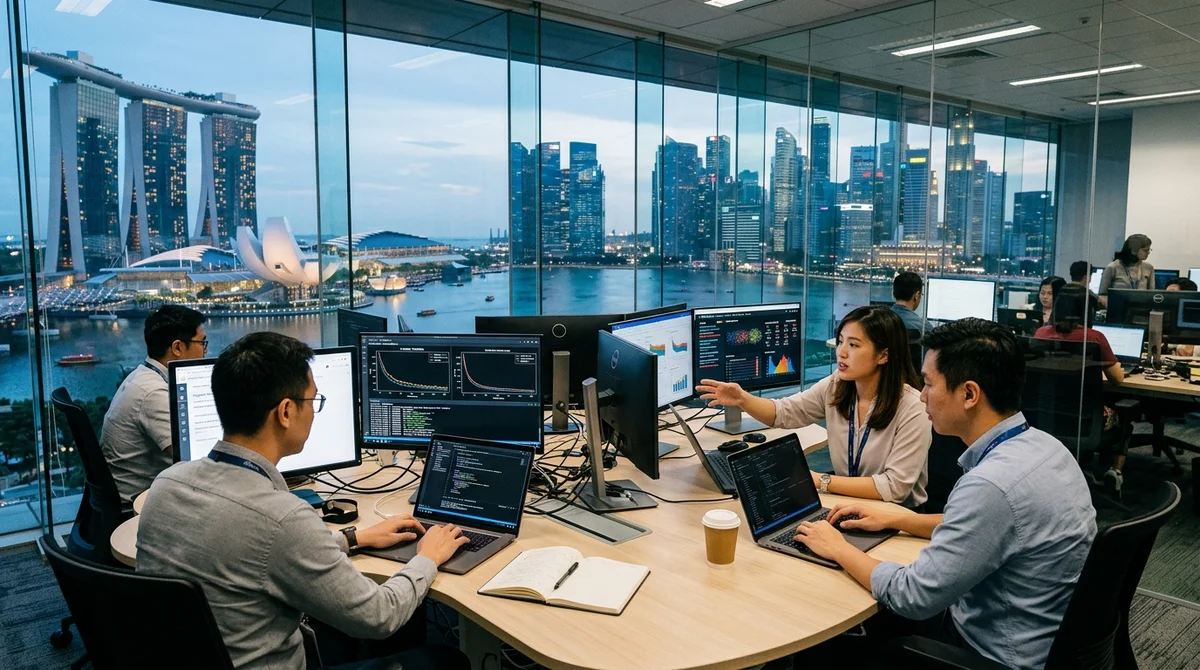
Singapore has already invested more than S$1 billion in becoming a global artificial intelligence hub. But a warning is coming from inside the national AI ecosystem: it is not enough to teach people to use off-the-shelf tools. The country needs to grow, faster, people who can build their own models and products.
A bet on homegrown models
In recent years Singapore has steadily stepped up its AI agenda: it updated its national strategy, set aside dedicated measures in the budget and is expanding programs for businesses and training. The official goal is not just to deploy other people's solutions, but to build a local school of developers, researchers and teams who can create technology inside the country. In the NAIS 2.0 strategy, the authorities state outright that they aim to grow the country's own pool of AI practitioners to 15 thousand people within five years, and that AI should become a factor in economic resilience, not merely a tool for improving efficiency.
Against this backdrop, a statement by Leslie Teo, senior director at AI Singapore and one of the architects of local AI policy, is especially telling. In his words, the current approach to national readiness may be drifting toward "certified users" of AI, while the economy needs "builders": engineers, researchers and product teams who know how to train, adapt and deploy systems. For a small country this is a question not only of growth but of technological agency: if domestic expertise is thin, you end up living by rules set by others.
Where training falls behind
The government's main instrument here is SkillsFuture, a program of learning credits and subsidized courses for citizens throughout their careers. In 2025, about 606 thousand people went through supported programs. But Teo points not to reach but to speed: by the time a course is designed, approved and officially launched, its content may already be out of date. In AI this is especially painful, because tools, approaches and even basic practices change literally by the quarter.
- Formal programs are updated more slowly than the AI market changes
- Companies are less and less willing to train juniors in-house
- The gap is growing between the skill of "using AI" and the ability to "build AI"
- It is dangerous for a small economy to depend entirely on models built abroad
"Junior staff are cheap. AI is even cheaper."
From this Teo concludes that the state may have to treat basic training of entry-level specialists as a public good. Employers used to take on part of this function, but with automation the incentive to invest in entry-level positions is falling. As a result, the market may end up with many people holding AI certificates, but too few who went through real engineering training on real problems.
The market is already shifting
The effect is already visible in the labor market. According to the annual survey of Singapore's universities, the share of graduates who found permanent full-time employment fell to 74.4% in 2025, from 79.4% a year earlier. This is not proof that AI alone is "eating" entry-level jobs, but it is a worrying signal: automation and the reshaping of junior roles are already affecting the first rung of the career ladder.
Still, the question for Singapore is broader than graduate employment. If the country relies entirely on AI systems built abroad, it has almost no influence over how those systems develop, which languages and cultural contexts they support, and whose interests are baked into them by default. That is why AI Singapore develops SEA-LION, a family of large language models for Southeast Asia that regional companies, including GoTo Group, already use. A homegrown model does not solve the talent shortage, but it gives the country a seat at the table where technology decisions are made.
What this means
Singapore illustrates a problem that will soon be common to many markets: mass AI literacy does not by itself create an AI industry. The next stage of competition is not teaching everyone to use chatbots, but quickly building a pipeline of engineers, researchers and product teams before formal education and the labor market fall irreversibly behind the technology.
- Oct 31, 2026Author puts his script before an AI jury: the verdict cost 850 thousand tokens
- Oct 29, 2026OvisOCR3: an 0.8B-parameter model that reads documents better than specialized systems
- Oct 29, 2026Tencent releases Youtu-Parsing-Omni: one model parses documents, audio and video
- Oct 28, 2026Liquid AI releases LFM2.5-24B-A2B: an agent model with 2B active parameters
Key Questions Answered
What are the key details on A bet on homegrown models?
In recent years Singapore has steadily stepped up its AI agenda: it updated its national strategy, set aside dedicated measures in the budget and is expanding programs for businesses and training. The official goal is not just to deploy other people's solutions, but to build a local school of developers, researchers and teams who can create technology inside the country. In the NAIS 2.0 strategy, the authorities state outright that they aim to grow the country's own pool of AI practitioners to 15 thousand people within five years, and that AI should become a factor in econo
Where training falls behind?
The government's main instrument here is SkillsFuture, a program of learning credits and subsidized courses for citizens throughout their careers. In 2025, about 606 thousand people went through supported programs. But Teo points not to reach but to speed: by the time a course is designed, approved and officially launched, its content may already be out of date. In AI this is especially painful, because tools, approaches and even basic practices change literally by the quarter. Formal programs are updated more slowly than the AI market changes Companies are less and less wi
What are the key details on The market is already shifting?
The effect is already visible in the labor market. According to the annual survey of Singapore's universities, the share of graduates who found permanent full-time employment fell to 74.4% in 2025, from 79.4% a year earlier. This is not proof that AI alone is "eating" entry-level jobs, but it is a worrying signal: automation and the reshaping of junior roles are already affecting the first rung of the career ladder. Still, the question for Singapore is broader than graduate employment. If the country relies entirely on AI systems built abroad, it has almost no influence ove
Ship AI Faster with Founders, Engineers & Weekly Architecture Reviews
Inside Vibe Club (hamidun.com/club) — weekly live masterminds with Zhemal Khamidun, Tech Radar, full LMS access, and 370+ production Claude Code skills.
The AI world, distilled — once a week
Seven stories that actually mattered, hand-picked. No noise, no reposts, no press releases.
Done! Check your inbox for a confirmation.