Microsoft and NVIDIA call physical AI the next advantage for industry
Traditional automation is no longer enough for factories: the next step is physical AI, which can see, analyze, and act in the real world. This approach connects simulation, robots, data, and AI agents in a single loop. Microsoft and NVIDIA are promoting infrastructure designed to move these systems from pilots to scaled production without losing control, safety, or quality.
AI-processed from MIT Technology Review; edited by Hamidun News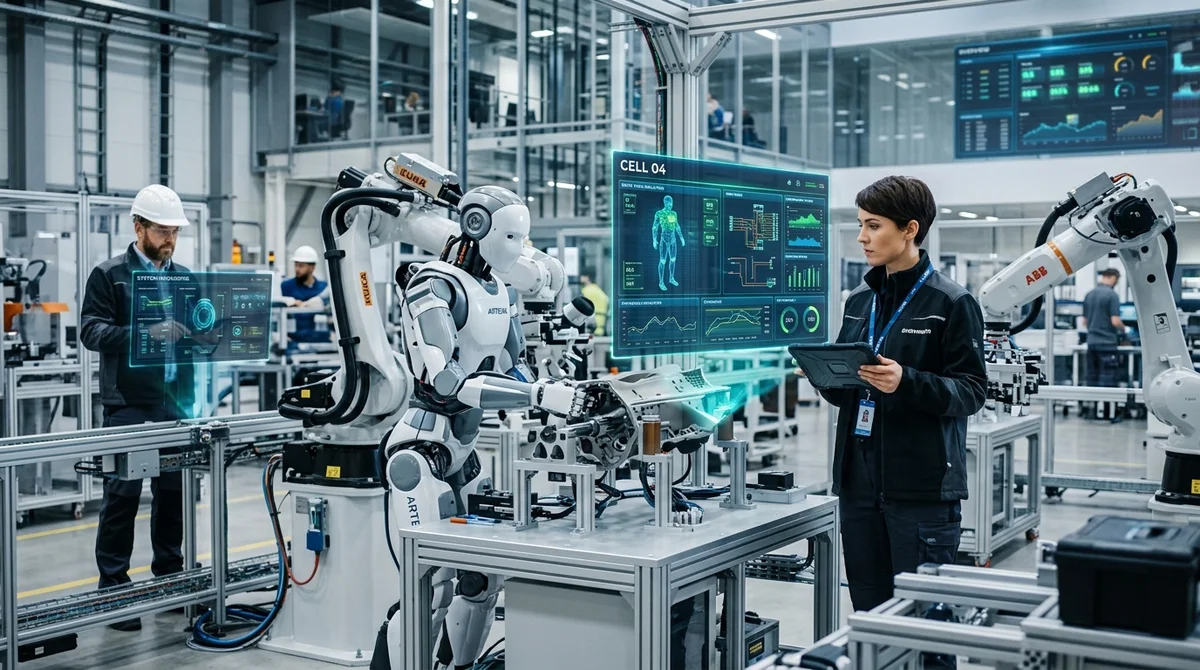
Industry is entering a new phase of automation: companies no longer just want to accelerate production lines and reduce costs. Physical AI comes into focus — systems that can perceive the real world, make decisions, and act on the factory floor alongside people.
Why Automation Is Not Enough
For decades, manufacturers have invested in automation for predictability, efficiency, and cost reduction. This approach has paid off, but now factories have a different agenda: labor shortages, more complex supply chains, short product development cycles, and constant pressure on safety and quality. Against this backdrop, simply automating repetitive operations is no longer enough.
Business needs a system that helps grow without losing control in daily operations. This is why the conversation is shifting from replacing labor to augmenting human capabilities. Early AI projects in manufacturing often solved narrow tasks: boost equipment utilization, eliminate individual bottlenecks, accelerate analytics.
But along with the gains came new problems — lack of expertise, management questions, and unclear long-term impact. In the new phase, as the material emphasizes, production leaders have two basic requirements: intelligence and trust.
"Without intelligence, AI becomes universal but superficial.
Without trust, implementation stops."
What Physical AI Changes
Physical AI moves artificial intelligence from the level of planning and reports into physical execution. It's no longer just software for forecasting, but systems that can see the situation, consider context, coordinate machines, and adapt to changes in real time during operations. Traditional automation works well in a stable environment where everything is predetermined.
Physical AI closes precisely that gap where a robot lacks flexibility and a human lacks scale. In this model, humans don't disappear from the loop. On the contrary, they set the intention, control the process, and make final decisions, while AI executes, monitors, and suggests options.
This approach is especially important for manufacturing, where an error can affect not only cost but also safety. That's why physical AI is viewed not as a set of separate robots, but as a unified environment where simulation, data, models, equipment, and management rules are connected.
- Virtually test changes in production before launching them on a real line
- Coordinate robots and equipment in changing factory conditions
- Spot quality deviations and signal risks in real time
- Link data on products, operations, and the supply chain into a single working loop
Microsoft and NVIDIA's Bet
The article describes Microsoft and NVIDIA as infrastructure providers for such a transition. NVIDIA covers the computational side: accelerated systems, open models, simulation libraries, robotics frameworks and templates. Microsoft adds a cloud platform and data platform on which physical AI can be safely deployed, scaled, and integrated into company processes.
Together they are advancing not a separate pilot, but a full production stack — from virtual verification to factory operations and further model improvement. The key emphasis here is not on robotics itself, but on trust in it. When AI affects critical operations, management requirements cannot be added at the end of the project.
The system must be observable, secure, compliant with internal policies, and provide clear accountability. Otherwise physical AI will remain at the level of demonstrations. Essentially, the bottleneck becomes not the availability of models, but a company's ability to implement them without losing control of production.
What This Means
For the market, this is a signal that the next stage of industrial competition will be built not around individual robots, but around a combination of data, simulation, AI agents, and human control. Whoever learns to verify changes faster virtually, launch them in a real environment, and keep safety under control will gain an advantage not just in costs but in time-to-market for new products. Physical AI is gradually turning from an experimental topic into a practical growth tool.
Want to stop reading about AI and start using it?
AI News is a curated feed of AI/tech news. Hamidun Academy teaches you to use AI systematically in your work.
The AI world, distilled — once a week
Seven stories that actually mattered, hand-picked. No noise, no reposts, no press releases.
Done! Check your inbox for a confirmation.