AI is forcing universities to rethink coursework, but cheating predates ChatGPT
AI did not break university education from scratch. It sped up a scheme that already worked. Dr. Nafisa Baba-Ahmed writes that essays for hire, old papers, template examples and outside help have long let students "outsource" their thinking. So universities should not idealize the past today. Instead, they should redefine what exactly a piece of coursework is supposed to test.
AI-processed from Guardian; edited by Hamidun News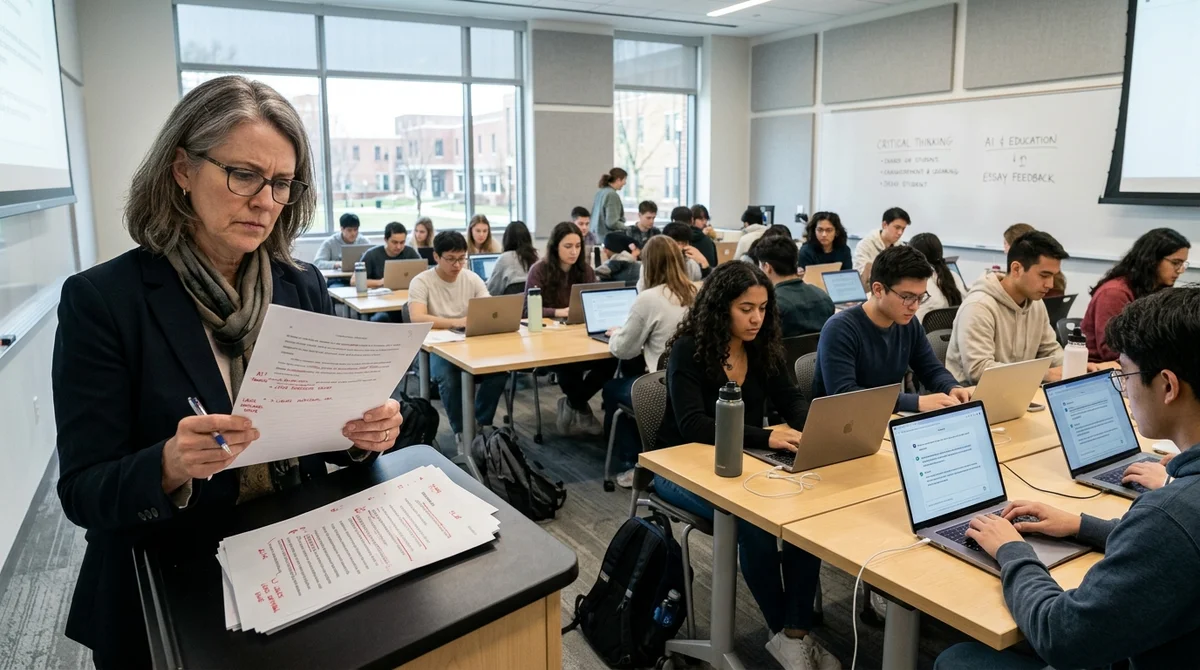
The arrival of ChatGPT and other generative models did not create the problem of dishonest university work from scratch. According to Dr. Nafisa Baba-Ahmed, AI only made mass-market and convenient a way of "moving thinking outside" that universities knew long before the current boom.
The problem is not new
It is easy to understand why instructors are frustrated by AI's effect on critical thinking. Many universities are already having an anxious conversation about how to protect students' independent work when a bot can quickly assemble an essay, an argument structure and even a polished academic style. But Baba-Ahmed suggests looking not only at the new technology but at the old assessment model, in which the final text could long be produced without entirely using one's own mind.
In her work with students on academic writing, she essentially describes a picture familiar from the era before generative AI. When the assignment format allows it, thinking gets outsourced: some students order essays, others use archives of past years, others pass successful model answers between cohorts, and others lean too heavily on tutors, friends or older students. In other words, the problem is not that AI corrupted a perfect system, but that it arrived in a system whose loopholes were already open.
How AI sped things up
In her view, the main change lies not in the nature of the violation but in its scale. Previously, such a shortcut required money, connections, time to search or a ready-made template from a previous cohort. Now much of it can be had in minutes: generate a draft, ask the model to restructure an argument, polish the style or adapt an old text to a new assignment. AI did not invent the workaround, but it sharply lowered its cost and barrier to entry.
"AI did not invent this behavior.
It merely put an existing way of cutting corners on an assembly line."
Because of this, the debate over whether "AI kills thinking" becomes too narrow. If a university primarily rewards the smoothness of the final text rather than the independence of the reasoning, the technology simply makes an old vulnerability more visible. The problem surfaces not because students suddenly stopped thinking, but because the system too often mistook a well-packaged result for proof of real understanding. That is why the current panic looks less like a new disease than a late diagnosis.
What universities should assess
This leaves universities with a more uncomfortable but more useful question: what exactly should a term paper, essay or other written assignment demonstrate? If the goal is to see whether a student understood the material, can connect ideas, build an argument and draw conclusions, a tidy text alone may not be enough. AI simply forces universities to say this out loud and stop pretending that the old format reliably measured everything on its own.
Baba-Ahmed suggests not romanticizing the pre-AI past. Instead of trying to "bring back the way things were," universities will have to redefine what they want to see in student work and where the line falls between help from a tool and replacing one's own thought. In practical terms, this means revisiting not only the rules but the logic of the assignment itself. This is no longer about cosmetic bans, but about a more honest answer to the question of what counts as evidence of learning here.
- Understanding of the topic, not just polished presentation
- An independent argument, not an assembly of ready-made phrases
- The ability to analyze, not to rewrite a template
- Personal coherence of reasoning, not a flawless tone
- A real demonstration of thinking, not just the final file
What this means
For universities, AI turned out to be less the root cause of a crisis than a stress test of old assessment methods. It showed that the question is no longer whether to ban the latest tool, but which assignments truly require independent thinking and make it possible to tell understanding from a carefully assembled imitation.
- Nov 2, 2026Meta's Muse assistant keeps dossiers on loved ones and gets root on Ubuntu by default
- Nov 1, 2026Local models lose to Opus and Codex: 0.21 on a MacBook versus 1.00 for Codex
- Nov 1, 2026Kimi scores 96.2% on a 1C database analytics test and emerges as a fallback if Claude access is blocked
- Nov 1, 2026OpenAI Rewrites GPT Behavior Rules: Five Values and a Chain of Command
Key Questions Answered
What are the key details on The problem is not new?
It is easy to understand why instructors are frustrated by AI's effect on critical thinking. Many universities are already having an anxious conversation about how to protect students' independent work when a bot can quickly assemble an essay, an argument structure and even a polished academic style. But Baba-Ahmed suggests looking not only at the new technology but at the old assessment model, in which the final text could long be produced without entirely using one's own mind. In her work with students on academic writing, she essentially describes a picture familiar from
How AI sped things up?
In her view, the main change lies not in the nature of the violation but in its scale. Previously, such a shortcut required money, connections, time to search or a ready-made template from a previous cohort. Now much of it can be had in minutes: generate a draft, ask the model to restructure an argument, polish the style or adapt an old text to a new assignment. AI did not invent the workaround, but it sharply lowered its cost and barrier to entry. "AI did not invent this behavior. It merely put an existing way of cutting corners on an assembly line." Because of this, the d
What universities should assess?
This leaves universities with a more uncomfortable but more useful question: what exactly should a term paper, essay or other written assignment demonstrate? If the goal is to see whether a student understood the material, can connect ideas, build an argument and draw conclusions, a tidy text alone may not be enough. AI simply forces universities to say this out loud and stop pretending that the old format reliably measured everything on its own. Baba-Ahmed suggests not romanticizing the pre-AI past. Instead of trying to "bring back the way things were," universities will h
Test Frontier LLMs & Autonomous Agents in One Workspace
Run Claude Opus 5.5, GPT-6, Gemini 3.1, and DeepSeek side-by-side in Nomad AI (nomadnet.ai) — unified model routing, deep research, and multimodal workflows under one subscription.
The AI world, distilled — once a week
Seven stories that actually mattered, hand-picked. No noise, no reposts, no press releases.
Done! Check your inbox for a confirmation.