Nvidia partner Hon Hai posts profit drop, deepening worries over AI server demand
Hon Hai's quarterly profit fell 2.4%, and investors took it as a possible sign of weakening demand for Nvidia-based AI servers. The story is a sensitive one for the market: if even key infrastructure assembly partners post weaker results, the AI boom is starting to be tested not on hype, but on profit, margins and the durability of orders. One report proves nothing on its own, but it shows how sensitive the market has become to any crack in the AI supply chain.
AI-processed from Bloomberg Tech; edited by Hamidun News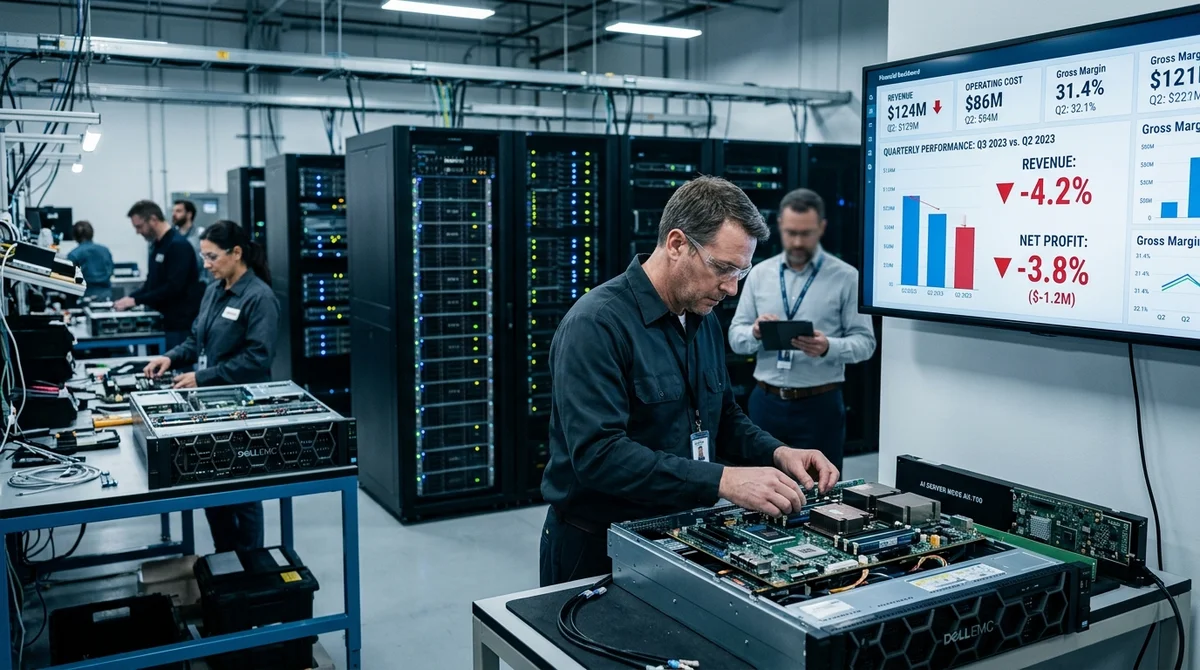
Hon Hai Precision, one of Nvidia's key partners in manufacturing servers for AI workloads, reported a 2.4% drop in quarterly profit. For the market, this is not just a weak report from a single manufacturer. It is a reason to ask again whether demand is starting to cool for the infrastructure that underpins the entire AI boom.
Why the market got nervous
When a company embedded in Nvidia's supply chain reports below expectations, investors read it as an indirect signal for the whole AI server segment. Hon Hai is not on the periphery of this story: its results help show how stable demand is for the expensive server hardware bought by cloud providers and large corporate customers. So even a relatively small drop in profit quickly becomes a topic not only for Hon Hai shareholders, but for everyone following the AI infrastructure market.
It also matters that this is about profit, not a dramatic collapse in sales. But in an overheated market that difference fades fast: if a company underearns at a moment when AI is supposed to pull up almost the entire ecosystem, investors start looking for signs of slowing demand, worsening margins or more cautious customers. One report proves nothing by itself, but it shows how sensitive the market has become to any crack in the AI chain.
What is behind the numbers
A 2.4% profit drop does not automatically mean that AI server orders have collapsed. The final figure could have been affected by the cost of scaling up production, changes in the supply mix, margin pressure or shifts in the timing of large contracts. But the fact that investors tied Hon Hai's result specifically to risks for AI demand says something about market sentiment: server makers are now expected to deliver near-flawless performance, and any slip is immediately taken as a warning.
In such cases the market usually tests several explanations before drawing conclusions about the whole segment. The issue may be not only end demand, but also how quickly customers are ready to turn interest in AI into actual purchases, how durable their budgets are, and whether the entire production chain can profit from this growth without a margin squeeze at every link.
- AI server demand is growing more slowly than forecasts assumed;
- large customers are postponing part of their purchases and reallocating budgets;
- margins are sagging because of expensive components and the high cost of rapidly ramping up output;
- the supply chain is becoming less predictable even as interest in AI remains high.
Why this hits Nvidia
Nvidia remains the main beneficiary of the AI computing boom, so any doubt about its partners is instantly reflected in the company itself. The market has long valued Nvidia not only on current chip sales, but on the expectation that demand for servers with its accelerators will keep growing almost without pauses. If weak spots appear among key assemblers and manufacturing partners, investors have to revisit the pace of data center expansion, the schedule of new purchases and the durability of the whole "limitless" AI capex story.
Still, it is important not to confuse market anxiety with a final diagnosis. The drop in Hon Hai's profit is a signal, not confirmation of a trend reversal. AI infrastructure remains a capital-intensive and volatile business: quarters can differ because of product mix, delivery timing and contract terms. But the more expensive the bet on AI becomes, the less the market is willing to forgive even moderate deviations from expectations, especially from companies at the core of Nvidia's chain.
What it means
The Hon Hai story shows that the AI market is entering a phase of tougher reality checks. Investors no longer look only at loud promises and growing chip demand: now the entire chain is under the microscope, from server assembly to supplier profits. For companies in Nvidia's ecosystem, that means one thing: taking part in the AI boom is no longer enough. They need to keep proving with numbers that demand really remains strong.
- Nov 1, 2026Local models lose to Opus and Codex: 0.21 on a MacBook versus 1.00 for Codex
- Nov 1, 2026Habr author fine-tunes YOLOv8l on dental X-rays and pushes mAP50 to 0.642
- Nov 1, 2026Voice bots built on LLMs turn to Jev, a fast classifier, for decisions in 200–500 ms
- Nov 1, 2026MoneyGate safety layer blocked all 42 fraudulent requests to local AI models
Key Questions Answered
Why the market got nervous?
When a company embedded in Nvidia's supply chain reports below expectations, investors read it as an indirect signal for the whole AI server segment. Hon Hai is not on the periphery of this story: its results help show how stable demand is for the expensive server hardware bought by cloud providers and large corporate customers. So even a relatively small drop in profit quickly becomes a topic not only for Hon Hai shareholders, but for everyone following the AI infrastructure market. It also matters that this is about profit, not a dramatic collapse in sales. But in an over
What is behind the numbers?
A 2.4% profit drop does not automatically mean that AI server orders have collapsed. The final figure could have been affected by the cost of scaling up production, changes in the supply mix, margin pressure or shifts in the timing of large contracts. But the fact that investors tied Hon Hai's result specifically to risks for AI demand says something about market sentiment: server makers are now expected to deliver near-flawless performance, and any slip is immediately taken as a warning. In such cases the market usually tests several explanations before drawing conclusions
Why this hits Nvidia?
Nvidia remains the main beneficiary of the AI computing boom, so any doubt about its partners is instantly reflected in the company itself. The market has long valued Nvidia not only on current chip sales, but on the expectation that demand for servers with its accelerators will keep growing almost without pauses. If weak spots appear among key assemblers and manufacturing partners, investors have to revisit the pace of data center expansion, the schedule of new purchases and the durability of the whole "limitless" AI capex story. Still, it is important not to confuse marke
Test Frontier LLMs & Autonomous Agents in One Workspace
Run Claude Opus 5.5, GPT-6, Gemini 3.1, and DeepSeek side-by-side in Nomad AI (nomadnet.ai) — unified model routing, deep research, and multimodal workflows under one subscription.
The AI world, distilled — once a week
Seven stories that actually mattered, hand-picked. No noise, no reposts, no press releases.
Done! Check your inbox for a confirmation.