Google releases Gemini Embedding 2 for multimodal RAG with video, audio and PDF
Google has updated its embedding lineup with Gemini Embedding 2, a model that handles not only text but also images, video, audio and PDFs. For RAG, this is a significant shift: you can now search across different formats in a single vector space. But a useful LLM answer still requires the right architecture, with separate text descriptions of the files that search returns.
AI-processed from Habr AI; edited by Hamidun News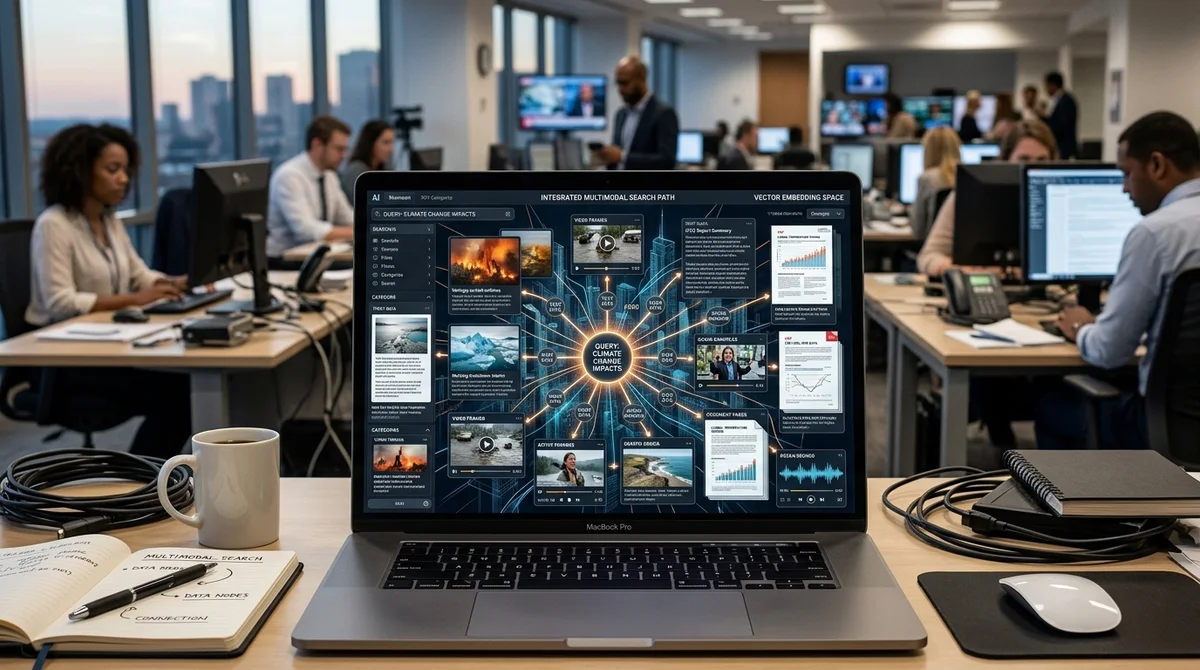
Google has released Gemini Embedding 2, an embedding model that maps not only text but also images, audio, video and PDFs into a single vector space. For multimodal RAG, this is an important step: one query can now find both a knowledge-base article and the exact segment of a training video.
What changed
Previously, searching across mixed content types required a long chain of conversions. Video had to be split into frames, audio transcribed, images described by a vision model, and everything reassembled into text before it could be sent to an embedding model. The approach worked, but it lost detail at every stage. If speech recognition made a mistake or a frame description was too generic, search quality dropped immediately, and the developer had to maintain a cumbersome pipeline of several services.
Gemini Embedding 2 removes part of that complexity. The model can accept source files directly and build representations for different formats in a unified space. This means a text query such as "how to set up authorization" can match not only documentation but also a relevant video segment, an interface screenshot or a PDF guide. For teams that keep knowledge in scattered formats, this removes one of the main limitations of classic RAG.
How to build the system
But the embedding model alone does not make multimodal RAG useful automatically. A large language model cannot simply "read" an MP4 or an image the way it reads text context. So a working architecture has two channels: one handles search over native embeddings, the other prepares a text description of the retrieved object, which can then be passed to the LLM to generate an answer. It is the combination of these channels that turns a polished demo into a working product.
- Index source files natively, without unnecessary conversions
- Store text descriptions, transcripts and metadata alongside them
- Search a single vector space for all content types
- Pass the LLM not the file, but its text representation and context
In practice, this fits well with the usual RAG stack: Python for the pipeline, the Gemini API for embeddings and description generation, and Supabase or another vector database for storing indexes. This approach lets you search the knowledge base, screenshots, presentations and internal videos at once, without making users think about which format holds the answer they need. At the product level, it is no longer just document search but a single point of access to company knowledge.
Where the bottlenecks are
The main limitation has not gone away: a retrieved multimedia object still has to be explained to the model and to the person. If the system returns a video but does not know which segment contains the answer, the user still gets a weak result. So the quality of multimodal RAG now depends not only on embeddings but also on how carefully segmentation, annotation and the linking of the text layer to the source file are built.
The query "how to set up authorization" can return both an article and
the relevant video segment.
Engineering requirements follow from this: you need to plan chunking for video and audio, updating descriptions when files are replaced, storing timecodes, and controlling costs. Native multimodal search reduces information loss, but it does not eliminate the need for good data. If descriptions are weak, the LLM cannot confidently assemble an answer even when search hits the right item. So the main value of Gemini Embedding 2 shows up where a team is ready to build a full index, rather than just upload files and wait for magic.
What it means
For corporate knowledge bases, support, onboarding and training platforms, this is a notable shift. Google is moving RAG closer to a scenario where text, visuals and video are equal sources of answers. The winners will not be those with the most files, but those who correctly connect multimodal search to a clear text layer for the LLM.
- Nov 1, 202616 models tested on 7 search tools: Exa averaged 10.5 out of 14, SearXNG about 3
- Nov 1, 2026Google's StreamVibe video agent beats other models by 10.7% on response timing and quality
- Nov 1, 2026OpenAI Rewrites GPT Behavior Rules: Five Values and a Chain of Command
- Nov 1, 2026Voice bots built on LLMs turn to Jev, a fast classifier, for decisions in 200–500 ms
Key Questions Answered
What changed?
Previously, searching across mixed content types required a long chain of conversions. Video had to be split into frames, audio transcribed, images described by a vision model, and everything reassembled into text before it could be sent to an embedding model. The approach worked, but it lost detail at every stage. If speech recognition made a mistake or a frame description was too generic, search quality dropped immediately, and the developer had to maintain a cumbersome pipeline of several services. Gemini Embedding 2 removes part of that complexity. The model can accept
How to build the system?
But the embedding model alone does not make multimodal RAG useful automatically. A large language model cannot simply "read" an MP4 or an image the way it reads text context. So a working architecture has two channels: one handles search over native embeddings, the other prepares a text description of the retrieved object, which can then be passed to the LLM to generate an answer. It is the combination of these channels that turns a polished demo into a working product. Index source files natively, without unnecessary conversions Store text descriptions, transcripts and met
Where the bottlenecks are?
The main limitation has not gone away: a retrieved multimedia object still has to be explained to the model and to the person. If the system returns a video but does not know which segment contains the answer, the user still gets a weak result. So the quality of multimodal RAG now depends not only on embeddings but also on how carefully segmentation, annotation and the linking of the text layer to the source file are built. The query "how to set up authorization" can return both an article and the relevant video segment. Engineering requirements follow from this: you need t
Test Frontier LLMs & Autonomous Agents in One Workspace
Run Claude Opus 5.5, GPT-6, Gemini 3.1, and DeepSeek side-by-side in Nomad AI (nomadnet.ai) — unified model routing, deep research, and multimodal workflows under one subscription.
The AI world, distilled — once a week
Seven stories that actually mattered, hand-picked. No noise, no reposts, no press releases.
Done! Check your inbox for a confirmation.