Professor Dionne to present VINPix, nanophotonics and AI for multiomics on a chip
IEEE Spectrum has announced a free webinar on VINPix, a platform that combines nanophotonic resonators, acoustic bioprinting and AI to read genes, proteins and metabolites on a single chip. The organizers promise to show how the technology could already work in ocean biosensing, in the search for new molecular species, and in profiling the tumor microenvironment down to individual cells and immune states. The pitch is that VINPix is a platform technology rather than a narrow academic prototype.
AI-processed from IEEE Spectrum AI; edited by Hamidun News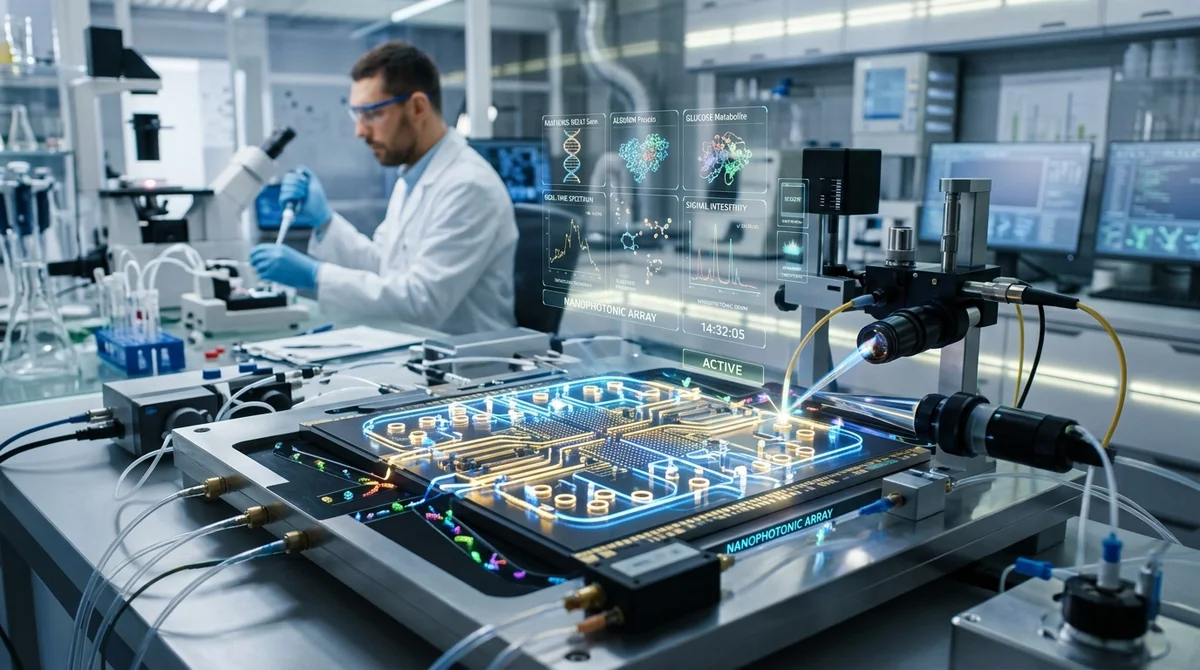
IEEE Spectrum has announced a free webinar on how nanophotonics and AI can speed up molecular sequencing and phenotyping of individual cells. The focus is VINPix, a platform that combines silicon photonic resonators, acoustic bioprinting and multiomic data analysis algorithms on a single chip.
What the webinar will cover
The main theme is an attempt to close the gap between how fast living nature processes information and how fast modern computing infrastructure does it. According to the organizers, the biosphere transmits data nine orders of magnitude faster than the technosphere. VINPix is conceived as one tool that could bring technical systems closer to that density and speed when handling biological signals. This is not distant theory, the organizers say, but a concrete sensor architecture suitable for mass integration.
"The biosphere transmits data nine orders of magnitude faster than the
technosphere."
VINPix is built on silicon photonic resonators with high Q-factors, from thousands to millions, subwavelength mode volumes and a packing density of more than 10 million elements per square centimeter. Combined with acoustic bioprinting and AI, this should make it possible to read multiomic signatures (genes, proteins and metabolites) directly on one chip and at speeds that were previously out of reach. For researchers this is an important shift: instead of a series of separate instruments and preparation stages, there is a chance to bring several types of molecular measurement into one compact system.
Where an impact is expected
The webinar puts particular emphasis on applications where such sensors can be used outside a conventional lab. One example is integration with autonomous underwater robots from the Monterey Bay Aquarium Research Institute for biochemical monitoring of the ocean. If the approach works, molecular measurements could be taken closer to where events happen: in the water, in the field, in harsh environments where the usual lab chain is too slow or expensive. This matters especially for ecology, sustainability and early detection of biochemical change.
Based on the webinar description, the platform covers several areas at once:
- multiomic analysis on one chip, with simultaneous detection of genes, proteins and metabolites
- field biosensors for ocean monitoring, paired with autonomous robots
- sequencing of peptides and glycoconjugates, including the search for previously undescribed molecular species
- profiling of the tumor microenvironment at the level of individual cells and subcellular states
This lineup shows that VINPix is presented not as a narrow academic prototype but as a platform technology. It has a fundamental layer, new photonic components, and an applied one: diagnostics, environmental monitoring and work with rare molecular patterns. For the biosensor market this is an important signal: the next leap may come not only from more powerful AI models, but also from a new generation of hardware that produces richer data from the start.
Why it matters for medicine
The medical part of the program looks no less ambitious. The webinar promises to cover sequencing of peptides and glycoconjugates, including peptides bound to the major histocompatibility complex, as well as the use of dynamic Raman spectroscopy and computational metadynamics to identify previously invisible molecular species. If these methods can be reliably combined with fast photonic readout and AI analysis, researchers would get a tool for finding biomarkers that are currently too hard or too slow to isolate with standard methods.
The tumor microenvironment segment is equally interesting. It covers subcellular prediction of drug resistance, macrophage polarization and T-cell activation states. In other words, the system aims not merely to record the presence of tumor cells, but to better understand how the immune environment around a tumor behaves and why therapy works in some patients and not in others. This is especially valuable in oncology, because such differences increasingly determine the choice of personalized treatment.
What this means
At the intersection of photonics, bioengineering and AI, a new class of tools is emerging that could sharply speed up work with molecular data. If VINPix confirms its claimed capabilities, multiomics, field biosensors and more precise cell profiling would stop being exotic tools for a few labs and become the basis for new biomedical and environmental systems.
- Nov 2, 2026Karpathy builds a YouTube clone with 6454 videos from Hacker News recommendations in two hours
- Nov 2, 2026Karpathy used Claude to build HackerTube from 6,454 videos recommended on Hacker News
- Nov 2, 2026Arca gives AI agents finance tasks lasting up to 10 days, but leaves the trades to humans
- Nov 2, 2026DeepSeek open-sources Super-agent prototype: p95 task completion time of 15.7 minutes vs. 29.5
Key Questions Answered
What the webinar will cover?
The main theme is an attempt to close the gap between how fast living nature processes information and how fast modern computing infrastructure does it. According to the organizers, the biosphere transmits data nine orders of magnitude faster than the technosphere. VINPix is conceived as one tool that could bring technical systems closer to that density and speed when handling biological signals. This is not distant theory, the organizers say, but a concrete sensor architecture suitable for mass integration. "The biosphere transmits data nine orders of magnitude faster than
Where an impact is expected?
The webinar puts particular emphasis on applications where such sensors can be used outside a conventional lab. One example is integration with autonomous underwater robots from the Monterey Bay Aquarium Research Institute for biochemical monitoring of the ocean. If the approach works, molecular measurements could be taken closer to where events happen: in the water, in the field, in harsh environments where the usual lab chain is too slow or expensive. This matters especially for ecology, sustainability and early detection of biochemical change. Based on the webinar descri
Why it matters for medicine?
The medical part of the program looks no less ambitious. The webinar promises to cover sequencing of peptides and glycoconjugates, including peptides bound to the major histocompatibility complex, as well as the use of dynamic Raman spectroscopy and computational metadynamics to identify previously invisible molecular species. If these methods can be reliably combined with fast photonic readout and AI analysis, researchers would get a tool for finding biomarkers that are currently too hard or too slow to isolate with standard methods. The tumor microenvironment segment is e
Test Frontier LLMs & Autonomous Agents in One Workspace
Run Claude Opus 5.5, GPT-6, Gemini 3.1, and DeepSeek side-by-side in Nomad AI (nomadnet.ai) — unified model routing, deep research, and multimodal workflows under one subscription.
The AI world, distilled — once a week
Seven stories that actually mattered, hand-picked. No noise, no reposts, no press releases.
Done! Check your inbox for a confirmation.