Citrini Research: how AI could collapse the intelligence premium and shake up the economy
Citrini Research published a thought experiment about a possible "intelligence crisis" by 2028. The logic is simple: if AI sharply cheapens cognitive labor, the market will begin revaluing the work of analysts, managers, designers, and other white-collar workers. The main question is not the date, but how quickly companies will start changing staffing levels, wages, and skill requirements.
AI-processed from HuXiu (虎嗅); edited by Hamidun News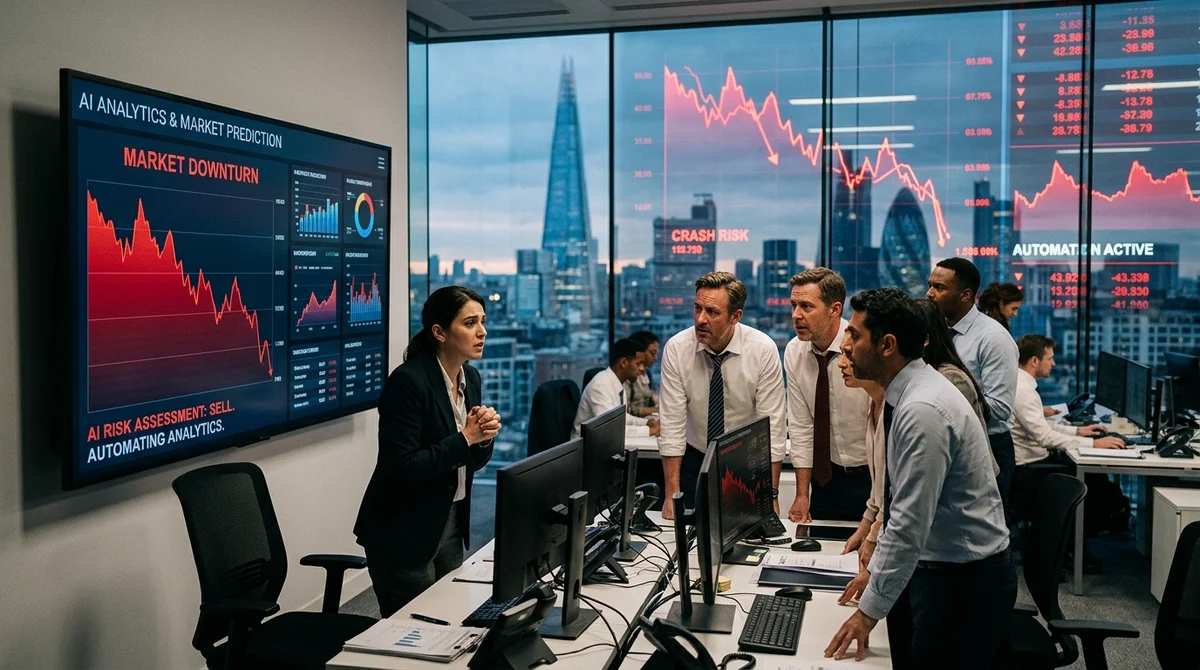
Citrini Research has proposed a thought experiment: what if by 2028 AI makes intellectual labour almost non-scarce. In such a scenario, not only the technology market comes under pressure, but also the entire middle-class economy, which for decades has lived on the premium for knowledge, analysis, and the ability to make decisions faster than others.
Where the Concern Comes From
Throughout modern economic history, human intelligence has remained a rare asset. Machines could amplify physical labour, accelerate production, and automate routine tasks, but for complex reasoning, strategy, negotiations, design, and management, people were still paid. This is what much of the "white-collar" economy rested on: education paid for itself, experience was monetized, and mid-level specialists received a steady premium simply for their competence.
"Human intelligence has always been a scarce resource."
The idea that the material points to is that AI for the first time strikes not at muscles and not at repetitive operations, but at the very scarcity of thinking itself. If a model can write, summarize, code, analyze tables, compile presentations, and propose solutions, a company gains the ability to scale intellectual labour almost like a cloud service. One strong employee with AI is already capable of doing the volume that previously required a team.
How the Market is Changing
Hence the main nerve: the labour market may begin a revaluation not because "people are no longer needed," but because the previous price for their work becomes too high. Business fairly quickly notices the difference between a task that requires unique human judgment and a task where a good model operator is sufficient. When there are many such tasks, pressure immediately hits hiring, salaries, career ladders, and expectations for office roles.
- The most compression happens in junior and middle positions, where there is a lot of template analytics and material preparation.
- Managers lose value if their function boils down to forwarding information and monitoring statuses.
- There is growing demand for those who can verify model conclusions, provide context, and be responsible for the final decision.
- The advantage shifts from "I know how to do it" to "I understand what exactly needs to be done and why."
This doesn't necessarily mean mass unemployment in a single day. Rather, it's about the familiar growth ladder starting to break: entry into the profession becomes narrower, and the top is valued even more. If the market once bought hours of skilled labour, now it increasingly buys results assembled at the intersection of people, models, data, and automation. For the middle class this is painful, because the predictability of such roles has long been the foundation of financial stability.
Why a Crisis Is Possible
The scenario of a global crisis emerges at the moment when the revaluation affects not one industry, but many at once. If millions of intellectual workers begin competing not only with each other, but also with nearly free AI, employee bargaining power declines, consumption suffers, and business reviews budgets and team structure. At the same time, markets may overvalue too sharply the future profits of companies that win from automation, and punish too quickly those who relied on expensive human labour.
The date 2028 in this thought experiment is important more as a signal of speed rather than an exact deadline. The concern here is not that "everything will collapse tomorrow," but that the transition may turn out to be sharp and uneven. Technologies are implemented in waves: first they seem like a toy, then they break the unit economics of entire functions.
This is why it's useful to worry not in the format of panic, but in the format of preparation: where do you have unique expertise, where do you have your own data, where do you have direct access to clients, and where are you simply selling hours of intellect that the market will soon learn to buy much cheaper.
What This Means
The main conclusion is simple: AI increasingly looks less like the next useful software and increasingly like a factor in the revaluation of human capital. For companies, this is a reason to rethink processes and organizational structure, and for specialists—to move away from selling "smart hours" to selling responsibility, taste, domain expertise, and final results.
Need AI working inside your business — not just in your newsfeed?
I build production AI for companies — custom CRM, internal tools, autonomous agents, workflow automation. Owned by you, shaped to your process, no per-seat tax. Built by Zhemal Khamidun, CPO of AlpinaGPT (AI platform, 6,000+ users).
The AI world, distilled — once a week
Seven stories that actually mattered, hand-picked. No noise, no reposts, no press releases.
Done! Check your inbox for a confirmation.