Meta expands AI deal with Nebius, OpenAI seeks partners, Nvidia kicks off GTC
The AI market opened the week with three strong signals. Meta expanded its compute deal with Nebius, and investors responded by sending the stock higher despite reports of major layoffs. OpenAI is discussing a joint venture with private equity firms to speed up enterprise sales. Meanwhile, Nvidia opens GTC, the conference the market typically uses to gauge demand for chips, cloud and the whole next cycle of AI infrastructure. *Meta is recognized as an extremist organization and banned in Russia.
AI-processed from Bloomberg Tech; edited by Hamidun News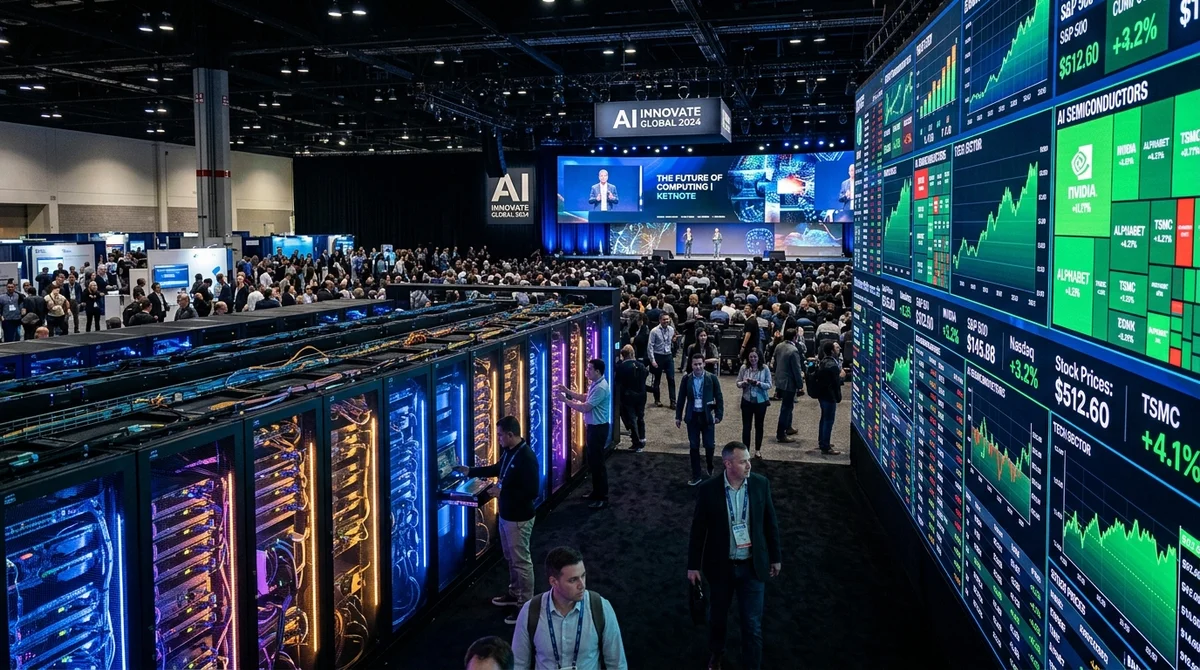
The AI market got three signals in a single day: Meta is increasing its access to computing capacity, OpenAI is looking for a new way into the enterprise segment, and Nvidia is opening GTC, the main showcase for the industry's infrastructure side. Together, these events show the contest shifting from demos and chatbots toward scaling, sales and hardware.
Meta builds up capacity
Meta shares rose after two pieces of news that the market read as a pair. On one side, there were reports of major layoffs, a sign of tighter cost control. On the other, the company expanded its compute deal with Nebius, a provider of cloud AI capacity. For investors, the formula is straightforward: cut secondary costs while not skimping on whatever directly affects how fast AI features ship and models develop.
For Meta, access to compute stopped being just a technical line in the budget long ago. The more actively the company builds generative AI into advertising, recommendations, assistants and internal tools, the more important guaranteed access to GPUs and cloud infrastructure becomes. The expanded Nebius agreement can be read as an attempt to reduce the risk of capacity shortages and avoid depending on a single supply channel.
The market reads several signals from this combination:
- cost discipline through layoffs
- broader access to AI compute
- lower risk of delays when launching new features
- a sign that Meta continues to keep AI at the center of its strategy
OpenAI goes after corporations
At the same time, OpenAI is in advanced talks to create a joint venture with private equity funds. The goal is to speed up adoption of AI software in companies. The move is telling in itself: the next wave of AI growth depends not only on user interest but on how quickly large businesses can build the tools into their processes, budgets and procurement systems. That takes not only strong models but also partners able to scale deals and carry them through to deployment.
The JV format matters here as much as the idea of enterprise sales itself. Private equity funds know how to handle long deployment cycles, operational transformation and financing. For OpenAI, it is a way to accelerate its enterprise business without turning into a classic systems integrator. For the market, it is another sign that generative AI is ceasing to be an experimental line in the innovation budget and becoming part of corporate infrastructure, where predictability, payback and support across the whole deployment cycle are valued.
GTC sets the tone
The third thread in this story is the start of Nvidia's GTC conference. Each such event is now seen not only as a showcase for new chips and platforms but as a checkpoint for the entire industry. Investors, developers and enterprise customers expect Nvidia to answer the key question: will the current pace of demand for AI infrastructure hold globally? So attention is fixed not just on announcements but on the overall signal about what the next growth cycle looks like, from data centers to applied software.
Against this backdrop, the Meta, OpenAI and Nvidia trio is especially telling. Meta shows demand for capacity, OpenAI shows a search for new monetization and deployment channels, and Nvidia is the infrastructure center of gravity around which market expectations are built. When these three stories converge on one agenda, it becomes clear that the AI race is no longer about individual models or one flashy presentation. It is increasingly about the compute supply chain, capital, enterprise sales and the ability to bring technology to large-scale use.
What this means
The AI market is entering a phase where the winner is not the one with the loudest demo, but the one that can secure compute, trim excess spending and bring a product to the enterprise customer at the same time. The news around Meta, OpenAI and Nvidia shows exactly this shift: infrastructure, sales channels and financial discipline are becoming as important as the quality of the model itself.
*Meta is recognized as an extremist organization and banned in Russia.
- Nov 1, 2026Local models lose to Opus and Codex: 0.21 on a MacBook versus 1.00 for Codex
- Nov 1, 2026Kimi scores 96.2% on a 1C database analytics test and emerges as a fallback if Claude access is blocked
- Nov 1, 2026OpenAI Rewrites GPT Behavior Rules: Five Values and a Chain of Command
- Nov 1, 2026Google admits AI Mode cuts search revenue, shares fall 15%
Key Questions Answered
What are the key details on Meta builds up capacity?
Meta shares rose after two pieces of news that the market read as a pair. On one side, there were reports of major layoffs, a sign of tighter cost control. On the other, the company expanded its compute deal with Nebius, a provider of cloud AI capacity. For investors, the formula is straightforward: cut secondary costs while not skimping on whatever directly affects how fast AI features ship and models develop. For Meta, access to compute stopped being just a technical line in the budget long ago. The more actively the company builds generative AI into advertising, recommen
What are the key details on OpenAI goes after corporations?
At the same time, OpenAI is in advanced talks to create a joint venture with private equity funds. The goal is to speed up adoption of AI software in companies. The move is telling in itself: the next wave of AI growth depends not only on user interest but on how quickly large businesses can build the tools into their processes, budgets and procurement systems. That takes not only strong models but also partners able to scale deals and carry them through to deployment. The JV format matters here as much as the idea of enterprise sales itself. Private equity funds know how t
What are the key details on GTC sets the tone?
The third thread in this story is the start of Nvidia's GTC conference. Each such event is now seen not only as a showcase for new chips and platforms but as a checkpoint for the entire industry. Investors, developers and enterprise customers expect Nvidia to answer the key question: will the current pace of demand for AI infrastructure hold globally? So attention is fixed not just on announcements but on the overall signal about what the next growth cycle looks like, from data centers to applied software. Against this backdrop, the Meta, OpenAI and Nvidia trio is especiall
Test Frontier LLMs & Autonomous Agents in One Workspace
Run Claude Opus 5.5, GPT-6, Gemini 3.1, and DeepSeek side-by-side in Nomad AI (nomadnet.ai) — unified model routing, deep research, and multimodal workflows under one subscription.
The AI world, distilled — once a week
Seven stories that actually mattered, hand-picked. No noise, no reposts, no press releases.
Done! Check your inbox for a confirmation.