Nvidia expects to make at least $1 trillion from Blackwell and Rubin AI chips
Nvidia is setting an extremely high bar for its AI business. At GTC in San Jose, Jensen Huang said the Blackwell and Rubin chip lines should bring the company at least $1 trillion by the end of 2027. It is one of the most ambitious forecasts in the industry and a signal that Nvidia sees demand for AI infrastructure as only the beginning of a new growth cycle.
AI-processed from Bloomberg Tech; edited by Hamidun News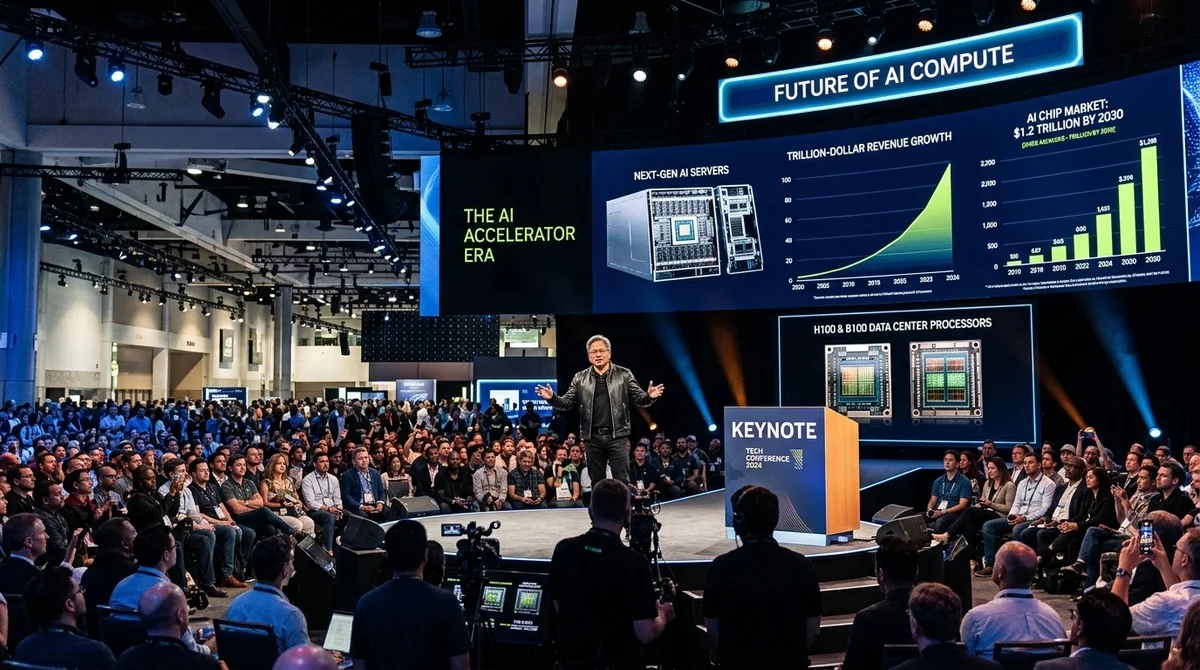
Nvidia has sharply raised expectations for its AI business. At the GTC conference in San Jose, company CEO Jensen Huang announced that the Blackwell and Rubin product lines should bring Nvidia at least $1 trillion by the end of 2027.
A Trillion as a Target
For a semiconductor manufacturer, this is not just an eye-catching figure, but a public statement about the scale of the entire AI infrastructure market. Huang voiced the forecast from the stage of GTC—Nvidia's main annual event, where the company typically showcases its roadmap for data centers, accelerators, and the software around them. If the target is met, it will represent one of the largest cash flows ever associated with a single line of computing platforms. The timeframe matters too: Nvidia is talking not about a distant future, but about the period through the end of 2027. For the industry, such statements serve as a benchmark for future purchases, supply chain utilization, and the pace of computing capacity expansion.
Betting on Two Platforms
Two names were mentioned in the statement—Blackwell and Rubin. This is important because Nvidia is not selling the market a single chip, but a sequence of generations on which customers build budgets and plans for data center expansion. Blackwell is the immediate driver of the new wave of AI systems, Rubin is the next major step in the same roadmap. When the company's CEO links both platforms in a single forecast, he is essentially telling investors and clients: demand should survive a generational shift, not end with a single successful launch. In other words, Nvidia is packaging the current AI excitement into a longer commercial story in advance.
- Blackwell figures as the immediate sales driver for Nvidia
- Rubin is already included in the company's long-term expectations
- The forecast horizon is limited not by abstract future but by the end of 2027
- Nvidia is betting on a multi-year cycle of AI infrastructure purchases
This approach differs from short-term hype around individual GPUs. Nvidia is showing that it sees sustained demand not only from experimental AI teams, but also from major buyers who are ready to plan infrastructure years ahead. For the ecosystem, this means the continuation of the race for capacity, memory, networks, and energy—because accelerators alone won't cover such volume. This is about an entire package of servers, network equipment, cooling, and software stack.
A Signal to the Entire Market
Huang's statement matters not only to Nvidia shareholders. It sets the tone for the entire supply chain: server manufacturers, cloud platforms, data center operators, and corporate customers budgeting for generative AI. The more confidently Nvidia talks about a trillion dollars, the more strongly the market builds further growth in capital expenditures on AI into its models. At the same time, this raises the bar for expectations: if demand slows, each subsequent quarterly report will be compared not simply against a strong baseline, but against a publicly stated super-ambitious target.
Essentially, Nvidia is trying to cement its role not just as a beneficiary of the AI boom, but as the company around which the entire economy of computing for modern models is built. This increases pressure on competitors: they need to respond not only in performance but also in the scale of available supplies, the ecosystem, and the speed of bringing new products to market. Against this backdrop, even cautious corporate clients get the signal that the window for slow adoption is narrowing. If the largest supplier of infrastructure is so confident in demand, postponing a redesign of AI strategy becomes harder.
What This Means
Jensen Huang's forecast is a bet that investments in AI infrastructure will remain gigantic for at least another two years. If Nvidia is right, the market will see not a brief spike but a long cycle of data center upgrades, where not only chip manufacturers win, but the entire layer of services, clouds, and corporate AI products around them. For business, this is yet another signal that the question is no longer whether there will be a computing deficit, but who will manage to take a place in this new value chain.
Want to stop reading about AI and start using it?
AI News is a curated feed of AI/tech news. Hamidun Academy teaches you to use AI systematically in your work.
The AI world, distilled — once a week
Seven stories that actually mattered, hand-picked. No noise, no reposts, no press releases.
Done! Check your inbox for a confirmation.