Google releases WAXAL, an open speech dataset for African languages
Google has released WAXAL, a speech dataset for African languages that aims to accelerate speech recognition and synthesis for low-resource languages. For recognition, contributors produced natural speech by describing images; for synthesis, they made cleaner recordings from balanced texts. Google also shows that the project is already expanding, covers dozens of languages and will keep growing.
AI-processed from MarkTechPost; edited by Hamidun News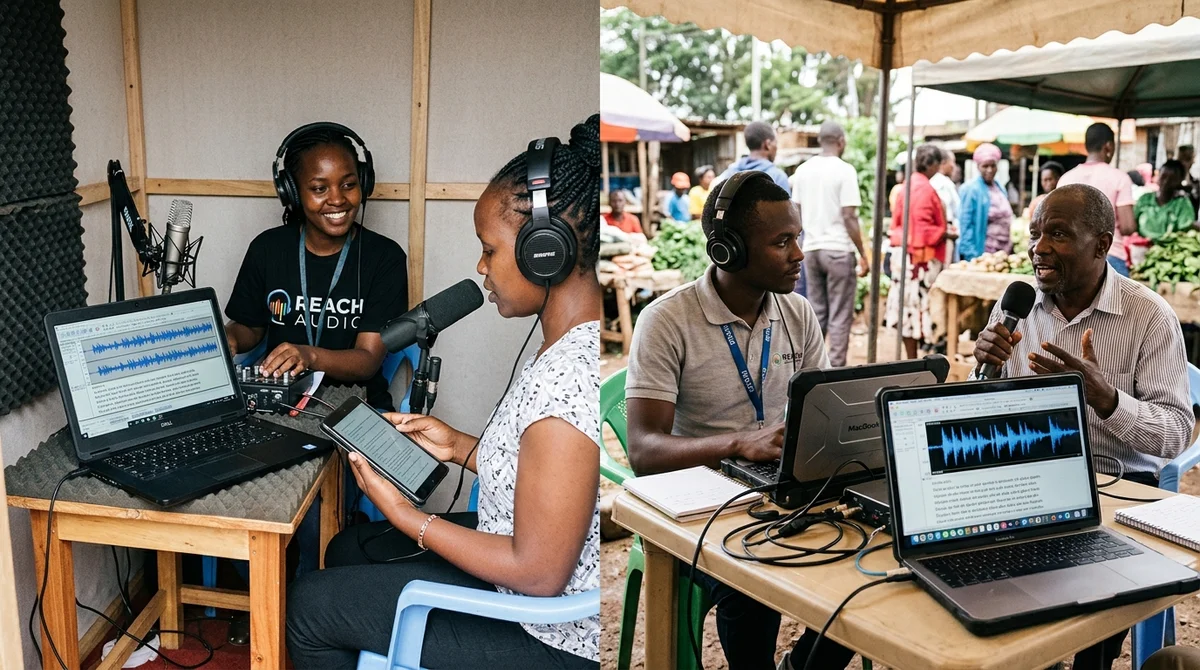
Google has released WAXAL, a large speech corpus for African languages, built as a foundation for speech recognition and speech synthesis systems. The project targets a market where voice technology develops noticeably more slowly because of a chronic shortage of high-quality open data.
Why it matters
The main problem in speech AI has long been not the models themselves but how data is distributed. English, Spanish and Chinese have huge open and commercial corpora, so speech recognition and voice synthesis progress quickly there. For many African languages the situation is the opposite: little labeled speech, few quality recordings, few open licenses. As a result, speakers of languages with millions of native speakers still get worse dictation, auto-captions, voice assistants and interface voiceovers.
WAXAL tries to close precisely this infrastructure gap.
Notably, the project already looks alive rather than like a static archive. In its technical description, the team mentions 24 languages and a starter set for speech recognition and synthesis tasks. Google's release blog post of March 6, 2026 lists an expanded initial release: 27 languages, more than 1,846 hours of speech recognition data and over 565 hours for synthesis. In other words, Google has not simply posted one dataset; it appears to be building a long-term open base for languages that usually fall outside major AI platforms.
How WAXAL is built
WAXAL is split into two independent parts, because speech recognition and voice synthesis have different data requirements. The first needs diverse speakers, natural environments and spontaneous speech so the model performs better in real-world conditions. The second needs cleaner audio, phonetically balanced texts and controlled recording; otherwise it is hard to get a natural, stable voice. In that sense WAXAL looks less like a generic "folder of audio" and more like a deliberately designed dataset for two different classes of tasks.
- In the speech recognition part, participants were asked to describe images in their native language rather than read prepared scripts.
- Google says these prompts covered more than 50 topics and drew out more natural speech, including tonal nuances and code-switching between languages.
- The synthesis part used phonetically balanced texts and more controlled recording conditions.
- The dataset is released under the open CC-BY-4.0 license, so it can be used in both research and applied products.
Who collected the data
The key part of the project is not only the volume but the collection method. Google did not work alone but with African universities and local organizations, including Makerere University, University of Ghana, Digital Umuganda, African Institute for Mathematical Sciences Senegal, Media Trust and Loud and Clear Communications. This setup matters because local teams better understand speech habits, language mixing, regional pronunciation variants and the contexts in which people actually speak, rather than read text in a quiet lab.
"The corpus was created by the community and for the community that needs it."
The production details are also interesting. For the TTS part, participants prepared texts of 10 to 20 thousand words and worked in pairs: one read, the other recorded and checked quality. To get cleaner sound, some teams even built their own studio booths.
Google separately stresses that WAXAL should help not only academic benchmarks but real-world scenarios: local voice interfaces, machine dictation, automatic transcription, voiceovers for services and conversational systems that must understand live speech, not just perfectly read text.
An applied and research ecosystem is also starting to grow around the corpus. Google mentions work on collecting data for people with speech impairments, a separate large corpus for five Ghanaian languages, and benchmarks for models such as Whisper, XLS-R, MMS and W2v-BERT on African languages. This is a good sign: WAXAL is useful not only as an archive but as a common reference point where models can be compared, weaknesses found and voice products brought to working quality faster.
What it means
WAXAL lowers the barrier to entry for startups, researchers and local teams that want to build voice AI for more than just global languages. If such open corpora keep growing and are updated regularly, African languages will have a chance to catch up faster with the rest of the market in recognition quality, synthesis and access to digital services.
- Nov 1, 202616 models tested on 7 search tools: Exa averaged 10.5 out of 14, SearXNG about 3
- Nov 1, 2026Google's StreamVibe video agent beats other models by 10.7% on response timing and quality
- Nov 1, 2026OpenAI Rewrites GPT Behavior Rules: Five Values and a Chain of Command
- Nov 1, 2026Voice bots built on LLMs turn to Jev, a fast classifier, for decisions in 200–500 ms
Key Questions Answered
Why it matters?
The main problem in speech AI has long been not the models themselves but how data is distributed. English, Spanish and Chinese have huge open and commercial corpora, so speech recognition and voice synthesis progress quickly there. For many African languages the situation is the opposite: little labeled speech, few quality recordings, few open licenses. As a result, speakers of languages with millions of native speakers still get worse dictation, auto-captions, voice assistants and interface voiceovers. WAXAL tries to close precisely this infrastructure gap. Notably, the p
How WAXAL is built?
WAXAL is split into two independent parts, because speech recognition and voice synthesis have different data requirements. The first needs diverse speakers, natural environments and spontaneous speech so the model performs better in real-world conditions. The second needs cleaner audio, phonetically balanced texts and controlled recording; otherwise it is hard to get a natural, stable voice. In that sense WAXAL looks less like a generic "folder of audio" and more like a deliberately designed dataset for two different classes of tasks. In the speech recognition part, partic
Who collected the data?
The key part of the project is not only the volume but the collection method. Google did not work alone but with African universities and local organizations, including Makerere University, University of Ghana, Digital Umuganda, African Institute for Mathematical Sciences Senegal, Media Trust and Loud and Clear Communications. This setup matters because local teams better understand speech habits, language mixing, regional pronunciation variants and the contexts in which people actually speak, rather than read text in a quiet lab. "The corpus was created by the community an
Test Frontier LLMs & Autonomous Agents in One Workspace
Run Claude Opus 5.5, GPT-6, Gemini 3.1, and DeepSeek side-by-side in Nomad AI (nomadnet.ai) — unified model routing, deep research, and multimodal workflows under one subscription.
The AI world, distilled — once a week
Seven stories that actually mattered, hand-picked. No noise, no reposts, no press releases.
Done! Check your inbox for a confirmation.